Showing posts with label Animals. Show all posts

Wednesday, September 30, 2020

Responsibilities

Monarch Butterfly on Goldenrod

 “The findings of contemporary astrophysics suggest that we might do well to settle ourselves imaginatively into an endlessly transforming universe without fixed beginning or end. Chemistry, microbiology, and behavioral sciences confirm a fundamental kinship extending from the earth itself through all living things, from the tiniest bacteria to the largest blue whale. The recent discovery of possible bacteria on rocks from Mars may reveal that such kinship extends throughout the solar system – and much further. Our deepening awareness of the impermanence of even the most solid and stable-seeming structures – mountains, seas, the atmosphere, the countless, wheeling galaxies – has become poignant. Human life, indeed, all life, can now be seen as more interconnected, and simultaneously more fragile, than past generations of Western thinkers could concede. In the ongoing effort to gain moral control over our own relentless defensive and economic drives – including learning to control our own masterworks of impermanence: our nuclear weapons – we must now struggle with spiritual responsibilities to the earth and all its future generations, nonhuman as well as human.”  

-- Rafe Martin, “The Hungry Tigress”

Tuesday, August 25, 2020

Friends with Benefits

I have grown Elecampane, Inula helenium, for years but never realized until this summer that Elecampane had a special relationship with ants. While the buds were getting fat and preparing to bloom, they were guarded by a swarm of ants. "Ants???," you say. "Most definitely," says I. And while I could not find a specific reference to Elecampane having these special structures, the presence of the ants tells me it is there - extrafloral nectaries. Extrafloral nectaries are special nectar producing glands located outside of the flower and unlike the nectar produced in flowers, this nectar has nothing to do with pollination and reproduction. In fact, it is to entice bodyguards who help discourage herbivores.

Peonies are very common plants to see this mutually beneficial plant - ant relationship on. You do not to spray the ants off your peonies or Elecampane with water or any bug repellents because the plant has put out a place setting for its ant friends and will only benefit from their presence.

Elecampane - ant relationship


Thursday, August 13, 2015

Being Kind to Wild Neighbors

While out snapping some pictures of awesome clouds and sunset, I spotted a small bee already slowed by the cooling temperatures atop some Queen Anne's Lace (aka wild carrot). In these days when pollinators are so challenged for survival, letting some of your space be filled with flowering plants whether they be wild or cultivated varieties in gardens can only help them and in the long run, our planet. Refrain from using pesticides and herbicides to make your space an oasis for you and your wild neighbors.

Clouds
Spectacular Clouds

Sunset
Stunning Sunset

Bee on Queen Anne's Lace

Thursday, March 14, 2013

Signs of Spring

Turkey Vulture
Turkey Vulture (Cathartes aura)
(photo by Dori, Wikimedia Commons)
Unlike some, I find the return appearance of the American Robin (Turdus migratorius) a poor indicator of the coming spring season. Too many times I have seen these birds looking cold and miserable as a late winter snow storm pounds the area. No, I find a less beautiful bird a much better indicator and harbinger of the coming spring. The Turkey Vulture (Cathartes aura) doesn't make his return to my area until spring is very close - usually syncing their appearance with the emergence of pussy willow catkins and skunk cabbage flowers which are other seasonal signs I look for.

Over this past weekend I saw my first turkey vultures of the season plus my pussy willow tree is also getting large and fuzzy catkins. I'll have to go out hiking to look for other pussy willows (Salix spp.), skunk cabbage (Symplocarpus foetidus), and coltsfoot (Tussilago farfara) to get a better guess as to how close spring is.

Either way, I had better finish my garden planning for the upcoming season - it will be here soon!

Update: Shortly after publishing this article, I happened to spy another one of my key spring signs. A Northern Mockingbird (Mimus polyglottos) was visiting my place and looking to lay his claim again to my yard. These highly territorial and migratory birds are warm weather only visitors at my house. All summer long I get to hear their bird "Top 40" - as I call their repertoire of copied bird song. Many times the male mockingbirds have they fooled visitors to my house thinking I have resident bluebirds. No bluebirds here but their copied song by proxy!

Tuesday, September 11, 2012

Even Pandora Prefers Natives


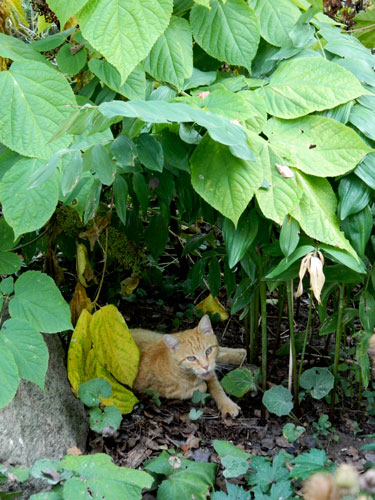
A couple of years ago a starved kitten started coming by our place. It was as wild and as untouched by human hands as cats can come. It would raid the compost bin of whatever was edible to vanish at the first sight of a human. Sometimes it would vanish for days or weeks at a time. So wild was it, that I started calling it "Pan" after the Greek god Pan who was the god of the Wild.

The weather turned colder and Pan roamed less and stayed more. We had 2 old barns filled old hay and straw that do provide a haven to many a critter. But it was clear that Pan was starving and I began to leave food out. I would call "kitty-kitty" and shake the food container to let Pan know that the human left the food and it just didn't fall like manna from the sky. Pan came to know the call meant food but was very secretive about coming for it and often waited until the human vanished again.

This went on for months....a year. Pan came more and now would let itself be seen but would keep a very safe distance. My husband began occasionally feeding the cat. He began talking to it. And over the course of many months and numerous hours of patient waiting, he was able to touch Pan. Over the following months, he came to be able to pet our feral cat. The cat even changed its scheduled time for visits to match his schedule. My husband also came to realize the cat we thought as male (red cats usually are) was female. Pan had become "Pandora."

Now 2 years later, she is still wild but she loves to be petted. She often hangs around our deck not only for food but for pets. Even though we speak of her as "Pandora" she knows her name as "Kitty-Kitty" from those early days of being fed.

She loves my "woodland" native plant garden. My woodland garden is on the east side of our house under a huge, old crabapple tree. It provides the copious leaf litter and shade to grow many native woodland plants. I grow wild ginger, twinleaf, bloodroot, jack-in-the-pulpit, black cohosh, blue cohosh, solomon's seal, spikenard, goldenseal, wild geranium, ferns, white baneberry, ramps, bellwort, and more in this garden. Some of the larger plants (like the solomon's seal and spikenard in the picture above) make a nice place to bed under. I couldn't resist snapping a picture of her snoozing there - of course she woke as I was going to take the picture, but you get the idea.