Showing posts with label Herb of the Week. Show all posts

Tuesday, January 13, 2015

Herb of the Week: Agave

Agave americana
Agave, Century Plant, Maguey

It is odd given my lifelong interest in both plants and nearly every art and craft known to man that I haven't done more in harvesting and creating botanical-based dyes and fibers. But after taking a workshop a few years back that focused on Native American cord and rope making, I like to occasionally try making cords from scratch - all the way from harvesting the raw plant materials. Last year I had the opportunity to work with fibers from an Agave americana plant.

I was inspired by a YouTube video linked in the Learn More section below. It shows a Kichwa man harvesting fibers from agave. He is a master and makes it look easy. I assure you, I struggled and took far more than the 7 minutes he did in the video! But thankfully, I did my homework and did more research than watching one YouTube video. It seems the sap from A. americana can cause contact dermatitis. In fact the horror stories of people who took chainsaws to such plants abound. So I took precautions and wore rubber gloves during my fiber harvesting. Unfortunately I got some fresh sap (unbeknownst to me) on my sleeves and when I hiked up the sleeves, I ended up with that dermatitis. Not fun!

See the pictures below for the story of how I make rope from this plant.

Learn More:
Plants for a Future: Agave americana
Wikipedia: Agave americana
Dave's Garden: Agave americana
YouTube: Indigenous people of Ecuador harvesting agave fibers

Agave Rope Making:

This is the agave plant. See detail of spiny leaf tip. These pretty blue-green leaves also sport sharp thorns along the leaves. (Plant location: Sonnenberg Gardens & Mansion State Historic Park)


After some scraping away of the fresh plant material, the long white fibers can be seen in the leaves. The fibers and their arrangement can also be seen in the cut edge of the leaf. Agave is an exceptional fiber plant.


After the bulk of the fleshy, soft plant material was scrapped away, I left the fibers to dry. After drying I found the fibers far too "prickly" and suspected that the oxalate crystals (which cause the dermatitis) were still too present. So I decided that retting may make the fibers more friendly to the touch. After a few weeks, I found the fibers better to work with. Below are some finished, ready to be worked fibers.


 Now for the fun part, making the cord. I used an S-twist or two-ply style. (Want to try it? See directions here.) You can twist it with your fingers or by rolling on your knee.


Finished cord! Like to get an idea as to what this fiber is like? Sisal ropes are made from another species of agave (Agave sisalana) and should be relatively easy to find.
 

Wednesday, June 4, 2014

Herb of the Week: Fringe Tree

Chionanthus virginicus
Fringe Tree, Old Man's Beard, White Fringe Tree

Chionanthus virginicus, Fringe tree
The Fringe Tree is thought by some to be one of the prettiest trees native to North America. In late spring this small tree is covered in white blossoms that have long dangling petals - its "fringe." Hardy to zone 5, the fringe tree's native range is the south-eastern US from NY to Florida and as far west as Texas. This pest-free tree will grow in full-sun or partial shade. The attractive leaves are ovate and yellow in the fall. The fringe tree is dioecious and the female plants produce purple drupes that resemble olives.

Over the years I have added many native plants to my gardens and landscaping. Even more so when they offer up both beauty and herbal use like the fringe tree. Six to eight years ago, I added a tiny little foot tall fringe tree seedling. It barely grew the first couple of years, often coming back so slowly in the spring I doubted it made the winter. While its growth has been slow in my cold and moist climate at the edge of its northern range, over the last couple of years it has finally put on some size and extra branches. This spring, after the coldest and hardest winter in decades, it gifted me with blossoms - the first since I planted it. (See picture above.) While I only have one cluster of flowers this year, I look forward to even more in future years!

The fringe tree -- like so many native plants -- were originally part of various Native people's medicine traditions which were later adopted by white herbalists and healers into their own herbal practices. Traditionally the fringe tree root bark has been used for liver and gall bladder disorders as well as wounds and rheumatism. For more on fringe tree's uses, see PFAF's entry on it or Peterson's Eastern/Central Medicinal Plants by Foster & Duke.

Learn more: 
http://en.wikipedia.org/wiki/Chionanthus_virginicus
http://www.pfaf.org/user/Plant.aspx?LatinName=Chionanthus+virginicus
http://www.wildflower.org/plants/result.php?id_plant=CHVI3

Looking to add this tree to your place? Try Forest Farm like I did.

Wednesday, April 23, 2014

Herb of the Week: Blue Cohosh

I feel a day is wasted unless you have learned something new. It doesn't have to be a huge thing, just something new. After taking a recent hike to snap some spring wildflower pictures, I found out that new thing for the day. During the hike I saw some blue cohosh that had just sprouted up and was in flower (see picture below). It sported deep maroon flowers rather than the light green ones I was used too. I snapped some pictures and looked it up when I got back. This is when I learned that new thing.

I never realized there was more than one species of blue cohosh but it seems there are two. The maroon flowers were an indication of Northern Blue Cohosh (Caulophyllum giganteum) whereas the species I was more familiar with, Caulophyllum thalictroides, has more numerous, light green flowers.

Both plants overlay much of the same native range though C. thalictroides ranges a little farther south and west than its sister species. (See http://plants.usda.gov for range details.) As for how to tell which species it is other than by its flower? Well, C. giganteum blooms 10-15 days earlier and has larger and less pinnately divided leaves than C. thalictroides. Exact differences according to one source were:
The two species differ somewhat vegetatively. The ultimate leaf segments of  C. giganteum are 5–10 cm long and first leaf is 2- or, more commonly, 3-times pinnately divided. The ultimate leaf segments of C. thalictroides are 3–8 cm long and the first leaf is 3- or, more commonly, 4-times pinnately divided.
It was a good day for something new indeed!

Northern Blue Cohosh (Caulophyllum giganteum) in flower:


Northern Blue Cohosh (Caulophyllum giganteum) in flower


Blue Cohosh (Caulophyllum thalictroides) in flower:


Blue Cohosh (Caulophyllum thalictroides) in flower


Blue Cohosh foliage:


Blue Cohosh


Blue Cohosh fruits (green) early/midsummer:


Blue Cohosh fruits (green) early/midsummer


Blue Cohosh fruits (ripe) late summer:

Blue Cohosh fruits (ripe) late summer


Tuesday, May 7, 2013

Herb of the Week: Asparagus

Asparagus (Asparagus officinalis)
Like so many of our food plants and culinary herbs, asparagus (Asparagus officinalis) is a plant that offers us something for our dinner plate as well as being an herb with medicinal uses. It is the earliest cultivated food item that I harvest each spring. Surely our ancestors appreciated that and it may be part of the reason why this plant has been harvested for more than 5,000 years.

Yesterday I harvested the first asparagus of the season. They are so good and so fresh, I always munch a few spears before I even get the bag to the house. Because this early vegetable is so tasty and so nutritious, rather than speak of the medicinal or other herbal qualities of this plant or the other species in the Asparagus genus*, I will share a simple recipe that I'm sure you will love as much as I:

Grilled Asparagus

Fresh asparagus spears
Extra Virgin Olive Oil
Salt & Pepper to taste
  1. Wash and drain asparagus well. Snap tough ends off.
  2. Preheat broiler or grill - this recipe will work with either method. I usually do them under the broiler. 
  3. Arrange on a sheet pan in a single layer. Drizzle with olive oil (approx. 1-2 tbsp. for 1 lb. bunch). Roll spears around to coat evenly with oil. 
  4. Sprinkle with sea salt and fresh cracked black pepper to taste.
  5. Put pan under the broiler or lay spears directly on your grill. Cook until bright green and done to your preference. Flip half way through cooking. 
  6. Optional: Use other seasonings for different tastes - lemon pepper, garlic salt, etc.
This recipe is naturally gluten free, lactose free, and vegan.

* There are other edible and medical members of the Asparagus genus. To learn more about them, search for "asparagus" at Plants for a Future Database.

Friday, April 26, 2013

Herb of the Week: Cranberry (Vaccinium macrocarpon)

Cranberry (Vaccinium macrocarpon)

Few things say Thanksgiving more than cranberries but they are good for more than a turkey dinner side-dish. Cranberry (Vaccinium macrocarpon) is a low-growing, native North American plant. While it doesn't require a bog to grow, it like its sister the blueberry, loves acid-rich soil and needs to be well-watered.

The cranberry's fruit is a powerful antioxidant as well as having nutritional benefits like vitamin c. (Read this article for more on the fruit's phytochemical benefits.) When I was growing up and there was mild urinary complaints in the house, cranberry juice was one of the home remedies we always tried. Studies seem to be inconclusive and contradictory whether or not the juice is effective for such complaints. But either way, it tastes good and is healthy! The leaves of the cranberry as well as the fruit can be used for herbal purposes. (Read more about the medicinal uses of the cranberry here.)

If you have the right conditions, look to add this native plant to your own home and gardens.

Herb of the Week Redux

When I launched this site I truly intended to have a new "Herb of the Week" feature each week. I started off with good intentions but found life got too busy to write the mini-monographs I was doing each week. I even have the next article partially drafted but it has been in that state for months - too many months.

So rather than abandon the feature, I will relaunch it with a different format. The feature will include photos and some brief info, links, or just my experiences with the plant - a teaser, to you dear reader, to learn more about the plant. I hope you enjoy the new format and articles!

Thursday, June 21, 2012

Herb of the Week - Burdock

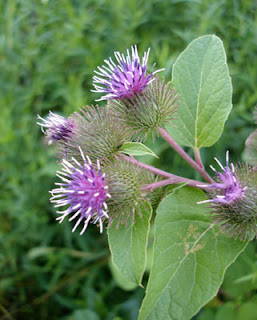
Burdock (Arctium lappa) Flowers
Burdock
Arctium lappa
Arctium mimus 
Few plants make me think of being a kid more than burdock. As a kid I spent a lot of time at my grandparents' dairy farm. Like most old farmsteads, plants like burdock, stinging nettle, cleavers, and catnip grew with wreckless abandon. These plants were most likely unbroken links to plants that were purposely planted by farmers and their families generations ago. My siblings, younger cousins, and I were left to our own devices for long summer days. Besides simple games like hide-and-seek or freeze tag, the natural resources were a great source of amusement. Hollyhock flower fairies, willow whips (good not only for "smacking" each other but for flinging green plums over the barn roof), climbing trees, eating wild berries, and of course, playing with burdock. The gigantic leaves leaves made great fairy and "wild man" hats and clothes. The burs could be made into mats and balls. Oh....the burdock balls. Those old balls could be thrown at a sibling or cousin and they would stick - just like the Velcro-based dart tag type items today. It was all "fun and games" until someone got one of the balls in their hair and went tattling to an adult.

Arctium lappa leaves
Burdock, no stranger to my childhood memories, was once a stranger to the North American shores. Burdock was brought to North America by the Europeans who settled here. It is now naturalized in North America but its native range was originally all the temperate areas of the Old World. Given all the great qualities of burdock it is easy to see why this plant made the trip across the ocean to the New World. It grows easily from seed in a wide range of growing conditions and provides us with choice edibles as well as strong medicine.

For medicinal purposes the stems, roots, and seeds ("niu bang zi") are generally used. In Western herbal medicine burdock root is typically used internally for skin diseases and inflammatory conditions due to chronic toxicity. In Traditional Chinese Medicine, the seeds are used for these similarly as well as to treat colds, pneumonia, and throat infections. [Source: The Herb Society of America New Encyclopedia of Herbs & Their Uses By Deni Bown]

In Kampo, a Japanese form of herbal medicine, burdock seed is a "cold, pungent, and sweet herb" that detoxifies tissues by encouraging the circulation of qi. The seed dispels heat, relieves swelling, and normalizes breathing. It is also used in formulas for coughs, rashes, and sore throats. [Source: Japanese Herbal Medicine: The Healing Art of Kampo by Robert Rister]

Herbalist James Green says that burdock is a "deep food and and alterative that moves the body to a state of well-nourished health." He also notes its use for a variety of skin conditions (incl. eczema, psoriasis, dermatitis, boils, rheumatism, gout), aids appetite/digestion, and in poultices. [Source: The Herbal Medicine Maker's Handbook by James Green]

Burdock roots and stems are also very good foods. The stems can be prepared like cardoon. The roots are popular in a wide range of Asian dishes - one of the most well-known being the Japanese dish kinpira. My personal favorite is my own version of tsukemono (Japanese quick pickles) with burdock root. Not only do I love the unique taste of these pickles, I like to make them whenever I'm feeling "low" and need a boost to my energy and vitality. Here's my recipe:

Sweet Vinegared Gobo (Burdock Root)
Gobo (burdock root)
2 Tbsp sugar
2 Tbsp lemon juice
1 tsp salt (sea salt preferred)
4 Tbsp rice wine vinegar
1. Wash gobo well. You can peel the root first if desired but this is not required especially for the thin-skinned cultivated roots found in Asian markets. Wild-dug roots are best peeled. Half or quarter root and cut into 1-2" sticks.
2. Boil root 2-3 minutes. While root is boiling, mix remaining ingredients.
3. Drain root and add hot to the marinade. Refrigerate and cool before eating. Best flavor if sat overnight. Keeps 3-5 days in refrigerator.

When asked about my favorite herbs, I usually tell people that my foods are my favorite herbs because I live Hippocrates' quote, "Let food be thy medicine and medicine be thy food.” Burdock is one of those healthful herbs that can make it to my dinner plate.

Sunday, May 20, 2012

Herb of the Week - Goldenseal

Goldenseal, Hydrastis canadensis
 
Goldenseal, Hydrastis canadensis
This week's herb is another medicinal plant native to our eastern woodlands that is currently blooming. While we are now in the bloom time of this plant, I am fairly certain that our readers have not seen this plant or its blooms.

This plant is a small, growing only 6-12" high and it has neither showy blooms or leaves. But more than its unassuming appearance, this plant has become increasingly rare in its native range. While habitat loss has effected all native plant populations, this plant's disappearance has been largely due to the overharvesting of wild plants for the herb trade. This plant is one of the most widely used herbs in America, second only to wild American ginseng, Panax quinquefolius. [Source: Planting the Future by Rosemary Gladstar]

Goldenseal was first used medicinally by the Native peoples of North America such as the Cherokee, Haudenosaunee (Iroquois), and Micmac where it was used for a wide range of remedies including those for diarrhea, inflammations, "sour stomach," fevers, liver complaints, and cancer. [Source: Native American Ethnobotany by Daniel Moerman] Later on the Eclectic medicine practitioners of the 1800's adopted goldenseal into their pharmacopeia as well. See King's American Dispensatory for an example of how goldenseal was used by this school of herbalism. Modern herbalists use goldenseal for a number of reasons but one of the chief reasons is for its antibacterial properties.

According to a 20-year, 16 organization study report, 34,000 plant species -- 12% of the plants worldwide and 29% of the plants in the US -- have become so rare that they could easily disappear. [Source: Planting the Future] Some of our most loved native medicinal plants clearly make that list. The United Plant Savers (UpS) is a non-profit organization dedicated to conservation of native medicinal plants. UpS maintains a list of plants that are most at-risk of vanishing completely called the "At-Risk" List. Goldenseal is on that list and so the UpS recommends that you use:
  • Alternatives to goldenseal such as barberry, cultivated oregon grape, cultivated yerba mansa, and other cultivated Berberis species.
  • Use only cultivated goldenseal 
I urge you , whether you are an herbalist or just a user of herbs, to make conscious choices about all the herbs you use. If there are alternatives to at-risk plants such as goldenseal, make every effort to use them. Or if you have the right conditions, you can add such plants to your own woodland areas and grow your own.  I currently have four goldenseal plants in my own woodland garden. They are not very fussy or difficult to grow if you have a woodland area in full-shade. Outside of a plant killed by rodents digging it up during the winter, I've never lost a plant. You may buy your goldenseal plants from a number of sources - my favorite is Prairie Moon Nursery.

Wednesday, May 9, 2012

Herb of the Week - Trout Lily

Trout Lily, Erythronium americanum
Trout Lily (Erythronium americanum)

Trout lilies are one of the "spring ephemerals" - wildflowers that do all their living for an entire year in a few short weeks each spring before vanishing beneath the soil until the next year. The ephemerals group include some of the most eagerly anticipated blooming plants that I know of - trillium, bloodroot, spring beauty, hepatica, and more. The trout lily certainly holds it own in this illustrious group.

This beautiful little plant is native to the woodlands of Eastern North America. It has yellow, almost violet-like flowers and distinctively spotted leaves. These physical characteristics have inspired quite a number of common names such as: adder's tongue, dog tooth violet, serpent's tongue, and yellow snowdrop. I so love the "color" of common names!

Trout lilies are rarely sighted as single plants. If happy in their location, these plants will spread to form a colony on the forest floor. Even without the pretty flowers, a carpet of their spotted leaves is a beautiful spring-time sight.

The trout lily is edible - both the corms and the young leaves can be boiled and eaten. (Source: Peterson's Edible Wild Plants) And both the bulbs and leaves have been used medicinally as an emetic, emollient, and antiscorbutic (when fresh) and a nutritive when dry. It is also said that the root and leaves simmered in milk could be used in remedies for dropsy, hiccoughs, vomiting, and bleeding from the lower bowels while the plant boiled in oil was used for wounds and to reduce inflammation. (Source: Indian Herbology of North America by A. Hutchens) See the PFAF.org entry for more information on the plant's uses.

But with other foods and remedies more commonly available, why would you want to pick this beauty for food or medicine? Like many wildflowers, the trout lily does not reproduce quickly. It can take up to 8 years to mature from seed. Loss of habitat along with irresponsible picking or harvesting can decimate such wild plants. If you do have a woodland area or garden, be sure to invite this plant into it. If you are a wildcrafter or a forager, appreciate this plant for how it has been used but please pass it by. Take only photos and memories from it to ensure it will remain for future generations.

Sunday, April 29, 2012

Herb of the Week - Galium

Herb of the Week - Galium

Cleavers, Galium aparine
"Galium? What kind of herb is galium?" you say. Well, galium isn't just one herb. It is a whole group of herbs or rather a whole genus of plants. Rather than just picking out one of the herbs in that group, I'll cover a couple in that group since they all make me think of spring.

I have three galiums growing at my place right now:

  • Cleavers, Galium aparine
  • Northern Bedstraw, Galium boreale
  • Sweet Woodruff, Galium odoratum

Cleavers (Galium aparine)

Cleavers. Wow, what can I say? It is a very prolific weed at my house. Yes, I said "weed." Ok, it's an herb too. But since I can pick it by the bushel-full out of every flower garden I have, it is a weed as well as an herb in my book. Herb-wise it is often used for its diuretic properties. I know more than one "pee tea" that includes this herb into its mix. Like many herbs, cleavers have a long list of herbal medicine uses beyond its use as a diuretic. Read more about the herbal medicine uses here.

In the days before frappuccinos, our coffee-loving ancestors tried to turn everything into a flavorful beverage. Sometimes they succeeded. Cleavers seed can be roasted and brewed for an excellent coffee substitute. Cleavers are reported to be edible, though I would think that I would find the prickly nature of them quite unpalatable.

Northern Bed Straw (Galium boreale)

Northern Bedstraw, Galium boreale
While northern bedstraw blooms much later in the year here, it sprouts and grows very well in the spring time. Though it looks quite a bit like a smaller, darker green version of its very aggressive cousin cleavers, bedstraw is a kinder and more polite plant. It doesn't sprawl through every garden. It grows in small clumps or patches. Bedstraw, both the plant and the seeds, don't "velcro" onto your clothes or pets' fur like cleavers do. Personal experience here - picking cleaver seed out of either is no fun! Cleavers have inconspicuous flowers but not so with northern bedstraw. Mid to late summer it gets airy clouds of tiny white blooms which are very pretty in a fairy garden sort of way.

In an herbal-sense it can be used for a number of medicinal and utilitarian purposes though not as many as its clingy cousin. Northern bedstraw is reported to be edible as well. See here for the list its uses and edibility.

Sweet Woodruff (Galium odoratum)

Sweet woodruff is a well-known and pretty spring bloomer. If you have a shady location that you want filled with a herbaceous groundcover, sweet woodruff is a good plant to consider. Though take care it is not a woodland you are introducing it to. This plant is native to Europe, North Africa, and Western Asia, not North America. Introduced, alien plants can be a problem unless controlled. I have a fir tree in our yard underplanted with sweet woodruff. It keeps to the ring of shade that the tree provides and is completely controllable that way.

Sweet Woodruff, Galium odoratum
One of the common names of this plant is said to be "master of the woods" which is a translation from the German name, Waldmeister. [Source] Whether that name is in reference to its ability to spread wildly through a woodland or that the Germans used it to flavor all manner of things from wine (the famous Maiwein or "May Wine") to beer to sausages and more, I'm not sure. Perhaps, the name is in reference to both! I have had May Wine. It is very tasty white wine and a perfect way to celebrate the coming of Spring and May Day.

Sweet woodruff also has a number of medicinal uses but care must be taken in using it since the plant contains coumarins which can interact with various medications and health conditions. It can also be used for dyes and strewing. Read more here about this herb's uses.

Friday, April 20, 2012

Herb of the Week - Dandelion

Dandelion Flower

Dandelion (Taraxacum officinale)


Few things herald the coming of spring more than the dandelion. While those wishing their lawns to be a monoculture of green revile it, I cheer its arrival. The bright yellow of their blooms is a welcome sight after the long drab months of winter.

Our ancestors cheered it as well. That is why the dandelion traveled to all the corners of the globe with them. It is a hardy and robust plant - ask those that try to remove it from their lawns. But more than that, it was a plant of great nutrition and medicine sprouting up in the Spring when it was most needed for the cupboards had gotten quite bare in the long, cold winter.

Dandelion leaves have a host of vitamins and minerals including: Folate, Magnesium, Phosphorus, Copper, Vitamin A, Vitamin C, Vitamin E, Vitamin K, Thiamin, Riboflavin, Vitamin B6, Calcium, Iron, Potassium and Manganese. [Source]

More than just nutritious, the dandelion offers us a number of pleasing beverages. The roots can be roasted and ground for a fine coffee substitute - with no caffeine! The flowers, roots, and leaves can be used to make a pleasing tea. But probably the most famous beverage is dandelion wine made from the flowers. The wine recipe is quite simple. But speaking from personal experience, it is a hard one to master!
Dandelion Leaves & Buds

Dandelion, the root especially, is commonly used in a variety of herbal remedies. Two of its most well known uses are as a cholagogue and as a diuretic. For more on the traditional medicinal uses of dandelion please see the Plants For a Future or the Modern Herbal entries on dandelion.

The plant also has provided great amusement for untold generations of children of all ages - who can resist scattering the seeds of the dandelion blow ball when the plant has gone to seed? I seem to also recall having read a long time ago in a book of old-timey amusements that the hollow stem dipped into soapy water could be used to blow bubbles. I think I'll pass on that one. The bitter sap would be a definite turn-off!

Finally one thought to leave you with, the history behind the name "dandelion." It is from the French phrase, dent-de-lion, meaning "lion's tooth" - which is certainly in reference to the toothed leaves. Our springtime friend the dandelion has not only the ruffled yellow mane of the lion, it has its teeth as well!