Thursday, March 17, 2022

The Secret Sauce

Taking photographs of plants is a hobby decades in the making for me. Thousands of plant images every year.  And there is one thing that all the photos I love best have in common. "What is that secret sauce?" you say. In truth, it is nothing. Sure, there is a good composition, ample lighting, and a steady hand. But pictures I don't love can have that too. All the good ones have nothing from me in them. I was the conduit, but it is all about letting the plants speak for themselves. No fancy filters or crazy photoshop techniques can do as much as stepping back and letting the plant speak for itself. They all have their own beauty and stories to tell. 

Wintergreen
Wintergreen in a mossy bed in a beech grove

wild strawberry
Wild strawberry along a woodland trail


Wednesday, December 30, 2020

Water for a thirsty man in the desert

Hedge Row
The hedge row

This fall, inspired by videos of people starting trees from seed I collected a bucket full of acorns from the "mighty" oak that is in an old fence line hedgerow in the field behind us. The fence line has obviously existed for some time and remnants of three different type of fencing materials can be found - stone, wire, and wood. For this collection work, I used one of my favorite foraging/harvesting tools -- a $0.99 plastic children's sand pail. With an hour's worth of work, I was able to collect most of a bucket's worth of acorns.  

I figure this tree is an exceptional source for seed as it grows in a tiny sliver of wild between two farm fields and those fields have been badly abused by 100+ years of broken agricultural practices. The soil in those fields is spent and crops only grow with chemicals. It took me 15 years of letting the ground lay fallow just to be able to support tree growth in the land I have that used to be part of these fields. So if this oak, the mother/hub tree of this area, has survived and thrived in spite of that, it hopefully will provide some nice local genotype stock to add to my young food forest plantings. 


My "mighty oak"
My "Mighty Oak"

So with a 5 galleon bucket full of water, I separated the bad from good seed. The bad ones float. I lost two-thirds to three-quarters of the seed that I harvested. And the water showed why, bugs. Lots of acorn eating larvae floated up with the water. I never imagined I would end up with so few acorns left. But regardless, I sowed some in pots to let the winter do her germination magic and will move any spouted seeds to larger containers come spring. I also scattered some in the wild areas to let the acorns sprout and grow all on their own.


Top: My acorn harvest
Bottom: How few acorns passed the sink test

Not long after this, I visited a local nature center with healthy and strong forest areas of pines, oaks, beeches, and more. On a whim, I collected 2 handfuls of acorns from underfoot on the trails. When I soaked them in water to separate out the bad from the good, I got completely different results. I ended up with somewhere between one-fifth and one-tenth loss. 

After considering the results for a while, it became clear why I saw such different experiences. The oak behind my house is one of only a couple of acorn producing trees in the that hedgerow. Whereas the nature center has many, many such trees. "My" tree is supporting more than its fair share of native fauna life and is in a sense to those creatures, like a glass of water for a man in the desert dying of thirst. If you can, plant oaks as they are powerhouses of support for our native animal life. See writings by Doug Tallamy to learn about just how critical they are. 

And I will let you know come spring time how my acorn germination project has fared.

Some additional photos:

Oak Gall
An oak gall - a small insect grows inside of these on oak trees

Oak leaves & acorn
Acorns and leaves of my "mighty" tree

Old fence line
What lies at the oak's feet - old fence line materials

Sorted acorns
The few good acorns after sorting

Turkey tail fungi
Turkey tail fungi growing under the oak's canopy


Monday, November 9, 2020

Good Gardeners Kill Plants

I once read a gardening article about all the plants killed by "good" gardeners. It seems like a counter intuitive statement on the surface but the author went on to talk about these gardeners taking chances and learning the right conditions that plants need experientially. So yes, while they do kill a number of things while getting it right, they are in a constant discovery and analysis mode that better serves them than overly cautious and only sure-fire success plantings. Few gardening tips and articles that I have read over the years have stayed with me as much as the message of this article -- which I interpret as having a willingness to take chances -- because it perfectly marries one of my longest held garden philosophies. I believe the garden is a rare and glorious thing in life because it is a place of endless second chances.

Ginseng seeds
My prize of ginseng seeds

So, with an idea of possible successes and failures firmly in my heart, I set off on an afternoon of seed planting. I recently got an awesome member deal on American Ginseng (Panax quinquefolius) seed from United Plant Savers. Members could get ~400 seeds for $15. How could I not take advantage of that. Now, I've tried planting ginseng seed before and that resulted in an utter failure with 0% germination. But what I did that time was pick what I thought would be the optimal location and planted all the seed in that location. I didn't do that this time. I roamed all over my 8+ acres and planted the seeds in what I thought may be viable locations, 40 different locations. 

Planting Location
One of many planting locations

Will they all grow? Absolutely not. But will I strike upon the right location? That is my fervent hope. Did I make notation of all the sites? Oh goodness, no. I don't operate in that manner plus that afternoon with its freeform planting was just as enjoyable as the possibility of seeing that seed surprising me in a few years with a full grown ginseng plant. 

So my suggestion?? Take chances. Learn from both your successes and failures. And if need be, try again.


Wednesday, September 30, 2020

Responsibilities

Monarch Butterfly on Goldenrod

 “The findings of contemporary astrophysics suggest that we might do well to settle ourselves imaginatively into an endlessly transforming universe without fixed beginning or end. Chemistry, microbiology, and behavioral sciences confirm a fundamental kinship extending from the earth itself through all living things, from the tiniest bacteria to the largest blue whale. The recent discovery of possible bacteria on rocks from Mars may reveal that such kinship extends throughout the solar system – and much further. Our deepening awareness of the impermanence of even the most solid and stable-seeming structures – mountains, seas, the atmosphere, the countless, wheeling galaxies – has become poignant. Human life, indeed, all life, can now be seen as more interconnected, and simultaneously more fragile, than past generations of Western thinkers could concede. In the ongoing effort to gain moral control over our own relentless defensive and economic drives – including learning to control our own masterworks of impermanence: our nuclear weapons – we must now struggle with spiritual responsibilities to the earth and all its future generations, nonhuman as well as human.”  

-- Rafe Martin, “The Hungry Tigress

Tuesday, August 25, 2020

Friends with Benefits

I have grown Elecampane, Inula helenium, for years but never realized until this summer that Elecampane had a special relationship with ants. While the buds were getting fat and preparing to bloom, they were guarded by a swarm of ants. "Ants???," you say. "Most definitely," says I. And while I could not find a specific reference to Elecampane having these special structures, the presence of the ants tells me it is there - extrafloral nectaries. Extrafloral nectaries are special nectar producing glands located outside of the flower and unlike the nectar produced in flowers, this nectar has nothing to do with pollination and reproduction. In fact, it is to entice bodyguards who help discourage herbivores.

Peonies are very common plants to see this mutually beneficial plant - ant relationship on. You do not to spray the ants off your peonies or Elecampane with water or any bug repellents because the plant has put out a place setting for its ant friends and will only benefit from their presence.

Elecampane - ant relationship


Friday, August 14, 2020

The Gift Not Intended

 So a bit of a story. Probably about 10-12 years ago, I had collected some black walnuts in the fall. It wasn't tons...maybe a gallon or so of nuts from some wild trees. At the time I was doing an annual presentation to local fourth graders on wild foods and medicines as part of their "pioneer day" activities. I had quite the road show and was always looking for more things for the kids to see and touch - like these black walnuts.

I was always amazed at how disconnected so many kids were with the natural world around them and so I did my best to introduce them to as much as possible in my 45 minutes with each class which included at least 20 minutes of letting them explore everything I brought on their own. This included a foraging game I made up which was always one of the highlights. While many probably forgot what they saw the moment they walked out the door, it made all the work so worthwhile to see the "lights" turn on for some of the children as to what amazing things were right out their own backdoors.

So I stored the nuts but like many older homes (and mine is 160 years old), rodents are a continual issue and they got into the nuts. I pitched the nuts out to the compost bin. "Critters" enjoy my open compost bins and it seems one of them planted one of the walnuts near the foundation of my house -- there are no nearby black walnuts and this is the only time these nuts made it to the compost bin so it didn't take much thought to figure out its origin.

Some time along the way, my husband or I chopped the seedling down at least once as the trunk bears the evidence. But last year it finally dawned on me what the tree was. So I dug it up in this spring, potted it, and will add it to my ever expanding young food forest this fall.

So while I never shared the nuts in my wild plant extravaganza, I did get a tree I always wanted out of it.


Monday, August 10, 2020

A Rare Find (Repost)

 This is a copy of a blog post I made on another, now defunct, blog in 2010. I am posting it here so as not to loose this wonderful info.

A couple of weeks ago while hiking at Letchworth State Park, I came across a rare find. Nestled between stands of spotted jewelweed (Impatiens capensis) and pale jewelweed (Impatiens pallida) I came across a jewelweed plant the likes of which I had not seen before. 

This plant looked like spotted jewelweed in the shape of the flowers and the leaves but it had white flowers with red spots. I've never in all my stomping about in wild places or perusing through various field guides trying to ID wild plants seen one like this. 

After some investigation, I believe it is one of two very uncommon variants of the spotted jewelweed: Impatiens capensis forma albiflora (white flowers with red spots) or Impatiens capensis forma Pease (white flowers with larger red spots/splotches). These variants are referenced here in a NYFA Newsletter  if you wish to read more.

It was very late in the day and the light was low so these pictures are not my best but hopefully you'll be able to see and enjoy this rare beauty as well!


Tuesday, June 21, 2016

The Healing Power of the Green

The peace of the forest

Loss and grief, like a freight train has barreled into my life. Though well-meaning, tears fall at the simple phrase, "how are you doing?" How to fill those first few days? We found our way to places of meaning. Places he wanted to go when he got better. Places we went together as a family and enjoyed. Happier times, happier memories that we are able to touch upon.

One of those places he most wanted to go was a place of natural beauty - green woodland, streams, and the shore of a fresh water lake. He didn't get there but we did. We hiked a gorge along its stream bed to the waterfall. Some conversion but largely quiet and mediative.

Native woodland plants graced the woodland edges. Wild strawberry, wild ginger, jack-in-the-pulpit, blue cohosh, stone root, and more. Stress and loss melted away. The most peace I had found in days found me in that walk.

After the walk, the kids and I both found the beach. They swam and played in the sand. I found another area to sit beside the lake. To "sit by the lake" here was one of his top goals so I did it for him. A peaceful sleep stole in on me. When the kids were ready to go, they woke a very relaxed me.

Each day more reports of the physical and mental health benefits of a walk through the green are published and shared. But sometimes it is the spirit, which cannot be quantified in scientific studies, that most needs that time with the natural world for it can bring peace and solace to a broken heart, even if only for a time. And in my case, that healing green power was combined with a place that was meaningful to the person now gone, transforming it to a touchstone to shared and happier times.


Friday, November 20, 2015

Special and Unique Places: The Bog

There are few places that offer a more unique glimpse into the natural world than a bog. It is a pocket of conditions as well as flora and fauna that are completely different than the surrounding locale. I am fortunate to have visited a local bog on a few occasions which is not only a protected botanical preserve but it has also been designated as National Natural Landmark by the National Park Service. This place, The Zurich Bog, is located in Arcadia, New York. It is off the beaten trail to be sure, but the trip is worth it to see such a place of unique beauty. 

The Zurich Bog preserve encompasses hiking trails through a bog forest and a peat bog. There is a floating bog, a mat of vegetation over a pond, but access onto the floating bog is generally not permitted nor entirely safe.

The pictures below are only a few of the species seen there.

If you are a gardener please take note, such special places are threatened by the harvesting of the peat moss for the gardening industry. Even this protected location is threatened by the draining of water in order to harvest peat that goes on outside of the preserve. If these places are special to you as well, please choose soil mixes without peat in them. Read more about why to use no peat here.

Here are photos from the Zurich Bog Preserve. Click on any of the images to see a larger view.

Grass Pink Orchid (Calopogon pulchellus)


Tamarack (Larix laricina)


Northern Pitcher Plant (Sarracenia purpurea). Last image is the pitcher plant bloom.


White Fringed Orchid (Platanthera blephariglottis)


Spoonleaf Sundew (Drosera intermedia)


Goldthread (Coptis trifolia). Second photo also includes starflower (Trientalis borealis) and Canada mayflower (Maianthemum canadense).


Indian Pipe (Monotropa uniflora)


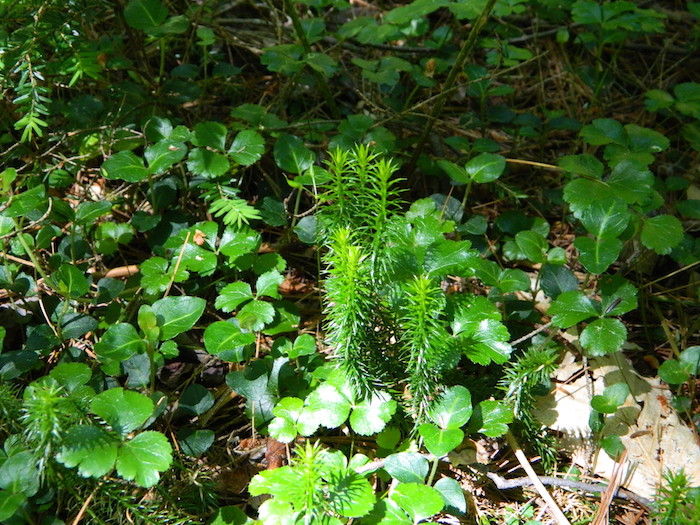
Club Moss (Lycopodium sp.). Second picture also includes goldthread (Coptis trifolia), partridge berry (Mitchella repens), and hemlock (Tsuga sp.).


Partridge Berry (Mitchella repens)


Starflower (Trientalis borealis)


Bog Rosemary (Andromeda polifolia)


Indian Cucumber (Medeola virginiana)


Labrador Tea (Ledum groenlandicum)


Links:

Thursday, August 13, 2015

Being Kind to Wild Neighbors

While out snapping some pictures of awesome clouds and sunset, I spotted a small bee already slowed by the cooling temperatures atop some Queen Anne's Lace (aka wild carrot). In these days when pollinators are so challenged for survival, letting some of your space be filled with flowering plants whether they be wild or cultivated varieties in gardens can only help them and in the long run, our planet. Refrain from using pesticides and herbicides to make your space an oasis for you and your wild neighbors.

Clouds
Spectacular Clouds

Sunset
Stunning Sunset

Bee on Queen Anne's Lace

Sunday, May 3, 2015

Early Spring Wildflowers

I love early spring wildflowers. But you must be vigilant in looking for them. If you blink with some (like the Twinleaf) you will miss them entirely. The twinleaf flowers last less than a day once they open. By nighttime, the petals have dropped. Here are a few from my woodland garden this spring.


Bloodroot
Bloodroot, Sanguinaria canadensis

Celandine Poppy
Celandine Poppy, Stylophorum diphyllum

Twinleaf
Twinleaf, Jeffersonia diphylla

Squirrel Corn
Squirrel Corn, Dicentra canadensis


Tuesday, February 24, 2015

Flowers & Grey Skies

Sonnenberg Orchid Show

I do not think it is any wonder why flower and garden shows are this time of the year. "Plant people" and everybody else all get "itchy" to see green again. Doubly so this year. This winter has been long, cold, and snowy. It is sad when you long for a 30 degree F day because it will seem balmy and tropical in comparison to what you have been experiencing. But spring will come - it always does. 

But in the mean time, visit your local flower and garden shows. They will give you that pick me up until the real thing, Spring that is, arrives.

Tuesday, January 13, 2015

Herb of the Week: Agave

Agave americana
Agave, Century Plant, Maguey

It is odd given my lifelong interest in both plants and nearly every art and craft known to man that I haven't done more in harvesting and creating botanical-based dyes and fibers. But after taking a workshop a few years back that focused on Native American cord and rope making, I like to occasionally try making cords from scratch - all the way from harvesting the raw plant materials. Last year I had the opportunity to work with fibers from an Agave americana plant.

I was inspired by a YouTube video linked in the Learn More section below. It shows a Kichwa man harvesting fibers from agave. He is a master and makes it look easy. I assure you, I struggled and took far more than the 7 minutes he did in the video! But thankfully, I did my homework and did more research than watching one YouTube video. It seems the sap from A. americana can cause contact dermatitis. In fact the horror stories of people who took chainsaws to such plants abound. So I took precautions and wore rubber gloves during my fiber harvesting. Unfortunately I got some fresh sap (unbeknownst to me) on my sleeves and when I hiked up the sleeves, I ended up with that dermatitis. Not fun!

See the pictures below for the story of how I make rope from this plant.

Learn More:
Plants for a Future: Agave americana
Wikipedia: Agave americana
Dave's Garden: Agave americana
YouTube: Indigenous people of Ecuador harvesting agave fibers

Agave Rope Making:

This is the agave plant. See detail of spiny leaf tip. These pretty blue-green leaves also sport sharp thorns along the leaves. (Plant location: Sonnenberg Gardens & Mansion State Historic Park)


After some scraping away of the fresh plant material, the long white fibers can be seen in the leaves. The fibers and their arrangement can also be seen in the cut edge of the leaf. Agave is an exceptional fiber plant.


After the bulk of the fleshy, soft plant material was scrapped away, I left the fibers to dry. After drying I found the fibers far too "prickly" and suspected that the oxalate crystals (which cause the dermatitis) were still too present. So I decided that retting may make the fibers more friendly to the touch. After a few weeks, I found the fibers better to work with. Below are some finished, ready to be worked fibers.


 Now for the fun part, making the cord. I used an S-twist or two-ply style. (Want to try it? See directions here.) You can twist it with your fingers or by rolling on your knee.


Finished cord! Like to get an idea as to what this fiber is like? Sisal ropes are made from another species of agave (Agave sisalana) and should be relatively easy to find.