Showing posts with label Vegetables. Show all posts

Monday, March 17, 2014

Seeds?

Heirloom Tomatoes
Heirloom Tomatoes grown from seed
Recently I was asked for where I buy my seeds from for my vegetable garden. I end up getting them from a lot of different places including local home & garden shops. Why so many?  Mostly because each vendor has their own specialty varieties. But here are some of my favorite seed sources - I hope you enjoy them too!

Friday, May 24, 2013

Know Your Herbs?

Today's Know Your Herbs is a bit different. Instead of giving you one herb to identify, I'm giving you two. More than that, I'm giving you two that look very similar when coming up in the spring. (To get a closer look at the details of these plants, be sure to click on the images for the full sized image.) I specifically took the photos where both plants were similar in size and didn't have last year's stalks in view giving you other clues as to the identification.

These plants are both medicinal herbs native to the North Eastern United States. The shoots of one of these herbs can be eaten if prepared correctly. The other is toxic and no amount of cooking will change that. This is a wonderful example of why you must be able to correctly identify not only a plant but any possible look-a-likes before ever harvesting a single leaf.

Think you know what these are? Check your answer here.


Herb #1


Herb #2

Tuesday, May 7, 2013

Herb of the Week: Asparagus

Asparagus (Asparagus officinalis)
Like so many of our food plants and culinary herbs, asparagus (Asparagus officinalis) is a plant that offers us something for our dinner plate as well as being an herb with medicinal uses. It is the earliest cultivated food item that I harvest each spring. Surely our ancestors appreciated that and it may be part of the reason why this plant has been harvested for more than 5,000 years.

Yesterday I harvested the first asparagus of the season. They are so good and so fresh, I always munch a few spears before I even get the bag to the house. Because this early vegetable is so tasty and so nutritious, rather than speak of the medicinal or other herbal qualities of this plant or the other species in the Asparagus genus*, I will share a simple recipe that I'm sure you will love as much as I:

Grilled Asparagus

Fresh asparagus spears
Extra Virgin Olive Oil
Salt & Pepper to taste
  1. Wash and drain asparagus well. Snap tough ends off.
  2. Preheat broiler or grill - this recipe will work with either method. I usually do them under the broiler. 
  3. Arrange on a sheet pan in a single layer. Drizzle with olive oil (approx. 1-2 tbsp. for 1 lb. bunch). Roll spears around to coat evenly with oil. 
  4. Sprinkle with sea salt and fresh cracked black pepper to taste.
  5. Put pan under the broiler or lay spears directly on your grill. Cook until bright green and done to your preference. Flip half way through cooking. 
  6. Optional: Use other seasonings for different tastes - lemon pepper, garlic salt, etc.
This recipe is naturally gluten free, lactose free, and vegan.

* There are other edible and medical members of the Asparagus genus. To learn more about them, search for "asparagus" at Plants for a Future Database.

Wednesday, February 6, 2013

Free Seed Giveaway

Balloon Flower - win seeds for this
beautiful medicinal herb
In combination with Classical Formulas, we will be giving away a free set of seeds to one lucky winner. The seeds included in this giveaway are:

Herbs (Culinary)
Chives, Mixed Sweet & Thai Basil, Sweet Basil

Herbs (Medicinal)
Plantain (P. Major), Marshmallow, Mountain Mint, Elecampane, Catnip, Purple Coneflower, Borage (Blue & White), Lemon Balm, Chicory, Yellow Dock, Feverfew, Bee Balm, Balloon Flower, Selfheal, Common Milkweed, Calendula

Vegetables/Edible
Broccoli, Lettuce, Sunflower, Squash, Radish, Carrot, Tomato (2 varieties), Turnip

To enter this free drawing, send your name, address, email, and phone number to giveaways@classicalformulas.com by midnight February 28, 2013. Winner to be announced March 1, 2013. Please include in your email if you wish to be added to the Classical Formulas mailing list to receive occasional communications from Classical Formulas about upcoming herbal education classes and events.  (One entry per household and US recipients only.)

Good luck!
Update: We have drawn our winner - Stephanie L. of Rochester, NY. Thank you all who entered. May each and everyone of you have a wonderful and green growing season!

Thursday, January 31, 2013

The Beauty of Seeds

Left: Tuscarora Bread Bean;  Top: Romano Pole;  Right: Seneca Speckled Egg 
Yesterday the first of my many seed orders arrived. Each year I try new varieties and wonder which will be new favorites to earn a permanent spot in my vegetable garden.

While the seeds of one variety of tomato may look exactly like another variety of tomato, the same cannot be said of beans. I always open up the bean seed packages to see what shape, color, and possibly patterning the seeds have. The seeds I received yesterday had two varieties new to my gardens this year: "Seneca Speckled Egg" and "Tuscarora Bread Bean" as well as a favorite from a previous year, "Romano Pole." The beauty of these seeds did not disappoint!

I'm especially excited to try the Tuscarora Bread Bean which is an heirloom variety that was originally passed on from a Tuscarora elder - the Tuscarora are one of the Six Nations of the Haudenosaunee (aka Iroquois). You can read more about the history of this bean on the beans product page at the Sample Seed Shop. This bean variety is used in the making of a traditional Native cornbread that has beans in it. The addition of beans makes this a heartier, more nutrition ladened cornbread. Interested in trying bean bread? You can find a recipe for bean bread on the Cherokee Nation website.

Looking for these seeds? Visit the The Sample Seed Shop.

Tuesday, January 22, 2013

Companion Planting with Pole Beans

Pole beans and borage
I must freely admit to being a bit of a "wild gardener." It is my term for gardeners who are the exact opposite of the gardeners who have their tidy, well-mulched gardens carefully planned, each plant with its defined and labeled space, and everything is rather prim-and-proper. "Wild gardeners" have a looser and more organic-style style to the gardens. We work with the natural tendencies of the plants to create gardens that take on a more natural and full look. Volunteer plants, those that self-seed themselves, are often seen as a bonus rather than something to be eradicated. Ok, I think I'm a very wild gardener.

Honeybee on a borage flower
This last spring and summer I had a slow start to planting the second half of my vegetable garden. By the time I got to planting the pole beans in one area, self-sown borage had sprouted. Borage (Borago officinalis) is probably one of the best self-seeders in my gardens outside of feverfew. Borage is potherb and medicinal plant - see more about its history and uses here. Even so, I really don't use borage outside of flowers for the salad bowl. But I do like to have borage in my vegetable garden because it is a terrific bee magnet. And once it starts blooming, it doesn't stop until the frosts kill it. The blooms are pretty and they bring pollinators to my garden in droves. So in a moment of "why not?" I left the young borage plants in place and planted my beans around them.

It wasn't long before the beans began their skyward climb up the poles I had put in place for them. The borage on the other hand, began its sprawl over the ground. Yes, borage is not a neat and tidy plant that respects the space in which you put it - it sprawls and it self-seeds. But I found it a wonderful underplanting for the pole beans. The borage smothered out the weeds plus provided a living mulch to keep the ground shaded and cool around the base of the beans. Best of all the borage plants attracted the bees that the beans so needed for pollination. It was a lucky happenstance that worked out very well.

In planning out your gardens this year, you may wish to try underplanting your pole beans with borage.  I'm going to do it this year -- but this year by choice!

Tuesday, January 15, 2013

Mid-Winter Sights

Even though it is in the middle of winter, some plants still provide beauty and edibles. Last week, prior to unseasonably warm temperatures and a thaw, I took some pictures of a few of the evergreen or "still going strong" plants peaking through the snow.

The picture of the sunrise on January 8th (to the right) was too beautiful not to share as well. It is a rare day here in winter when the sky is clear enough to see a sunrise let alone one so spectacularly colored. Enjoy.


Kale

If I recall correctly, this kale variety is "Fizz." The one you can barely see behind it is "Nero di Toscana." I have quite a number of different kale varieties in the garden still green and still very tasty. This is always a great plant to add to your veggie garden but especially if you end up getting a late start to things. Kale will happily grow into the fall and winter extending out your fresh harvest season.


Bloody Dock

While this plant is a little hidden by some grass - it did plant itself here after all, the beautiful red veining for which this dock was named, is visible. While you can add young leaves of this dock to the salad bowl, I like it better for it ornamental qualities since I don't find the flavor anything special.


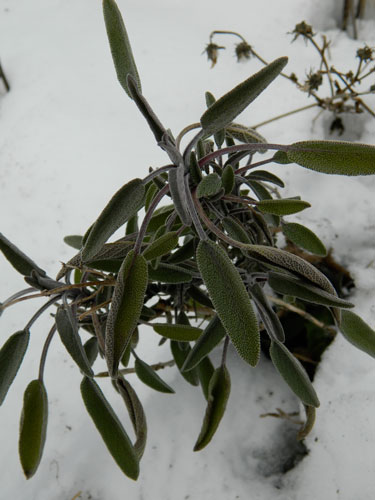
Sage

Sage (Salvia officinalis) is one my favorite herbs and garden plants. As a garden plant, what is not to like? It has striking grey-green foliage and blue-violet flowers and is a well-mannered and evergreen plant. In the winter my sage takes on purple colors - hints of that can be seen even in this picture. Some years, depending upon the severity of winter, they get even more purple. Even though the sage hails from the sunny Mediterranean, it survives Western NY State winters quite nicely.


Mustard

Like kale, I have a variety of mustards, radishes, green onions, and other cold tolerant plants still available in the garden. This is one of the many mustards still green in the garden. I can't seem to recall this variety's name at the moment but if I do recall correctly, it was from Kitazawa Seed Company. Kitazawa is a great source for Asian vegetable seeds of all sorts. 


Broccoli

This strikingly colored broccoli came along very late in the season. I got the seed in just as our summer-long drought began and so these plants got a slow start - my fault, not the seeds'. Even so, as our rains finally returned in the fall some of the plants that were in a "holding pattern" all summer finally began to grow. This variety is called "Purple Peacock" and I got the seed from Horizon Herbs. I've always been very happy with seeds I've gotten from Horizon Herbs - they are plant people who truly love their plants and the seeds always have shown that. 


Tuesday, December 4, 2012

Late Fall - Early Winter Veggies

Daikon Radish
(Photo by Chris 73 / Wikimedia Commons)
While the first hard frosts and freezes of fall this year were nearly two months ago, I still have vegetables going strong in the garden. I just picked some more daikon radishes. I think I will have to make some quick pickles with them - they are so good! Here is a basic recipe for takuan which is a Japanese-styled quick pickle made with daikon. I tend to adjust quick pickle recipes to my own taste, sometimes adding more or less of an ingredient and other times adding others.

Pickled Daikon Radish 
1/4 C. rice wine vinegar
1/2 C. sugar
1 Tbsp salt
1 medium daikon, cut into bite-sized slices
Bring first three ingredients to a boil to dissolve salt and sugar. Allow to cool slightly, and pour over sliced daikon. Store in refrigerator for up to 4 days. Make a day head for best flavor.

I've added minced fresh red hot chili pepper, black sesame seeds, other veggies, or whatever else suits me at the time. The first time making a new quick pickle recipe, I would suggest to make a small batch exactly per the recipe. After than, have fun. Adjust the ingredients and seasonings plus you can add or substitute other veggies. With white veggies like daikon and turnips, the red of the hot chili is a stunning color combination. And yes, this recipe is good with Japanese white turnips too. Be sure to add a small bit of the turnip greens for color and a bit of mustard bite. 

Note, I often like using mirin, a sweet cooking rice wine, instead of sugar for quick pickles. No boiling is needed to dissolve the sugar and it has a different character and flavor than white sugar.

Speaking of still growing in the garden....My garden also still has mustard, radishes, kale, broccoli, and some other scattered veggies still going strong after cold weather including snow. The snow peas gave up a few weeks back and so did the favas when we had a couple of days very bitter weather with 20 degree F nights. With a bit of planning and mid to late summer planting, you can extend out your fresh vegetable season to late fall - early winter. Something to consider in your planning for next year's veggie garden.

Thursday, September 13, 2012

Seed and Plant Sources

One of the questions often asked of me is, "where do you get your plants and seeds?" My answer is always many places! Hopefully this article will share a little of my years of experience and favorite vendors with you.

Local

I shop locally whenever I can - and I'm not talking about your "Big-Box" stores like Lowes and Walmart. I urge everyone to visit your locally owned and operated nurseries. They are people who know and love plants and will be willing to work with you. They will help you make the best choices plus your dollars will be going back into your community.

Ok, yes. The Big-Box places have great prices on flats of summer annuals like petunias and marigolds. Get those there if you that is your thing, but shop at your locally-owned nurseries for everything else.

Vegetables & Food Crops

I have a lot of favorites here. Not every place carries all the varieties I want so I end up placing seed orders to a dozen or more vendors each year. Many of these vendors also carry herb and flower seeds as well. Some seed vendors also carry vegetable transplants if seed-starting isn't an art you've mastered.

Abundant Life Seeds - Organic and biodynamic vegetable seeds
Baker Creek Heirloom Seeds - One of my favorite heirloom seed sources.
Comstock Seeds - A 200 year old tradition of selling seeds
Johnny's Selected Seeds - A wide range of vegetable and herb seed. No genetically modified seed.
Miller Nurseries - A local company that specializes in fruit tree, shrubs, and plants. Get a variety of plants and varieties. Great edible landscaping source.
Pinetree Garden Seeds - A favorite place to get not only a wide range of vegetable varieties but a place to get small amounts of seed for a small price which is a wonderful way to test out a variety
Raintree Nursery - All manner of fruit-bearing plants and trees are available here. Great edible landscaping source.
Seed Savers - Heirloom vegetable seeds.
Seeds of Change - Organic vegetable, flower, and herb seed.
Territorial Seed Company - A wide range of heirloom, open pollinated, and hybrid vegetable varieties. No genetically modified or treated seed.
Totally Tomato - Can't find a particular tomato or pepper variety elsewhere? Find it here.
Terroir Seeds - Heirloom and open-pollinated seeds.
Kitazawa Seed Company - Specialty Asian vegetable seed source.

Medicinal & Native Plants

Other than the food plants I've planted in the vegetable garden and the edible landscaping I've done, this is where I spend the most gardening energy. Given the number of medicinal native plants, I rolled both this two categories together, but the sources are easy to pick which is which.

Horizon Herbs - Medicinal plants and seeds of many herbal traditions
Nichols Garden Nusery - A nice selection of culinary herb and vegetable seed
Richters - A wonderful source for medicinal plants and seeds of all sorts from nearby Toronto
Forest Farm - While shipping from the westcoast is costly, this is a wonderful place to find many hard to find plants, trees, and shrubs.
Musser Forests - A nice place to get many native trees and shrubs in small amounts or in quantity. Located in nearby Pennsylvania.
Prairie Moon Nursery - One of the best native plant and seed sources around.
Amanda's Garden  - A local nursery specializing in native perennial plants
White Oak Nursery - A local nursery specializing in native trees and shrubs
Ion Exchange - A great source for native plant seedlings

Flowers

I don't do much ornamental gardening these days but I do always slip some flowers into the vegetable beds to attract pollinators.

Select Seeds - Get antique flower seeds from this company including some of my favorite poppy varieties

Thursday, June 21, 2012

Herb of the Week - Burdock

Burdock (Arctium lappa) Flowers
Burdock
Arctium lappa
Arctium mimus 
Few plants make me think of being a kid more than burdock. As a kid I spent a lot of time at my grandparents' dairy farm. Like most old farmsteads, plants like burdock, stinging nettle, cleavers, and catnip grew with wreckless abandon. These plants were most likely unbroken links to plants that were purposely planted by farmers and their families generations ago. My siblings, younger cousins, and I were left to our own devices for long summer days. Besides simple games like hide-and-seek or freeze tag, the natural resources were a great source of amusement. Hollyhock flower fairies, willow whips (good not only for "smacking" each other but for flinging green plums over the barn roof), climbing trees, eating wild berries, and of course, playing with burdock. The gigantic leaves leaves made great fairy and "wild man" hats and clothes. The burs could be made into mats and balls. Oh....the burdock balls. Those old balls could be thrown at a sibling or cousin and they would stick - just like the Velcro-based dart tag type items today. It was all "fun and games" until someone got one of the balls in their hair and went tattling to an adult.

Arctium lappa leaves
Burdock, no stranger to my childhood memories, was once a stranger to the North American shores. Burdock was brought to North America by the Europeans who settled here. It is now naturalized in North America but its native range was originally all the temperate areas of the Old World. Given all the great qualities of burdock it is easy to see why this plant made the trip across the ocean to the New World. It grows easily from seed in a wide range of growing conditions and provides us with choice edibles as well as strong medicine.

For medicinal purposes the stems, roots, and seeds ("niu bang zi") are generally used. In Western herbal medicine burdock root is typically used internally for skin diseases and inflammatory conditions due to chronic toxicity. In Traditional Chinese Medicine, the seeds are used for these similarly as well as to treat colds, pneumonia, and throat infections. [Source: The Herb Society of America New Encyclopedia of Herbs & Their Uses By Deni Bown]

In Kampo, a Japanese form of herbal medicine, burdock seed is a "cold, pungent, and sweet herb" that detoxifies tissues by encouraging the circulation of qi. The seed dispels heat, relieves swelling, and normalizes breathing. It is also used in formulas for coughs, rashes, and sore throats. [Source: Japanese Herbal Medicine: The Healing Art of Kampo by Robert Rister]

Herbalist James Green says that burdock is a "deep food and and alterative that moves the body to a state of well-nourished health." He also notes its use for a variety of skin conditions (incl. eczema, psoriasis, dermatitis, boils, rheumatism, gout), aids appetite/digestion, and in poultices. [Source: The Herbal Medicine Maker's Handbook by James Green]

Burdock roots and stems are also very good foods. The stems can be prepared like cardoon. The roots are popular in a wide range of Asian dishes - one of the most well-known being the Japanese dish kinpira. My personal favorite is my own version of tsukemono (Japanese quick pickles) with burdock root. Not only do I love the unique taste of these pickles, I like to make them whenever I'm feeling "low" and need a boost to my energy and vitality. Here's my recipe:

Sweet Vinegared Gobo (Burdock Root)
Gobo (burdock root)
2 Tbsp sugar
2 Tbsp lemon juice
1 tsp salt (sea salt preferred)
4 Tbsp rice wine vinegar
1. Wash gobo well. You can peel the root first if desired but this is not required especially for the thin-skinned cultivated roots found in Asian markets. Wild-dug roots are best peeled. Half or quarter root and cut into 1-2" sticks.
2. Boil root 2-3 minutes. While root is boiling, mix remaining ingredients.
3. Drain root and add hot to the marinade. Refrigerate and cool before eating. Best flavor if sat overnight. Keeps 3-5 days in refrigerator.

When asked about my favorite herbs, I usually tell people that my foods are my favorite herbs because I live Hippocrates' quote, "Let food be thy medicine and medicine be thy food.” Burdock is one of those healthful herbs that can make it to my dinner plate.

Monday, June 11, 2012

Maize "Pearl" Earrings

Earring #1
We've all seen beautiful examples of jewelry made with seeds from plants that can only grow in tropical rain forest locations. We too can grow beautiful seeds to use in jewelry. The eldest of the Three Sisters, maize, is a beautiful example. It comes in a rainbow of jewel-like colors that just ask to be used as beads.

This project features earrings made using maize kernel beads. Three different styles with different materials are presented to suggest the variety of styles you might try.
               
All maize used in this the examples shown were grown in my garden. Earring #1 features the blue-grey kernels of "Hopi Blue Dent" and earrings #2 and #3 feature two different colored kernels (pearl white and burgundy) of the multi-hued "Painted Mountain."
              
Earring #1 (Silver & Turquoise)
  • 2 dried corn kernels
  • 2 size #11 crystal seed beads
  • 2 sterling silver earwires (22 gauge, fishhook w/ ball & coil)
  • 2 sterling silver 2-inch, 26 gauge headpins
  • 2 turquoise rondelles, 6x3mm


 Earring #2 (Chevron & Gold)
  • 2 dried corn kernels
  • 2 size #11 crystal seed beads
  • 2 chevron beads approx. 10x5mm
  • 2 gold-filled french hook earwires
  • 2 gold-filled 1.5-inch, 22 gauge headpins


Earring #3 (Silver & Garnet)
  • 2 dried corn kernels
  • 2 size #11 crystal seed beads
  • 2 sterling silver earwires (22 gauge, fishhook w/ ball & coil)
  • 2 sterling silver 2-inch, 26 gauge headpins
  • 4 garnet beads, 3mm
See vendor resources below for sources on where to get all the materials used.

Tools Needed
  • Jewelry pliers like round-nose pliers. Needle nose pliers will work.
  • Flush cut pliers or another tool capable of clipping fine wire
  • Hand awl or a hand drill/Dremel tool with a very fine drill bit
  • Small vise. If you do not one, a hinged clothespin will work to hold the kernels for drilling.
  • X-acto knife

Instructions
  1. Select only completely dried, well-formed corn kernels. The flat-sided and hard dent or flint corns generally work best. Trim any rough spots off the end of the kernel - do not cut into the kernel.
  2. Use a small vise or clothespin to hold each kernel so it can be drilled long ways. Drill the hole. If you use a hand awl, the hole will have a larger bore and you will need to put it through the middle of the flat side of the kernel. Adjust the complementing bead sizes as needed.
  3. Carefully trim or smooth any rough spots from drilling. 
  4. String beads and corn kernel onto headpin. Bead order: Earring #1 - seed bead, kernel, turquoise rondelle;  Earring #2 - seed bead, kernel, chevron bead;  Earring #3 - garnet bead, kernel, garnet bead
  5. For small gauge wire (i.e. 26 gauge), put headpin through the loop on the fishhook earwire. Use pliers to bend and loop the wire with the top of the loop being 3-5mm above the top bead. Use pliers to pull the free end of the wire around the headpin shaft, leaving a loop at the top to work down to the top bead coiling the wire 3-4 times. Trim excess. Use pliers to pinch the trimmed end flush with the rest of the coil.
  6. For the heavier gauge wire (i.e. 22 gauge), use the pliers to bend the wire at the top bead 45 degrees to the left. Use the tip of the pliers to grip wire at the top bead. Use your fingers or other pliers to bend the wire to the right, curling it around the plier nose until it crosses the headpin shaft. Trim the excess wire beyond where it crosses the shaft. Adjust loop shape as needed. Loop onto fishhook earwire.

If you are new to wire bending for jewelry, try out your wire bending skills with a similar gauge inexpensive brass or copper wire first. It is costly to learn on precious metals! I hope you enjoy this project!

Vendor Resources

Earrings #1:

Seed bead, Delica, glass, transparent rainbow crystal, #11
Earwire, sterling silver, 18mm flat fishhook with ball and coil with open loop, 22 gauge
Headpin, sterling silver, 2-inches long, 26 gauge
Bead, turquoise (D/S), 6x3mm rondelle

Earrings #2:
Seed bead, Delica, glass, transparent rainbow crystal, #11
Bead, chevron glass, multicolored, 4x2mm-12x8mm mixed shapes
Earwire, 14Kt gold-filled, 13mm fishhook with open loop, 21 gauge
Headpin, gold-filled, 1-1/2 inches long, 22 gauge

Earring #3
Earwire, sterling silver, 18mm flat fishhook with ball and coil with open loop, 22 gauge
Headpin, sterling silver, 2-inches long, 26 gauge
Bead, garnet, 3mm round

Ears of various colors of maize can be purchased at farmers' markets in late summer through late fall. But even better, grow some maize yourself. If you don't know where to get such seed, check the the vendors listed in the 'Vegetable/Food Crop' section of a gardening article I wrote. The vegetable seed vendors listed all sell heirloom/open-pollinated varieties of maize. Try growing some in your own garden for food or for crafts. As a bonus, some of the colored maize even has colored corn husks which lend themselves beautifully to corn husk crafts.