Showing posts with label Woodland. Show all posts

Wednesday, December 30, 2020

Water for a thirsty man in the desert

Hedge Row
The hedge row

This fall, inspired by videos of people starting trees from seed I collected a bucket full of acorns from the "mighty" oak that is in an old fence line hedgerow in the field behind us. The fence line has obviously existed for some time and remnants of three different type of fencing materials can be found - stone, wire, and wood. For this collection work, I used one of my favorite foraging/harvesting tools -- a $0.99 plastic children's sand pail. With an hour's worth of work, I was able to collect most of a bucket's worth of acorns.  

I figure this tree is an exceptional source for seed as it grows in a tiny sliver of wild between two farm fields and those fields have been badly abused by 100+ years of broken agricultural practices. The soil in those fields is spent and crops only grow with chemicals. It took me 15 years of letting the ground lay fallow just to be able to support tree growth in the land I have that used to be part of these fields. So if this oak, the mother/hub tree of this area, has survived and thrived in spite of that, it hopefully will provide some nice local genotype stock to add to my young food forest plantings. 


My "mighty oak"
My "Mighty Oak"

So with a 5 galleon bucket full of water, I separated the bad from good seed. The bad ones float. I lost two-thirds to three-quarters of the seed that I harvested. And the water showed why, bugs. Lots of acorn eating larvae floated up with the water. I never imagined I would end up with so few acorns left. But regardless, I sowed some in pots to let the winter do her germination magic and will move any spouted seeds to larger containers come spring. I also scattered some in the wild areas to let the acorns sprout and grow all on their own.


Top: My acorn harvest
Bottom: How few acorns passed the sink test

Not long after this, I visited a local nature center with healthy and strong forest areas of pines, oaks, beeches, and more. On a whim, I collected 2 handfuls of acorns from underfoot on the trails. When I soaked them in water to separate out the bad from the good, I got completely different results. I ended up with somewhere between one-fifth and one-tenth loss. 

After considering the results for a while, it became clear why I saw such different experiences. The oak behind my house is one of only a couple of acorn producing trees in the that hedgerow. Whereas the nature center has many, many such trees. "My" tree is supporting more than its fair share of native fauna life and is in a sense to those creatures, like a glass of water for a man in the desert dying of thirst. If you can, plant oaks as they are powerhouses of support for our native animal life. See writings by Doug Tallamy to learn about just how critical they are. 

And I will let you know come spring time how my acorn germination project has fared.

Some additional photos:

Oak Gall
An oak gall - a small insect grows inside of these on oak trees

Oak leaves & acorn
Acorns and leaves of my "mighty" tree

Old fence line
What lies at the oak's feet - old fence line materials

Sorted acorns
The few good acorns after sorting

Turkey tail fungi
Turkey tail fungi growing under the oak's canopy


Monday, November 9, 2020

Good Gardeners Kill Plants

I once read a gardening article about all the plants killed by "good" gardeners. It seems like a counter intuitive statement on the surface but the author went on to talk about these gardeners taking chances and learning the right conditions that plants need experientially. So yes, while they do kill a number of things while getting it right, they are in a constant discovery and analysis mode that better serves them than overly cautious and only sure-fire success plantings. Few gardening tips and articles that I have read over the years have stayed with me as much as the message of this article -- which I interpret as having a willingness to take chances -- because it perfectly marries one of my longest held garden philosophies. I believe the garden is a rare and glorious thing in life because it is a place of endless second chances.

Ginseng seeds
My prize of ginseng seeds

So, with an idea of possible successes and failures firmly in my heart, I set off on an afternoon of seed planting. I recently got an awesome member deal on American Ginseng (Panax quinquefolius) seed from United Plant Savers. Members could get ~400 seeds for $15. How could I not take advantage of that. Now, I've tried planting ginseng seed before and that resulted in an utter failure with 0% germination. But what I did that time was pick what I thought would be the optimal location and planted all the seed in that location. I didn't do that this time. I roamed all over my 8+ acres and planted the seeds in what I thought may be viable locations, 40 different locations. 

Planting Location
One of many planting locations

Will they all grow? Absolutely not. But will I strike upon the right location? That is my fervent hope. Did I make notation of all the sites? Oh goodness, no. I don't operate in that manner plus that afternoon with its freeform planting was just as enjoyable as the possibility of seeing that seed surprising me in a few years with a full grown ginseng plant. 

So my suggestion?? Take chances. Learn from both your successes and failures. And if need be, try again.


Friday, August 14, 2020

The Gift Not Intended

 So a bit of a story. Probably about 10-12 years ago, I had collected some black walnuts in the fall. It wasn't tons...maybe a gallon or so of nuts from some wild trees. At the time I was doing an annual presentation to local fourth graders on wild foods and medicines as part of their "pioneer day" activities. I had quite the road show and was always looking for more things for the kids to see and touch - like these black walnuts.

I was always amazed at how disconnected so many kids were with the natural world around them and so I did my best to introduce them to as much as possible in my 45 minutes with each class which included at least 20 minutes of letting them explore everything I brought on their own. This included a foraging game I made up which was always one of the highlights. While many probably forgot what they saw the moment they walked out the door, it made all the work so worthwhile to see the "lights" turn on for some of the children as to what amazing things were right out their own backdoors.

So I stored the nuts but like many older homes (and mine is 160 years old), rodents are a continual issue and they got into the nuts. I pitched the nuts out to the compost bin. "Critters" enjoy my open compost bins and it seems one of them planted one of the walnuts near the foundation of my house -- there are no nearby black walnuts and this is the only time these nuts made it to the compost bin so it didn't take much thought to figure out its origin.

Some time along the way, my husband or I chopped the seedling down at least once as the trunk bears the evidence. But last year it finally dawned on me what the tree was. So I dug it up in this spring, potted it, and will add it to my ever expanding young food forest this fall.

So while I never shared the nuts in my wild plant extravaganza, I did get a tree I always wanted out of it.


Tuesday, June 21, 2016

The Healing Power of the Green

The peace of the forest

Loss and grief, like a freight train has barreled into my life. Though well-meaning, tears fall at the simple phrase, "how are you doing?" How to fill those first few days? We found our way to places of meaning. Places he wanted to go when he got better. Places we went together as a family and enjoyed. Happier times, happier memories that we are able to touch upon.

One of those places he most wanted to go was a place of natural beauty - green woodland, streams, and the shore of a fresh water lake. He didn't get there but we did. We hiked a gorge along its stream bed to the waterfall. Some conversion but largely quiet and mediative.

Native woodland plants graced the woodland edges. Wild strawberry, wild ginger, jack-in-the-pulpit, blue cohosh, stone root, and more. Stress and loss melted away. The most peace I had found in days found me in that walk.

After the walk, the kids and I both found the beach. They swam and played in the sand. I found another area to sit beside the lake. To "sit by the lake" here was one of his top goals so I did it for him. A peaceful sleep stole in on me. When the kids were ready to go, they woke a very relaxed me.

Each day more reports of the physical and mental health benefits of a walk through the green are published and shared. But sometimes it is the spirit, which cannot be quantified in scientific studies, that most needs that time with the natural world for it can bring peace and solace to a broken heart, even if only for a time. And in my case, that healing green power was combined with a place that was meaningful to the person now gone, transforming it to a touchstone to shared and happier times.


Friday, November 20, 2015

Special and Unique Places: The Bog

There are few places that offer a more unique glimpse into the natural world than a bog. It is a pocket of conditions as well as flora and fauna that are completely different than the surrounding locale. I am fortunate to have visited a local bog on a few occasions which is not only a protected botanical preserve but it has also been designated as National Natural Landmark by the National Park Service. This place, The Zurich Bog, is located in Arcadia, New York. It is off the beaten trail to be sure, but the trip is worth it to see such a place of unique beauty. 

The Zurich Bog preserve encompasses hiking trails through a bog forest and a peat bog. There is a floating bog, a mat of vegetation over a pond, but access onto the floating bog is generally not permitted nor entirely safe.

The pictures below are only a few of the species seen there.

If you are a gardener please take note, such special places are threatened by the harvesting of the peat moss for the gardening industry. Even this protected location is threatened by the draining of water in order to harvest peat that goes on outside of the preserve. If these places are special to you as well, please choose soil mixes without peat in them. Read more about why to use no peat here.

Here are photos from the Zurich Bog Preserve. Click on any of the images to see a larger view.

Grass Pink Orchid (Calopogon pulchellus)


Tamarack (Larix laricina)


Northern Pitcher Plant (Sarracenia purpurea). Last image is the pitcher plant bloom.


White Fringed Orchid (Platanthera blephariglottis)


Spoonleaf Sundew (Drosera intermedia)


Goldthread (Coptis trifolia). Second photo also includes starflower (Trientalis borealis) and Canada mayflower (Maianthemum canadense).


Indian Pipe (Monotropa uniflora)


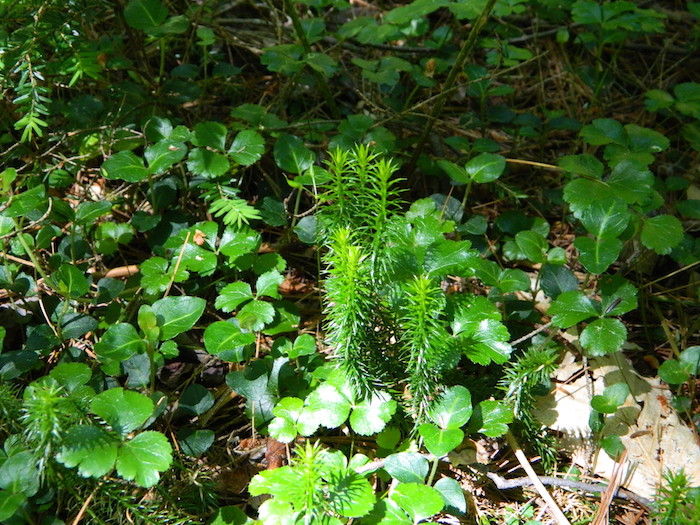
Club Moss (Lycopodium sp.). Second picture also includes goldthread (Coptis trifolia), partridge berry (Mitchella repens), and hemlock (Tsuga sp.).


Partridge Berry (Mitchella repens)


Starflower (Trientalis borealis)


Bog Rosemary (Andromeda polifolia)


Indian Cucumber (Medeola virginiana)


Labrador Tea (Ledum groenlandicum)


Links:

Wednesday, June 4, 2014

Herb of the Week: Fringe Tree

Chionanthus virginicus
Fringe Tree, Old Man's Beard, White Fringe Tree

Chionanthus virginicus, Fringe tree
The Fringe Tree is thought by some to be one of the prettiest trees native to North America. In late spring this small tree is covered in white blossoms that have long dangling petals - its "fringe." Hardy to zone 5, the fringe tree's native range is the south-eastern US from NY to Florida and as far west as Texas. This pest-free tree will grow in full-sun or partial shade. The attractive leaves are ovate and yellow in the fall. The fringe tree is dioecious and the female plants produce purple drupes that resemble olives.

Over the years I have added many native plants to my gardens and landscaping. Even more so when they offer up both beauty and herbal use like the fringe tree. Six to eight years ago, I added a tiny little foot tall fringe tree seedling. It barely grew the first couple of years, often coming back so slowly in the spring I doubted it made the winter. While its growth has been slow in my cold and moist climate at the edge of its northern range, over the last couple of years it has finally put on some size and extra branches. This spring, after the coldest and hardest winter in decades, it gifted me with blossoms - the first since I planted it. (See picture above.) While I only have one cluster of flowers this year, I look forward to even more in future years!

The fringe tree -- like so many native plants -- were originally part of various Native people's medicine traditions which were later adopted by white herbalists and healers into their own herbal practices. Traditionally the fringe tree root bark has been used for liver and gall bladder disorders as well as wounds and rheumatism. For more on fringe tree's uses, see PFAF's entry on it or Peterson's Eastern/Central Medicinal Plants by Foster & Duke.

Learn more: 
http://en.wikipedia.org/wiki/Chionanthus_virginicus
http://www.pfaf.org/user/Plant.aspx?LatinName=Chionanthus+virginicus
http://www.wildflower.org/plants/result.php?id_plant=CHVI3

Looking to add this tree to your place? Try Forest Farm like I did.

Wednesday, April 23, 2014

Herb of the Week: Blue Cohosh

I feel a day is wasted unless you have learned something new. It doesn't have to be a huge thing, just something new. After taking a recent hike to snap some spring wildflower pictures, I found out that new thing for the day. During the hike I saw some blue cohosh that had just sprouted up and was in flower (see picture below). It sported deep maroon flowers rather than the light green ones I was used too. I snapped some pictures and looked it up when I got back. This is when I learned that new thing.

I never realized there was more than one species of blue cohosh but it seems there are two. The maroon flowers were an indication of Northern Blue Cohosh (Caulophyllum giganteum) whereas the species I was more familiar with, Caulophyllum thalictroides, has more numerous, light green flowers.

Both plants overlay much of the same native range though C. thalictroides ranges a little farther south and west than its sister species. (See http://plants.usda.gov for range details.) As for how to tell which species it is other than by its flower? Well, C. giganteum blooms 10-15 days earlier and has larger and less pinnately divided leaves than C. thalictroides. Exact differences according to one source were:
The two species differ somewhat vegetatively. The ultimate leaf segments of  C. giganteum are 5–10 cm long and first leaf is 2- or, more commonly, 3-times pinnately divided. The ultimate leaf segments of C. thalictroides are 3–8 cm long and the first leaf is 3- or, more commonly, 4-times pinnately divided.
It was a good day for something new indeed!

Northern Blue Cohosh (Caulophyllum giganteum) in flower:


Northern Blue Cohosh (Caulophyllum giganteum) in flower


Blue Cohosh (Caulophyllum thalictroides) in flower:


Blue Cohosh (Caulophyllum thalictroides) in flower


Blue Cohosh foliage:


Blue Cohosh


Blue Cohosh fruits (green) early/midsummer:


Blue Cohosh fruits (green) early/midsummer


Blue Cohosh fruits (ripe) late summer:

Blue Cohosh fruits (ripe) late summer


Monday, April 14, 2014

Has Spring Sprung Yet?

Bloodroot is one of my spring favorites but I haven't spied yet, but my pussy willow, coltsfoot, and crocus are blooming. I guess I will have to keep my eyes open!

Bloodroot, Sanguinaria canadensis

Friday, March 29, 2013

Get Down Onto Your Belly

Photo: Wintergreen, Gaultheria procumbens
Wintergreen (Gaultheria procumbens)
The biggest tip I could give people for taking good plant pictures (other than buying a good camera to start with!) is get low, real low. Get down to the plant's level to take your photo. Sometimes in the case of tiny plants like wintergreen, it means you are at least kneeling or even on your belly to take the shot. The lovely part of getting down to take this picture was the soft and incredibly carpet-like nature of the moss bed in this beech grove (visible in this shot).

Monday, March 18, 2013

I Go to Nature to Be Soothed and Healed

Barnes Creek, Canandaigua, NY in Winter
Barnes Creek, Canandaigua, New York

"I go to nature to be soothed and healed, and to have my senses
put in order." 

John Burroughs, (American Essayist and Naturalist, 1837-1921)


If you are like me in that you retreat to Nature for solace and healing, you will want to read these articles: Find Therapeutic Healing in 'Forest Bathing' and Forest Bathing for more information about Shinrin-yoku or forest bathing which is a Japanese tradition of therapeutic walks in the forest. Now you have a name and some supporting science for what you already knew to be true!

Monday, February 25, 2013

Northeast Wildflowers and Wild Plants

As time allows, I will be creating and uploading videos featuring wildflowers and other plants of the woodlands of the Northeastern United States. These videos will feature identification tips, ethnobotanical information, and various bits of related trivia. I have created a playlist at YouTube for this series which you may find at YouTube or you may view it below. At the time of this writing, I have three videos available but visit often since there will be more!


Monday, December 31, 2012

Friend or Foe?

(click to see a larger image of any of the photos)
Just because winter has chased the leaves from the forest's trees and vines, doesn't mean that you can't still get poison ivy. The worst case of poison ivy I ever got was in the winter time when I was helping my dad cut and stack firewood. After that I learned to ID the dreaded PI in ALL seasons and all its many guises.

What makes it more complicated to those that don't know how to winter ID poison ivy is that we have three very common vines that grow in our area and may grow all together as the photo to the right indicates. The three vines are: poison ivy (Toxicodendron radicans), virginia creeper (Parthenocissus quinquefolia), and grape (Vitis spp.).

Poison Ivy


Poison Ivy climbing on a tree trunk
Poison ivy is the chameleon. It can appear as a vine, ground cover, and even rather bush-like plant. It is an attractive and robust plant all year long. If it didn't cause extreme contact dermatitis as it does, I'm sure it would be a much loved garden addition with hundreds of cultivars.

In winter it is the large bush-like and vine forms that we see most while out on the trails and the dried - yet still very irritating to the skin - vines on firewood. Yes, you can get the poison ivy rash from the vines on firewood too. Vines on firewood will look much like the picture to the right. Older vines will be thicker, woodier looking with a lot more of the hair-like tendrils along the length of the vine - more like the first picture above.

See the detail below for a close up of the hair-like tendrils. The detail also shows a shoot where leaves will sprout from come the spring. Slender buds can be seen on the tips of the vines. The picture farther below shows a vine with buds growing along an old fence.

Tendril detail
Like the grape and virginia creeper, poison ivy also has berries and the remnants can often be spied on the winter vines. These often still have a light color that hint at the white color the berries originally were. Both grape and virginia creeper have dark fruits. Poison ivy produces tiny fruits in greater numbers than either of the other two vines. (Click on any of the images for a larger view.)

Identification?

Wikipedia has a list of identification aids for this tricky plant. You can find it here.

There is also a whole site on poison ivy here with more info and images which you can find here.


Poison ivy vines and berries. Notice bud at end of vine.
Of course the image search at google will show you many images as well. If you add other qualifiers to the search like "vine," you will get other results that will show you many images of that specifically like so. Try other qualifiers like "buds" and "berries" for other images.

Got a photo of a plant you are questioning the ID of? Try GardenWeb's Name That Plant forum for identification help.


Virginia Creeper

Virginia creeper's small looping tendrils and knobbed joints 
Virginia Creeper is another common vine in the Northeastern US. Some people are sensitive to this plant as well and may also get contact dermatitis but that sensitivity is no where near as common. I personally pull this from the gardens (in which it can be quite a "thug") bare-handed with no ill-effects.

It too has its beauty - attractive leaves with 5 leaflets, scarlet fall color, and blue-black berries. This is also a "robust" and vital vine that is not easily removed from the garden. And a word of warning - never rototill the roots of this plant. Each piece will sprout a new plant. Yes, personal experience talking here!

The thin-barked and green fleshed vine
Unlike poison ivy, you rarely see any other form of this plant other than a vine. You may occasionally, however, see virginia creeper appearing as a ground cover in the full-shade of the forest understory. It is only waiting for some sunlight before vining off to the nearest tree. I have read that ginseng, too often harvested completely from areas, can hide amongst these young, low-growing creeper plants for it too has 5 leaflets. A thank you to the creeper for hiding the besieged 'sang!

Virginia creeper vines have a very thin bark with green flesh right under the surface. The vines have knobs or "knuckles" where the leaves would sprout come spring.
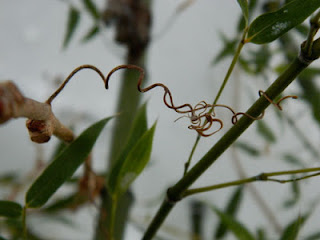
The tendrils grasping bamboo

The tendrils on the virginia creeper are never hairy. The tendrils are always small tight loops which they use to grasp fences, trees, or as in the pictures here, bamboo. All the vines featured here are very effective climbers.

Virginia creeper also has berries in the fall, but I have never seen them hold these berries into the winter season. The fruits are produced in clusters that have more of an umbrella-like arrangement than the standard downward hanging clusters that grapes prefer.

Identification?

Like with many plants, google image searches provide many wonder photos to compare against and learn from. Find one such google search here. Add other qualifiers to see more.

For information as well as images, please see here or here.


Grape
The large looping tendrils of the grape

Last but definitely not least, is the wild grape. The grape is the only one of the three vines featured here that is not poisonous - in fact, the fruit is edible and foragers can collect them for preserves and food. The leaves and young shoots are edible as well. Stuffed grape leaves - who doesn't love those!

The wild grape in our Northeastern forests can grow into such large woody vines that not only Tarzan but Tantor his elephant could successfully swing on them. The vines are also so plentiful in Eastern North America that the Vikings who discovered America, named the continent "Vinland" - "vine land." (The Vikings were first Europeans to discover America - sorry, Christopher Columbus!)

The bark and filaments in a grape vine
The grape is the visually most woody looking of the three vines. It has a rough bark when the vines get any sort of maturity on them. Larger, mature vines have almost a shaggy appearance to them with paper-like bark bits hanging from the vines. Even young vines demonstrate that papery quality if you break the vine - as in the picture to the right. Woody filaments are visible right under the surface of the bark and undoubtably give the grape vine some of its toughness and strength.

Last season's grapes
The grape also has rather knobby joints and "knuckles" on the vine - as you can see in the pictures here. But the large looping tendrils will not be confused with either of the two other vines featured here. See the picture at the top for a size comparison of of the tendril loops of the virginia creeper and grape. Side-by-side, the difference is incredibly obvious.

The grape often holds its last season's fruit clusters and maybe dried out bits of fruit on its vines. Albeit smaller, the wild grape fruit clusters look just like the cultivated grape clusters bought in a grocery store. They will look like a grape cluster to you.

Important - Before eating any wild grapes, be sure to know how to ID them from the poisonous look-a-like Canada Moonseed (Menispermum canadense). Always be smart and be safe.

Identification?

You have to love the images available via google - they are a boon to plant lovers and enthusiasts every where. Check out some wild grape images here and here. Use other qualifiers to the search for other image results.

Get more info and pictures of the wild grape from here and here.