Showing posts with label Wildcrafting. Show all posts

Friday, May 24, 2013

Know Your Herbs?

Today's Know Your Herbs is a bit different. Instead of giving you one herb to identify, I'm giving you two. More than that, I'm giving you two that look very similar when coming up in the spring. (To get a closer look at the details of these plants, be sure to click on the images for the full sized image.) I specifically took the photos where both plants were similar in size and didn't have last year's stalks in view giving you other clues as to the identification.

These plants are both medicinal herbs native to the North Eastern United States. The shoots of one of these herbs can be eaten if prepared correctly. The other is toxic and no amount of cooking will change that. This is a wonderful example of why you must be able to correctly identify not only a plant but any possible look-a-likes before ever harvesting a single leaf.

Think you know what these are? Check your answer here.


Herb #1


Herb #2

Friday, April 19, 2013

Laughing in Flowers

If the Earth laughs in flowers, then spring must be quite the season of giggles and belly-laughs!

Some of my favorite flowers, such as violets, bloom this time of the year. Violets are one of my oldest and dearest favorites. I have very fond memories of them even as a young child. Some think of them as weeds - which is quite impossible to my way of thinking! Here are a couple of snaps of a few of my violets in bloom at the moment.

Viola odorata 'Rosina'

Viola odorata "Rosina"


A wild growing Viola sp. in my lawn (perhaps another Viola odorata)

Photo of a wild Viola sp.

Monday, February 25, 2013

Northeast Wildflowers and Wild Plants

As time allows, I will be creating and uploading videos featuring wildflowers and other plants of the woodlands of the Northeastern United States. These videos will feature identification tips, ethnobotanical information, and various bits of related trivia. I have created a playlist at YouTube for this series which you may find at YouTube or you may view it below. At the time of this writing, I have three videos available but visit often since there will be more!


Monday, December 31, 2012

Friend or Foe?

(click to see a larger image of any of the photos)
Just because winter has chased the leaves from the forest's trees and vines, doesn't mean that you can't still get poison ivy. The worst case of poison ivy I ever got was in the winter time when I was helping my dad cut and stack firewood. After that I learned to ID the dreaded PI in ALL seasons and all its many guises.

What makes it more complicated to those that don't know how to winter ID poison ivy is that we have three very common vines that grow in our area and may grow all together as the photo to the right indicates. The three vines are: poison ivy (Toxicodendron radicans), virginia creeper (Parthenocissus quinquefolia), and grape (Vitis spp.).

Poison Ivy


Poison Ivy climbing on a tree trunk
Poison ivy is the chameleon. It can appear as a vine, ground cover, and even rather bush-like plant. It is an attractive and robust plant all year long. If it didn't cause extreme contact dermatitis as it does, I'm sure it would be a much loved garden addition with hundreds of cultivars.

In winter it is the large bush-like and vine forms that we see most while out on the trails and the dried - yet still very irritating to the skin - vines on firewood. Yes, you can get the poison ivy rash from the vines on firewood too. Vines on firewood will look much like the picture to the right. Older vines will be thicker, woodier looking with a lot more of the hair-like tendrils along the length of the vine - more like the first picture above.

See the detail below for a close up of the hair-like tendrils. The detail also shows a shoot where leaves will sprout from come the spring. Slender buds can be seen on the tips of the vines. The picture farther below shows a vine with buds growing along an old fence.

Tendril detail
Like the grape and virginia creeper, poison ivy also has berries and the remnants can often be spied on the winter vines. These often still have a light color that hint at the white color the berries originally were. Both grape and virginia creeper have dark fruits. Poison ivy produces tiny fruits in greater numbers than either of the other two vines. (Click on any of the images for a larger view.)

Identification?

Wikipedia has a list of identification aids for this tricky plant. You can find it here.

There is also a whole site on poison ivy here with more info and images which you can find here.


Poison ivy vines and berries. Notice bud at end of vine.
Of course the image search at google will show you many images as well. If you add other qualifiers to the search like "vine," you will get other results that will show you many images of that specifically like so. Try other qualifiers like "buds" and "berries" for other images.

Got a photo of a plant you are questioning the ID of? Try GardenWeb's Name That Plant forum for identification help.


Virginia Creeper

Virginia creeper's small looping tendrils and knobbed joints 
Virginia Creeper is another common vine in the Northeastern US. Some people are sensitive to this plant as well and may also get contact dermatitis but that sensitivity is no where near as common. I personally pull this from the gardens (in which it can be quite a "thug") bare-handed with no ill-effects.

It too has its beauty - attractive leaves with 5 leaflets, scarlet fall color, and blue-black berries. This is also a "robust" and vital vine that is not easily removed from the garden. And a word of warning - never rototill the roots of this plant. Each piece will sprout a new plant. Yes, personal experience talking here!

The thin-barked and green fleshed vine
Unlike poison ivy, you rarely see any other form of this plant other than a vine. You may occasionally, however, see virginia creeper appearing as a ground cover in the full-shade of the forest understory. It is only waiting for some sunlight before vining off to the nearest tree. I have read that ginseng, too often harvested completely from areas, can hide amongst these young, low-growing creeper plants for it too has 5 leaflets. A thank you to the creeper for hiding the besieged 'sang!

Virginia creeper vines have a very thin bark with green flesh right under the surface. The vines have knobs or "knuckles" where the leaves would sprout come spring.
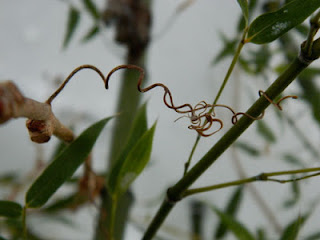
The tendrils grasping bamboo

The tendrils on the virginia creeper are never hairy. The tendrils are always small tight loops which they use to grasp fences, trees, or as in the pictures here, bamboo. All the vines featured here are very effective climbers.

Virginia creeper also has berries in the fall, but I have never seen them hold these berries into the winter season. The fruits are produced in clusters that have more of an umbrella-like arrangement than the standard downward hanging clusters that grapes prefer.

Identification?

Like with many plants, google image searches provide many wonder photos to compare against and learn from. Find one such google search here. Add other qualifiers to see more.

For information as well as images, please see here or here.


Grape
The large looping tendrils of the grape

Last but definitely not least, is the wild grape. The grape is the only one of the three vines featured here that is not poisonous - in fact, the fruit is edible and foragers can collect them for preserves and food. The leaves and young shoots are edible as well. Stuffed grape leaves - who doesn't love those!

The wild grape in our Northeastern forests can grow into such large woody vines that not only Tarzan but Tantor his elephant could successfully swing on them. The vines are also so plentiful in Eastern North America that the Vikings who discovered America, named the continent "Vinland" - "vine land." (The Vikings were first Europeans to discover America - sorry, Christopher Columbus!)

The bark and filaments in a grape vine
The grape is the visually most woody looking of the three vines. It has a rough bark when the vines get any sort of maturity on them. Larger, mature vines have almost a shaggy appearance to them with paper-like bark bits hanging from the vines. Even young vines demonstrate that papery quality if you break the vine - as in the picture to the right. Woody filaments are visible right under the surface of the bark and undoubtably give the grape vine some of its toughness and strength.

Last season's grapes
The grape also has rather knobby joints and "knuckles" on the vine - as you can see in the pictures here. But the large looping tendrils will not be confused with either of the two other vines featured here. See the picture at the top for a size comparison of of the tendril loops of the virginia creeper and grape. Side-by-side, the difference is incredibly obvious.

The grape often holds its last season's fruit clusters and maybe dried out bits of fruit on its vines. Albeit smaller, the wild grape fruit clusters look just like the cultivated grape clusters bought in a grocery store. They will look like a grape cluster to you.

Important - Before eating any wild grapes, be sure to know how to ID them from the poisonous look-a-like Canada Moonseed (Menispermum canadense). Always be smart and be safe.

Identification?

You have to love the images available via google - they are a boon to plant lovers and enthusiasts every where. Check out some wild grape images here and here. Use other qualifiers to the search for other image results.

Get more info and pictures of the wild grape from here and here.

Wednesday, August 1, 2012

Know Your Poisons

Poison Hemlock (along a local hiking trail)
In a conversation once with another herbalist about poisonous plants, we agreed that those were some of the first plants we learned in our wildcrafting and harvesting endeavors. Why learn the poisonous plants right away? You need that knowledge to avoid dangerous, potentially deadly mistakes.

You need to know what dangerous look-a-likes may exist (queen anne's lace or poison hemlock?). Also, how to avoid dangerous situations (don't plant deadly monkshood next to your edible chicory). You need to know that some plants have edible parts and toxic other parts. And still others need to be harvested at specific times or need special processing to make them usable and non-toxic.

Knowledge is power. Certainly so in this case. But even more than power, this knowledge teaches you to respect the power our green friends have. They can cure us or kill us with equal ease.

(If you like this sort of info, be sure to catch my daily herb posts at the Classical Formulas Facebook page.)

Thursday, June 21, 2012

Herb of the Week - Burdock

Burdock (Arctium lappa) Flowers
Burdock
Arctium lappa
Arctium mimus 
Few plants make me think of being a kid more than burdock. As a kid I spent a lot of time at my grandparents' dairy farm. Like most old farmsteads, plants like burdock, stinging nettle, cleavers, and catnip grew with wreckless abandon. These plants were most likely unbroken links to plants that were purposely planted by farmers and their families generations ago. My siblings, younger cousins, and I were left to our own devices for long summer days. Besides simple games like hide-and-seek or freeze tag, the natural resources were a great source of amusement. Hollyhock flower fairies, willow whips (good not only for "smacking" each other but for flinging green plums over the barn roof), climbing trees, eating wild berries, and of course, playing with burdock. The gigantic leaves leaves made great fairy and "wild man" hats and clothes. The burs could be made into mats and balls. Oh....the burdock balls. Those old balls could be thrown at a sibling or cousin and they would stick - just like the Velcro-based dart tag type items today. It was all "fun and games" until someone got one of the balls in their hair and went tattling to an adult.

Arctium lappa leaves
Burdock, no stranger to my childhood memories, was once a stranger to the North American shores. Burdock was brought to North America by the Europeans who settled here. It is now naturalized in North America but its native range was originally all the temperate areas of the Old World. Given all the great qualities of burdock it is easy to see why this plant made the trip across the ocean to the New World. It grows easily from seed in a wide range of growing conditions and provides us with choice edibles as well as strong medicine.

For medicinal purposes the stems, roots, and seeds ("niu bang zi") are generally used. In Western herbal medicine burdock root is typically used internally for skin diseases and inflammatory conditions due to chronic toxicity. In Traditional Chinese Medicine, the seeds are used for these similarly as well as to treat colds, pneumonia, and throat infections. [Source: The Herb Society of America New Encyclopedia of Herbs & Their Uses By Deni Bown]

In Kampo, a Japanese form of herbal medicine, burdock seed is a "cold, pungent, and sweet herb" that detoxifies tissues by encouraging the circulation of qi. The seed dispels heat, relieves swelling, and normalizes breathing. It is also used in formulas for coughs, rashes, and sore throats. [Source: Japanese Herbal Medicine: The Healing Art of Kampo by Robert Rister]

Herbalist James Green says that burdock is a "deep food and and alterative that moves the body to a state of well-nourished health." He also notes its use for a variety of skin conditions (incl. eczema, psoriasis, dermatitis, boils, rheumatism, gout), aids appetite/digestion, and in poultices. [Source: The Herbal Medicine Maker's Handbook by James Green]

Burdock roots and stems are also very good foods. The stems can be prepared like cardoon. The roots are popular in a wide range of Asian dishes - one of the most well-known being the Japanese dish kinpira. My personal favorite is my own version of tsukemono (Japanese quick pickles) with burdock root. Not only do I love the unique taste of these pickles, I like to make them whenever I'm feeling "low" and need a boost to my energy and vitality. Here's my recipe:

Sweet Vinegared Gobo (Burdock Root)
Gobo (burdock root)
2 Tbsp sugar
2 Tbsp lemon juice
1 tsp salt (sea salt preferred)
4 Tbsp rice wine vinegar
1. Wash gobo well. You can peel the root first if desired but this is not required especially for the thin-skinned cultivated roots found in Asian markets. Wild-dug roots are best peeled. Half or quarter root and cut into 1-2" sticks.
2. Boil root 2-3 minutes. While root is boiling, mix remaining ingredients.
3. Drain root and add hot to the marinade. Refrigerate and cool before eating. Best flavor if sat overnight. Keeps 3-5 days in refrigerator.

When asked about my favorite herbs, I usually tell people that my foods are my favorite herbs because I live Hippocrates' quote, "Let food be thy medicine and medicine be thy food.” Burdock is one of those healthful herbs that can make it to my dinner plate.

Sunday, May 20, 2012

Herb of the Week - Goldenseal

Goldenseal, Hydrastis canadensis
 
Goldenseal, Hydrastis canadensis
This week's herb is another medicinal plant native to our eastern woodlands that is currently blooming. While we are now in the bloom time of this plant, I am fairly certain that our readers have not seen this plant or its blooms.

This plant is a small, growing only 6-12" high and it has neither showy blooms or leaves. But more than its unassuming appearance, this plant has become increasingly rare in its native range. While habitat loss has effected all native plant populations, this plant's disappearance has been largely due to the overharvesting of wild plants for the herb trade. This plant is one of the most widely used herbs in America, second only to wild American ginseng, Panax quinquefolius. [Source: Planting the Future by Rosemary Gladstar]

Goldenseal was first used medicinally by the Native peoples of North America such as the Cherokee, Haudenosaunee (Iroquois), and Micmac where it was used for a wide range of remedies including those for diarrhea, inflammations, "sour stomach," fevers, liver complaints, and cancer. [Source: Native American Ethnobotany by Daniel Moerman] Later on the Eclectic medicine practitioners of the 1800's adopted goldenseal into their pharmacopeia as well. See King's American Dispensatory for an example of how goldenseal was used by this school of herbalism. Modern herbalists use goldenseal for a number of reasons but one of the chief reasons is for its antibacterial properties.

According to a 20-year, 16 organization study report, 34,000 plant species -- 12% of the plants worldwide and 29% of the plants in the US -- have become so rare that they could easily disappear. [Source: Planting the Future] Some of our most loved native medicinal plants clearly make that list. The United Plant Savers (UpS) is a non-profit organization dedicated to conservation of native medicinal plants. UpS maintains a list of plants that are most at-risk of vanishing completely called the "At-Risk" List. Goldenseal is on that list and so the UpS recommends that you use:
  • Alternatives to goldenseal such as barberry, cultivated oregon grape, cultivated yerba mansa, and other cultivated Berberis species.
  • Use only cultivated goldenseal 
I urge you , whether you are an herbalist or just a user of herbs, to make conscious choices about all the herbs you use. If there are alternatives to at-risk plants such as goldenseal, make every effort to use them. Or if you have the right conditions, you can add such plants to your own woodland areas and grow your own.  I currently have four goldenseal plants in my own woodland garden. They are not very fussy or difficult to grow if you have a woodland area in full-shade. Outside of a plant killed by rodents digging it up during the winter, I've never lost a plant. You may buy your goldenseal plants from a number of sources - my favorite is Prairie Moon Nursery.

Wednesday, May 9, 2012

Herb of the Week - Trout Lily

Trout Lily, Erythronium americanum
Trout Lily (Erythronium americanum)

Trout lilies are one of the "spring ephemerals" - wildflowers that do all their living for an entire year in a few short weeks each spring before vanishing beneath the soil until the next year. The ephemerals group include some of the most eagerly anticipated blooming plants that I know of - trillium, bloodroot, spring beauty, hepatica, and more. The trout lily certainly holds it own in this illustrious group.

This beautiful little plant is native to the woodlands of Eastern North America. It has yellow, almost violet-like flowers and distinctively spotted leaves. These physical characteristics have inspired quite a number of common names such as: adder's tongue, dog tooth violet, serpent's tongue, and yellow snowdrop. I so love the "color" of common names!

Trout lilies are rarely sighted as single plants. If happy in their location, these plants will spread to form a colony on the forest floor. Even without the pretty flowers, a carpet of their spotted leaves is a beautiful spring-time sight.

The trout lily is edible - both the corms and the young leaves can be boiled and eaten. (Source: Peterson's Edible Wild Plants) And both the bulbs and leaves have been used medicinally as an emetic, emollient, and antiscorbutic (when fresh) and a nutritive when dry. It is also said that the root and leaves simmered in milk could be used in remedies for dropsy, hiccoughs, vomiting, and bleeding from the lower bowels while the plant boiled in oil was used for wounds and to reduce inflammation. (Source: Indian Herbology of North America by A. Hutchens) See the PFAF.org entry for more information on the plant's uses.

But with other foods and remedies more commonly available, why would you want to pick this beauty for food or medicine? Like many wildflowers, the trout lily does not reproduce quickly. It can take up to 8 years to mature from seed. Loss of habitat along with irresponsible picking or harvesting can decimate such wild plants. If you do have a woodland area or garden, be sure to invite this plant into it. If you are a wildcrafter or a forager, appreciate this plant for how it has been used but please pass it by. Take only photos and memories from it to ensure it will remain for future generations.

Tuesday, May 8, 2012

May Flowers, Herbs, and Trees

May is always a time of abundant life and plants to me. It is the time when the forests become a verdant green and when wildflowers continue their spring show. It is also a busy time of gardening and planting for the coming season. To celebrate this greening of the world and the start of the new agricultural season, I take May 1st off of work. It is a 20-year old tradition. Often I spend the day in my gardens, but sometimes I take hikes or do other activities to celebrate May Day. 

In that spirit of celebrating the Earth and her greening cloak, it was my pleasure to attend not one but two plant hikes over this past weekend. The first of these hikes was led by Dr. Les Moore on Saturday May 5, 2012. It was held in Phelps, NY along the Ontario Pathways Trail System. This hike focused on identification as well as the medicinal properties of the wild plants found. This hike is also part of a series of classes Dr. Moore teaches on medical herbalism. If you are interested in learning more about these classes, please see the Classical Formulas website. I created the video at the bottom of this article from the photos I took on that hike.

The second hike was at Ganondagan and it was led by Tonia Loran-Galban and Peter Jemison on Sunday May 6, 2012. This hike was along the Earth is Our Mother trail and it focused on the medicinal as well as the ethnobotanical uses of the plants along the trail. It was a beautiful day for a hike - made even more special by the abundance of the migrating red admiral butterflies. You can see the slideshow from this walk on the Plant Hike slideshow webpage.

I hope you enjoy the slideshow and video. I wish for your May to be happy and abundantly green!


Thursday, April 26, 2012

Wild Strawberries in Bloom

Wild Strawberry, Fragaria virginiana
The inches of snow that fell this week did little to stop the march of Spring. The wild strawberries here, as well as my cultivated varieties, are in full bloom. Wild strawberry plants and flowers - as well as the very fine fruit are quite diminutive compared to the cultivated varieties. But fruit? Pure ambrosia. Even the best cultivated varieties pale in comparison.

Here are a few of the wild strawberry (Fragaria virginiana) blooming here at this time. Be sure to note the flowers are nearly the same height as the leaves. This is one of the identifying characteristics of the more common wild strawberry or Virginia Strawberry, Fragaria virginiana. The other wild strawberry species that is also native throughout much of the United States and Canada is the Woodland Strawberry,  Fragaria vesca. The flowers of that species are held much higher above the leaves. The fruits of both species also have other identifying characteristics - but those pictures will have to come later! Enjoy these pictures of spring!


Wild Strawberry, Fragaria virginiana


Don't know how to identify wild strawberries at all? 

The short video included below will show you the key characteristics to look for. They are probably growing closer than you thought!


Friday, April 20, 2012

Herb of the Week - Dandelion

Dandelion Flower

Dandelion (Taraxacum officinale)


Few things herald the coming of spring more than the dandelion. While those wishing their lawns to be a monoculture of green revile it, I cheer its arrival. The bright yellow of their blooms is a welcome sight after the long drab months of winter.

Our ancestors cheered it as well. That is why the dandelion traveled to all the corners of the globe with them. It is a hardy and robust plant - ask those that try to remove it from their lawns. But more than that, it was a plant of great nutrition and medicine sprouting up in the Spring when it was most needed for the cupboards had gotten quite bare in the long, cold winter.

Dandelion leaves have a host of vitamins and minerals including: Folate, Magnesium, Phosphorus, Copper, Vitamin A, Vitamin C, Vitamin E, Vitamin K, Thiamin, Riboflavin, Vitamin B6, Calcium, Iron, Potassium and Manganese. [Source]

More than just nutritious, the dandelion offers us a number of pleasing beverages. The roots can be roasted and ground for a fine coffee substitute - with no caffeine! The flowers, roots, and leaves can be used to make a pleasing tea. But probably the most famous beverage is dandelion wine made from the flowers. The wine recipe is quite simple. But speaking from personal experience, it is a hard one to master!
Dandelion Leaves & Buds

Dandelion, the root especially, is commonly used in a variety of herbal remedies. Two of its most well known uses are as a cholagogue and as a diuretic. For more on the traditional medicinal uses of dandelion please see the Plants For a Future or the Modern Herbal entries on dandelion.

The plant also has provided great amusement for untold generations of children of all ages - who can resist scattering the seeds of the dandelion blow ball when the plant has gone to seed? I seem to also recall having read a long time ago in a book of old-timey amusements that the hollow stem dipped into soapy water could be used to blow bubbles. I think I'll pass on that one. The bitter sap would be a definite turn-off!

Finally one thought to leave you with, the history behind the name "dandelion." It is from the French phrase, dent-de-lion, meaning "lion's tooth" - which is certainly in reference to the toothed leaves. Our springtime friend the dandelion has not only the ruffled yellow mane of the lion, it has its teeth as well!