Showing posts with label Crafts. Show all posts

Tuesday, January 13, 2015

Herb of the Week: Agave

Agave americana
Agave, Century Plant, Maguey

It is odd given my lifelong interest in both plants and nearly every art and craft known to man that I haven't done more in harvesting and creating botanical-based dyes and fibers. But after taking a workshop a few years back that focused on Native American cord and rope making, I like to occasionally try making cords from scratch - all the way from harvesting the raw plant materials. Last year I had the opportunity to work with fibers from an Agave americana plant.

I was inspired by a YouTube video linked in the Learn More section below. It shows a Kichwa man harvesting fibers from agave. He is a master and makes it look easy. I assure you, I struggled and took far more than the 7 minutes he did in the video! But thankfully, I did my homework and did more research than watching one YouTube video. It seems the sap from A. americana can cause contact dermatitis. In fact the horror stories of people who took chainsaws to such plants abound. So I took precautions and wore rubber gloves during my fiber harvesting. Unfortunately I got some fresh sap (unbeknownst to me) on my sleeves and when I hiked up the sleeves, I ended up with that dermatitis. Not fun!

See the pictures below for the story of how I make rope from this plant.

Learn More:
Plants for a Future: Agave americana
Wikipedia: Agave americana
Dave's Garden: Agave americana
YouTube: Indigenous people of Ecuador harvesting agave fibers

Agave Rope Making:

This is the agave plant. See detail of spiny leaf tip. These pretty blue-green leaves also sport sharp thorns along the leaves. (Plant location: Sonnenberg Gardens & Mansion State Historic Park)


After some scraping away of the fresh plant material, the long white fibers can be seen in the leaves. The fibers and their arrangement can also be seen in the cut edge of the leaf. Agave is an exceptional fiber plant.


After the bulk of the fleshy, soft plant material was scrapped away, I left the fibers to dry. After drying I found the fibers far too "prickly" and suspected that the oxalate crystals (which cause the dermatitis) were still too present. So I decided that retting may make the fibers more friendly to the touch. After a few weeks, I found the fibers better to work with. Below are some finished, ready to be worked fibers.


 Now for the fun part, making the cord. I used an S-twist or two-ply style. (Want to try it? See directions here.) You can twist it with your fingers or by rolling on your knee.


Finished cord! Like to get an idea as to what this fiber is like? Sisal ropes are made from another species of agave (Agave sisalana) and should be relatively easy to find.
 

Thursday, November 8, 2012

Cordage Plants

Our ancestors, regardless of what corner of the world they lived in, all had to answer the same questions with regards to food, shelter, clothing, and the other basic necessities of life. How they answered those challenges varied. Often those variations were because of the raw materials they had at hand.

Plants were often one of those key those raw materials that supplied our ancestors and in fact, still supply us with the basics of life. The study of how various peoples have traditionally used plants for food, medicine, utilitarian needs, sacred purposes, and so on is called ethnobotany. It is one of my passions because it combines two of my life-long loves - plants and archaeology/anthropology.

One of the things you will find in ethnobotanical references that modern peoples give little thought to is fiber and cordage plants. While we can visit our local department store for thread, rope, or even fabric whenever we want, our ancestors had no such resources. They made all the ropes, cords, and cloth that they needed. While certainly there are some animal sources like wool and sinew that were used for these purposes, plants provided the bulk of the fiber raw material used.

Why should this be so important and so universal a need? Think of what a cord, rope, or piece of fabric meant. A bow string, net or snare for hunting and fishing meant food. Fabric clothed and so warmed or protected our bodies. Even if you wore skins and furs, you probably stitched them in some manner to better fit and cover your form. Ropes and cords lashed our shelters together, made it possible for us to better haul, pull, or carry items. Ropes or other bindings kept our animals from wandering away. Fibers and the cordage were indeed a key element of survival.
Stinging Nettle Fibers
Visiting my gardens this morning, I happened to collect up three examples of plant fibers traditionally used for cordage in different parts of the world - stinging nettle (Urtica dioica), jew's mallow (Corchorus olitorius), and dogbane (Apocynum cannabinum).

Stinging Nettle

Stinging nettle is one of the great plants of the world. Like the dandelion, it is much maligned yet it gives us so much. The leafy parts of the stinging nettle provide a nutritious food and a host of medicinal uses.

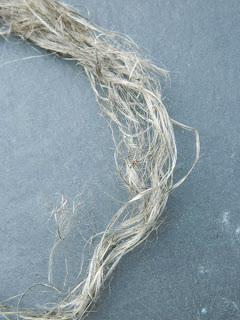
But the nettle has also been used in Europe since ancient times (Bronze Age at least), for fiber and cloth. The fiber from stinging nettle is linen-like. In the raw fibers I collected today, it was by far the most fine and luxurious to the touch.


Jew's Mallow Fibers
Jew's Mallow

Jew's mallow or "molokhuiya" is a popular potherb and vegetable in the Middle East and it too has some medicinal usage. The fiber from this plant is the main source of jute. Jute is a coarse fiber. It is indeed "sack cloth." But since it has so many utilitarian uses, it is second only to cotton in its important vegetable fiber source.

Like linen and variety of other fiber plants, jute is normally "retted" or soaked in water until the plant fibers can be worked free. I didn't ret the plants and my plants were not dry so the fibers were rather hard to peel from the stems. But it is clear that the fibers were the most coarse I collected today.


Dogbane Fibers
Dogbane

Dogbane is a New World plant that despite its toxic nature was a medicinal plant used by the Native Americans. But its use as a fiber plant gives dogbane one of its more common names, "Indian Hemp." Earlier this year I attended a workshop that focused on Haudenosaunee (Iroquois) cordage making. If you would like to see photos from that workshop or read more on that topic, please see my article on it.

Dogbane is an amazingly strong and fine fiber. I find it relatively easy to peel from the stems - no retting required. This native and hardy perennial supplies fibers that can be worked into a variety of cordage needs.  


Monday, June 11, 2012

Maize "Pearl" Earrings

Earring #1
We've all seen beautiful examples of jewelry made with seeds from plants that can only grow in tropical rain forest locations. We too can grow beautiful seeds to use in jewelry. The eldest of the Three Sisters, maize, is a beautiful example. It comes in a rainbow of jewel-like colors that just ask to be used as beads.

This project features earrings made using maize kernel beads. Three different styles with different materials are presented to suggest the variety of styles you might try.
               
All maize used in this the examples shown were grown in my garden. Earring #1 features the blue-grey kernels of "Hopi Blue Dent" and earrings #2 and #3 feature two different colored kernels (pearl white and burgundy) of the multi-hued "Painted Mountain."
              
Earring #1 (Silver & Turquoise)
  • 2 dried corn kernels
  • 2 size #11 crystal seed beads
  • 2 sterling silver earwires (22 gauge, fishhook w/ ball & coil)
  • 2 sterling silver 2-inch, 26 gauge headpins
  • 2 turquoise rondelles, 6x3mm


 Earring #2 (Chevron & Gold)
  • 2 dried corn kernels
  • 2 size #11 crystal seed beads
  • 2 chevron beads approx. 10x5mm
  • 2 gold-filled french hook earwires
  • 2 gold-filled 1.5-inch, 22 gauge headpins


Earring #3 (Silver & Garnet)
  • 2 dried corn kernels
  • 2 size #11 crystal seed beads
  • 2 sterling silver earwires (22 gauge, fishhook w/ ball & coil)
  • 2 sterling silver 2-inch, 26 gauge headpins
  • 4 garnet beads, 3mm
See vendor resources below for sources on where to get all the materials used.

Tools Needed
  • Jewelry pliers like round-nose pliers. Needle nose pliers will work.
  • Flush cut pliers or another tool capable of clipping fine wire
  • Hand awl or a hand drill/Dremel tool with a very fine drill bit
  • Small vise. If you do not one, a hinged clothespin will work to hold the kernels for drilling.
  • X-acto knife

Instructions
  1. Select only completely dried, well-formed corn kernels. The flat-sided and hard dent or flint corns generally work best. Trim any rough spots off the end of the kernel - do not cut into the kernel.
  2. Use a small vise or clothespin to hold each kernel so it can be drilled long ways. Drill the hole. If you use a hand awl, the hole will have a larger bore and you will need to put it through the middle of the flat side of the kernel. Adjust the complementing bead sizes as needed.
  3. Carefully trim or smooth any rough spots from drilling. 
  4. String beads and corn kernel onto headpin. Bead order: Earring #1 - seed bead, kernel, turquoise rondelle;  Earring #2 - seed bead, kernel, chevron bead;  Earring #3 - garnet bead, kernel, garnet bead
  5. For small gauge wire (i.e. 26 gauge), put headpin through the loop on the fishhook earwire. Use pliers to bend and loop the wire with the top of the loop being 3-5mm above the top bead. Use pliers to pull the free end of the wire around the headpin shaft, leaving a loop at the top to work down to the top bead coiling the wire 3-4 times. Trim excess. Use pliers to pinch the trimmed end flush with the rest of the coil.
  6. For the heavier gauge wire (i.e. 22 gauge), use the pliers to bend the wire at the top bead 45 degrees to the left. Use the tip of the pliers to grip wire at the top bead. Use your fingers or other pliers to bend the wire to the right, curling it around the plier nose until it crosses the headpin shaft. Trim the excess wire beyond where it crosses the shaft. Adjust loop shape as needed. Loop onto fishhook earwire.

If you are new to wire bending for jewelry, try out your wire bending skills with a similar gauge inexpensive brass or copper wire first. It is costly to learn on precious metals! I hope you enjoy this project!

Vendor Resources

Earrings #1:

Seed bead, Delica, glass, transparent rainbow crystal, #11
Earwire, sterling silver, 18mm flat fishhook with ball and coil with open loop, 22 gauge
Headpin, sterling silver, 2-inches long, 26 gauge
Bead, turquoise (D/S), 6x3mm rondelle

Earrings #2:
Seed bead, Delica, glass, transparent rainbow crystal, #11
Bead, chevron glass, multicolored, 4x2mm-12x8mm mixed shapes
Earwire, 14Kt gold-filled, 13mm fishhook with open loop, 21 gauge
Headpin, gold-filled, 1-1/2 inches long, 22 gauge

Earring #3
Earwire, sterling silver, 18mm flat fishhook with ball and coil with open loop, 22 gauge
Headpin, sterling silver, 2-inches long, 26 gauge
Bead, garnet, 3mm round

Ears of various colors of maize can be purchased at farmers' markets in late summer through late fall. But even better, grow some maize yourself. If you don't know where to get such seed, check the the vendors listed in the 'Vegetable/Food Crop' section of a gardening article I wrote. The vegetable seed vendors listed all sell heirloom/open-pollinated varieties of maize. Try growing some in your own garden for food or for crafts. As a bonus, some of the colored maize even has colored corn husks which lend themselves beautifully to corn husk crafts.

Tuesday, May 22, 2012

Cordage from Plant Sources

Stripping bark from a basswood tree
It was my pleasure to take a class this past weekend where I learned both the sources and techniques for making cords, ropes, and useful fibers from indigenous plants. The workshop was a real treat for me since it hit two of my passions, crafts and plants.

While the workshop focused on Haudenosaunee (Iroquois) cordage techniques, the ability to make cords, thread, and ropes from the raw materials found in the natural world is something that all our ancestors did. It was key to survival because everything from tools to shelters to clothing made use of cords and threads.

Class participants all got some hands-on with bark cordage techniques including how to get raw fibers from dogbane (Apocynum cannabinum) stalks and then how to turn those fibers into a very fine and strong cord.  (See a picture of one of my dogbane cords below.)

I took quite a variety of photos and the slideshow can be seen here: Cordage Workshop Slideshow. I hope you enjoy!

Dogbane (Apocynum cannabinum) Cord