Showing posts with label Oddities. Show all posts

Monday, August 10, 2020

A Rare Find (Repost)

 This is a copy of a blog post I made on another, now defunct, blog in 2010. I am posting it here so as not to loose this wonderful info.

A couple of weeks ago while hiking at Letchworth State Park, I came across a rare find. Nestled between stands of spotted jewelweed (Impatiens capensis) and pale jewelweed (Impatiens pallida) I came across a jewelweed plant the likes of which I had not seen before. 

This plant looked like spotted jewelweed in the shape of the flowers and the leaves but it had white flowers with red spots. I've never in all my stomping about in wild places or perusing through various field guides trying to ID wild plants seen one like this. 

After some investigation, I believe it is one of two very uncommon variants of the spotted jewelweed: Impatiens capensis forma albiflora (white flowers with red spots) or Impatiens capensis forma Pease (white flowers with larger red spots/splotches). These variants are referenced here in a NYFA Newsletter  if you wish to read more.

It was very late in the day and the light was low so these pictures are not my best but hopefully you'll be able to see and enjoy this rare beauty as well!


Friday, November 20, 2015

Special and Unique Places: The Bog

There are few places that offer a more unique glimpse into the natural world than a bog. It is a pocket of conditions as well as flora and fauna that are completely different than the surrounding locale. I am fortunate to have visited a local bog on a few occasions which is not only a protected botanical preserve but it has also been designated as National Natural Landmark by the National Park Service. This place, The Zurich Bog, is located in Arcadia, New York. It is off the beaten trail to be sure, but the trip is worth it to see such a place of unique beauty. 

The Zurich Bog preserve encompasses hiking trails through a bog forest and a peat bog. There is a floating bog, a mat of vegetation over a pond, but access onto the floating bog is generally not permitted nor entirely safe.

The pictures below are only a few of the species seen there.

If you are a gardener please take note, such special places are threatened by the harvesting of the peat moss for the gardening industry. Even this protected location is threatened by the draining of water in order to harvest peat that goes on outside of the preserve. If these places are special to you as well, please choose soil mixes without peat in them. Read more about why to use no peat here.

Here are photos from the Zurich Bog Preserve. Click on any of the images to see a larger view.

Grass Pink Orchid (Calopogon pulchellus)


Tamarack (Larix laricina)


Northern Pitcher Plant (Sarracenia purpurea). Last image is the pitcher plant bloom.


White Fringed Orchid (Platanthera blephariglottis)


Spoonleaf Sundew (Drosera intermedia)


Goldthread (Coptis trifolia). Second photo also includes starflower (Trientalis borealis) and Canada mayflower (Maianthemum canadense).


Indian Pipe (Monotropa uniflora)


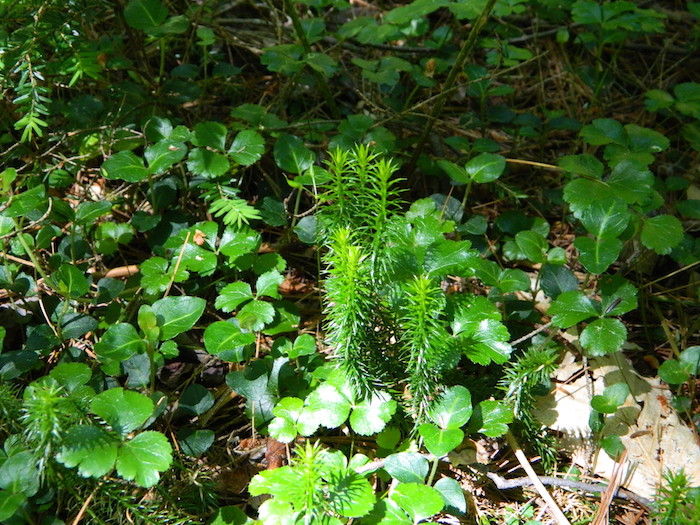
Club Moss (Lycopodium sp.). Second picture also includes goldthread (Coptis trifolia), partridge berry (Mitchella repens), and hemlock (Tsuga sp.).


Partridge Berry (Mitchella repens)


Starflower (Trientalis borealis)


Bog Rosemary (Andromeda polifolia)


Indian Cucumber (Medeola virginiana)


Labrador Tea (Ledum groenlandicum)


Links:

Monday, April 28, 2014

Hot Stuff in the Greenhouse

Tree Philodendron
Be sure to check out my new article on Sonnenberg Garden's Strolling Through Sonnenberg blog.

It is about a plant world oddity that can be seen in bloom in the tropical plant collection in Sonnenberg's greenhouses. The strangeness is not so much in the fact that the plant is blooming, but in the characteristics that this plant, the tree philodendron (Philodendron bipinnatifidum), exhibits in its flowers.

Article:

Things are Heating Up in the Greenhouse

Monday, February 25, 2013

Northeast Wildflowers and Wild Plants

As time allows, I will be creating and uploading videos featuring wildflowers and other plants of the woodlands of the Northeastern United States. These videos will feature identification tips, ethnobotanical information, and various bits of related trivia. I have created a playlist at YouTube for this series which you may find at YouTube or you may view it below. At the time of this writing, I have three videos available but visit often since there will be more!


Friday, August 10, 2012

Native Orchid: Summer Coralroot

Summer Coralroot (Corallorhiza maculata)

While on a recent hike I spotted an usual sight - a native orchid in bloom. I had never seen this plant before and had to ID it after the hike - good photos are always key to that! The plant was tiny and appeared to be possibly a parasitic plant since it had no leaves or green parts.

The plant I spotted was the blooming Summer Coralroot (Corallorhiza maculata). This orchid's native range is much of the US and Canada, including NY State, but this is the first time I have ever spotted it. According to Wikipedia, it "is a myco-heterotroph; it lacks chlorophyll and gets food by parasitizing the mycelium of fungi in the family Russulaceae." I guess first impressions were correct!

Orchids are a special sight and one in bloom even more so.  Other than this plant and the alien orchid Epipactis helleborine, I've only seen wild, native orchids blooming in one location, Zurich Bog. I've found lady slipper plants (no blooms!) in a couple of other locations but that is it. Our native orchids are special as are the places they grow for these plants usually have very specific needs.  Poaching these plants for your own garden - very illegal given the rules of the parks and preserves they usually grow in - is unwise. Few gardens are going to meet the growing needs these plants have and the plants will die. Take only photos and leave the plants be.

Because this was such an unusual plant, I referenced my ethnobotanical sources to see if the Native peoples here used these plants. According to Moerman in Native American Ethnobotany, the local Iroquois people used this plant for:
  • Basket Medicine - Infusion of pounded root used as a basket medicine
  • Hunting Medicine - Root placed in a half cup of water and used to wash guns and clothes as a hunting medicine
  • Love Medicine - Infusion of pounded roots used as a love medicine
  • Tuberculosis Remedy - Compound infusion of roots taken for tuberculosis
  • Veterinary Aid - Infusion of whole plant added to horse's grain for heaves
  • Witchcraft Medicine - Infusion of pounded roots used as an anti-witch medicine
Looks like the Iroquois found this plant to be special as well given the number of ceremonial "medicine" uses of the plant.

For more information on this plant, see the links below. I have also included other photos below as well.

For more information:

Orchids of NY State:
http://www.dec.ny.gov/docs/administration_pdf/orchidsofny.pdf

Plants For a Future:
http://www.pfaf.org/user/Plant.aspx?LatinName=Corallorhiza+maculata

Wikipedia:
http://en.wikipedia.org/wiki/Corallorhiza_maculata

USDA Plants:
http://plants.usda.gov/java/profile?symbol=coma25

Other Images:
Entire Plant
Plant with author's hand for scale

Thursday, May 3, 2012

It's a one in a million chance

My 1st five-leaf clover of the season
I'm happy to share a picture of my first 5-leaf clover and second 4-leaf clover for the season.

Yes, I find 4-leaf clovers where ever I go. I chalk it up to my "super power," the unnatural ability to see patterns in anything and everything. Definitely not the same as wall-crawling like Spiderman, but it lets me spot a 4-leaf clover in a field of millions at a full walk.

Supposedly the chances for finding a 4-leaf clover is 1 in 10,000 and the chances for a 5-leaf is 1 in 1,000,000. I blow  those odds all to bits!

I do also find 6-leaf clovers occasionally as well. I wonder about those odds!!
My 2nd four-leaf clover of the season