Showing posts with label Winter. Show all posts

Tuesday, February 24, 2015

Flowers & Grey Skies

Sonnenberg Orchid Show

I do not think it is any wonder why flower and garden shows are this time of the year. "Plant people" and everybody else all get "itchy" to see green again. Doubly so this year. This winter has been long, cold, and snowy. It is sad when you long for a 30 degree F day because it will seem balmy and tropical in comparison to what you have been experiencing. But spring will come - it always does. 

But in the mean time, visit your local flower and garden shows. They will give you that pick me up until the real thing, Spring that is, arrives.

Monday, March 18, 2013

I Go to Nature to Be Soothed and Healed

Barnes Creek, Canandaigua, NY in Winter
Barnes Creek, Canandaigua, New York

"I go to nature to be soothed and healed, and to have my senses
put in order." 

John Burroughs, (American Essayist and Naturalist, 1837-1921)


If you are like me in that you retreat to Nature for solace and healing, you will want to read these articles: Find Therapeutic Healing in 'Forest Bathing' and Forest Bathing for more information about Shinrin-yoku or forest bathing which is a Japanese tradition of therapeutic walks in the forest. Now you have a name and some supporting science for what you already knew to be true!

Thursday, March 14, 2013

Signs of Spring

Turkey Vulture
Turkey Vulture (Cathartes aura)
(photo by Dori, Wikimedia Commons)
Unlike some, I find the return appearance of the American Robin (Turdus migratorius) a poor indicator of the coming spring season. Too many times I have seen these birds looking cold and miserable as a late winter snow storm pounds the area. No, I find a less beautiful bird a much better indicator and harbinger of the coming spring. The Turkey Vulture (Cathartes aura) doesn't make his return to my area until spring is very close - usually syncing their appearance with the emergence of pussy willow catkins and skunk cabbage flowers which are other seasonal signs I look for.

Over this past weekend I saw my first turkey vultures of the season plus my pussy willow tree is also getting large and fuzzy catkins. I'll have to go out hiking to look for other pussy willows (Salix spp.), skunk cabbage (Symplocarpus foetidus), and coltsfoot (Tussilago farfara) to get a better guess as to how close spring is.

Either way, I had better finish my garden planning for the upcoming season - it will be here soon!

Update: Shortly after publishing this article, I happened to spy another one of my key spring signs. A Northern Mockingbird (Mimus polyglottos) was visiting my place and looking to lay his claim again to my yard. These highly territorial and migratory birds are warm weather only visitors at my house. All summer long I get to hear their bird "Top 40" - as I call their repertoire of copied bird song. Many times the male mockingbirds have they fooled visitors to my house thinking I have resident bluebirds. No bluebirds here but their copied song by proxy!

Monday, February 25, 2013

Northeast Wildflowers and Wild Plants

As time allows, I will be creating and uploading videos featuring wildflowers and other plants of the woodlands of the Northeastern United States. These videos will feature identification tips, ethnobotanical information, and various bits of related trivia. I have created a playlist at YouTube for this series which you may find at YouTube or you may view it below. At the time of this writing, I have three videos available but visit often since there will be more!


Wednesday, February 20, 2013

The Coming Season

Bloodroot - One of the heralds of spring
I often wonder if people who live in warm, green places all year long can appreciate what kind of gift that truly is. It has been months since my world was green and so it is about this point in the winter that I begin to long for the green of spring and become anxious for those few first blooms that are heralds of the coming season.

Don't get me wrong - I love winter. It is a quiet season, where like the Earth herself, I am able to turn inward to refresh and renew myself for the coming year. But winter is a season of browns, grays, white, and black and I miss the green of the growing and vibrant plant world - my green neighbors are all asleep. And so May is my favorite time of the year. May cloaks the world in a vivid bright green. That green of May is so vivid and so full of life that it is palpable. It takes on a magical quality that puts a smile on your face and a spring in your step. You feel like you are dancing on air and it is no wonder why our ancestors held various spring celebrations like May Day. They felt that energy and joy too.

So while I do not want to wish the season away, I do await those first few blooms of late winter and early spring with bated breath!

Monday, February 18, 2013

The Hedgehog in Your Garden

While the botanical or scientific names of plants may only seem like Greek to you - and sometimes they truly are just that, there can be clever insights into the plant buried in those names.

The Purple Coneflower (Echinacea purpurea) is a staple in many sunny ornamental flower and herb gardens. What is not to like about this beautiful and hardy native plant? It is a perennial with stunning and long-lived blooms, few if any pests, and it needs no special care or water once established. It is also a plant that has often been used medicinally as an immune system booster. Learn more about this and other echinaces here.

According to the Dictionary of Plant Names by Allen J. Coombes,
Echinacea. From Gk. [Greek] echinos (a hedgehog) referring to the prickly receptacle scales.
While you may see the hedgehog in central disks of the vibrant summer blooms as the picture above shows, I think it is with the winter snow-frosted seed heads where the name becomes even more evident - as the picture I snapped this morning (below) shows. I think all the picture needs is some beady little eyes and pointed nose to complete the hedgehog visual, don't you agree?

(Garden Tip: Next fall do not remove all the dead plant material like the old coneflower stalks from your garden beds. They provide for much winter interest in your sleeping garden.)

Purple Coneflower - The Hedgehog in
your garden?

Tuesday, January 15, 2013

Mid-Winter Sights

Even though it is in the middle of winter, some plants still provide beauty and edibles. Last week, prior to unseasonably warm temperatures and a thaw, I took some pictures of a few of the evergreen or "still going strong" plants peaking through the snow.

The picture of the sunrise on January 8th (to the right) was too beautiful not to share as well. It is a rare day here in winter when the sky is clear enough to see a sunrise let alone one so spectacularly colored. Enjoy.


Kale

If I recall correctly, this kale variety is "Fizz." The one you can barely see behind it is "Nero di Toscana." I have quite a number of different kale varieties in the garden still green and still very tasty. This is always a great plant to add to your veggie garden but especially if you end up getting a late start to things. Kale will happily grow into the fall and winter extending out your fresh harvest season.


Bloody Dock

While this plant is a little hidden by some grass - it did plant itself here after all, the beautiful red veining for which this dock was named, is visible. While you can add young leaves of this dock to the salad bowl, I like it better for it ornamental qualities since I don't find the flavor anything special.


Sage

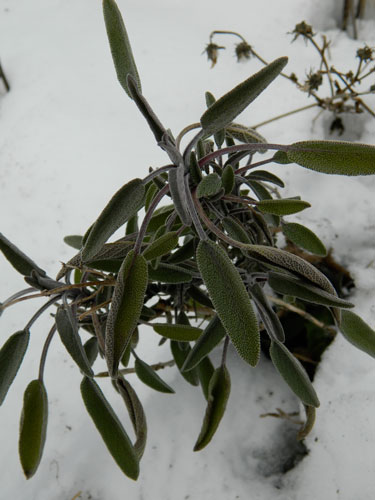
Sage (Salvia officinalis) is one my favorite herbs and garden plants. As a garden plant, what is not to like? It has striking grey-green foliage and blue-violet flowers and is a well-mannered and evergreen plant. In the winter my sage takes on purple colors - hints of that can be seen even in this picture. Some years, depending upon the severity of winter, they get even more purple. Even though the sage hails from the sunny Mediterranean, it survives Western NY State winters quite nicely.


Mustard

Like kale, I have a variety of mustards, radishes, green onions, and other cold tolerant plants still available in the garden. This is one of the many mustards still green in the garden. I can't seem to recall this variety's name at the moment but if I do recall correctly, it was from Kitazawa Seed Company. Kitazawa is a great source for Asian vegetable seeds of all sorts. 


Broccoli

This strikingly colored broccoli came along very late in the season. I got the seed in just as our summer-long drought began and so these plants got a slow start - my fault, not the seeds'. Even so, as our rains finally returned in the fall some of the plants that were in a "holding pattern" all summer finally began to grow. This variety is called "Purple Peacock" and I got the seed from Horizon Herbs. I've always been very happy with seeds I've gotten from Horizon Herbs - they are plant people who truly love their plants and the seeds always have shown that. 


Monday, December 31, 2012

Friend or Foe?

(click to see a larger image of any of the photos)
Just because winter has chased the leaves from the forest's trees and vines, doesn't mean that you can't still get poison ivy. The worst case of poison ivy I ever got was in the winter time when I was helping my dad cut and stack firewood. After that I learned to ID the dreaded PI in ALL seasons and all its many guises.

What makes it more complicated to those that don't know how to winter ID poison ivy is that we have three very common vines that grow in our area and may grow all together as the photo to the right indicates. The three vines are: poison ivy (Toxicodendron radicans), virginia creeper (Parthenocissus quinquefolia), and grape (Vitis spp.).

Poison Ivy


Poison Ivy climbing on a tree trunk
Poison ivy is the chameleon. It can appear as a vine, ground cover, and even rather bush-like plant. It is an attractive and robust plant all year long. If it didn't cause extreme contact dermatitis as it does, I'm sure it would be a much loved garden addition with hundreds of cultivars.

In winter it is the large bush-like and vine forms that we see most while out on the trails and the dried - yet still very irritating to the skin - vines on firewood. Yes, you can get the poison ivy rash from the vines on firewood too. Vines on firewood will look much like the picture to the right. Older vines will be thicker, woodier looking with a lot more of the hair-like tendrils along the length of the vine - more like the first picture above.

See the detail below for a close up of the hair-like tendrils. The detail also shows a shoot where leaves will sprout from come the spring. Slender buds can be seen on the tips of the vines. The picture farther below shows a vine with buds growing along an old fence.

Tendril detail
Like the grape and virginia creeper, poison ivy also has berries and the remnants can often be spied on the winter vines. These often still have a light color that hint at the white color the berries originally were. Both grape and virginia creeper have dark fruits. Poison ivy produces tiny fruits in greater numbers than either of the other two vines. (Click on any of the images for a larger view.)

Identification?

Wikipedia has a list of identification aids for this tricky plant. You can find it here.

There is also a whole site on poison ivy here with more info and images which you can find here.


Poison ivy vines and berries. Notice bud at end of vine.
Of course the image search at google will show you many images as well. If you add other qualifiers to the search like "vine," you will get other results that will show you many images of that specifically like so. Try other qualifiers like "buds" and "berries" for other images.

Got a photo of a plant you are questioning the ID of? Try GardenWeb's Name That Plant forum for identification help.


Virginia Creeper

Virginia creeper's small looping tendrils and knobbed joints 
Virginia Creeper is another common vine in the Northeastern US. Some people are sensitive to this plant as well and may also get contact dermatitis but that sensitivity is no where near as common. I personally pull this from the gardens (in which it can be quite a "thug") bare-handed with no ill-effects.

It too has its beauty - attractive leaves with 5 leaflets, scarlet fall color, and blue-black berries. This is also a "robust" and vital vine that is not easily removed from the garden. And a word of warning - never rototill the roots of this plant. Each piece will sprout a new plant. Yes, personal experience talking here!

The thin-barked and green fleshed vine
Unlike poison ivy, you rarely see any other form of this plant other than a vine. You may occasionally, however, see virginia creeper appearing as a ground cover in the full-shade of the forest understory. It is only waiting for some sunlight before vining off to the nearest tree. I have read that ginseng, too often harvested completely from areas, can hide amongst these young, low-growing creeper plants for it too has 5 leaflets. A thank you to the creeper for hiding the besieged 'sang!

Virginia creeper vines have a very thin bark with green flesh right under the surface. The vines have knobs or "knuckles" where the leaves would sprout come spring.
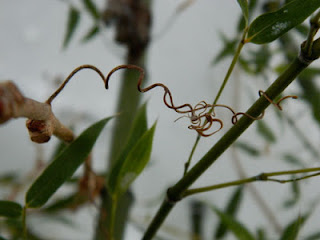
The tendrils grasping bamboo

The tendrils on the virginia creeper are never hairy. The tendrils are always small tight loops which they use to grasp fences, trees, or as in the pictures here, bamboo. All the vines featured here are very effective climbers.

Virginia creeper also has berries in the fall, but I have never seen them hold these berries into the winter season. The fruits are produced in clusters that have more of an umbrella-like arrangement than the standard downward hanging clusters that grapes prefer.

Identification?

Like with many plants, google image searches provide many wonder photos to compare against and learn from. Find one such google search here. Add other qualifiers to see more.

For information as well as images, please see here or here.


Grape
The large looping tendrils of the grape

Last but definitely not least, is the wild grape. The grape is the only one of the three vines featured here that is not poisonous - in fact, the fruit is edible and foragers can collect them for preserves and food. The leaves and young shoots are edible as well. Stuffed grape leaves - who doesn't love those!

The wild grape in our Northeastern forests can grow into such large woody vines that not only Tarzan but Tantor his elephant could successfully swing on them. The vines are also so plentiful in Eastern North America that the Vikings who discovered America, named the continent "Vinland" - "vine land." (The Vikings were first Europeans to discover America - sorry, Christopher Columbus!)

The bark and filaments in a grape vine
The grape is the visually most woody looking of the three vines. It has a rough bark when the vines get any sort of maturity on them. Larger, mature vines have almost a shaggy appearance to them with paper-like bark bits hanging from the vines. Even young vines demonstrate that papery quality if you break the vine - as in the picture to the right. Woody filaments are visible right under the surface of the bark and undoubtably give the grape vine some of its toughness and strength.

Last season's grapes
The grape also has rather knobby joints and "knuckles" on the vine - as you can see in the pictures here. But the large looping tendrils will not be confused with either of the two other vines featured here. See the picture at the top for a size comparison of of the tendril loops of the virginia creeper and grape. Side-by-side, the difference is incredibly obvious.

The grape often holds its last season's fruit clusters and maybe dried out bits of fruit on its vines. Albeit smaller, the wild grape fruit clusters look just like the cultivated grape clusters bought in a grocery store. They will look like a grape cluster to you.

Important - Before eating any wild grapes, be sure to know how to ID them from the poisonous look-a-like Canada Moonseed (Menispermum canadense). Always be smart and be safe.

Identification?

You have to love the images available via google - they are a boon to plant lovers and enthusiasts every where. Check out some wild grape images here and here. Use other qualifiers to the search for other image results.

Get more info and pictures of the wild grape from here and here.

Tuesday, December 4, 2012

Late Fall - Early Winter Veggies

Daikon Radish
(Photo by Chris 73 / Wikimedia Commons)
While the first hard frosts and freezes of fall this year were nearly two months ago, I still have vegetables going strong in the garden. I just picked some more daikon radishes. I think I will have to make some quick pickles with them - they are so good! Here is a basic recipe for takuan which is a Japanese-styled quick pickle made with daikon. I tend to adjust quick pickle recipes to my own taste, sometimes adding more or less of an ingredient and other times adding others.

Pickled Daikon Radish 
1/4 C. rice wine vinegar
1/2 C. sugar
1 Tbsp salt
1 medium daikon, cut into bite-sized slices
Bring first three ingredients to a boil to dissolve salt and sugar. Allow to cool slightly, and pour over sliced daikon. Store in refrigerator for up to 4 days. Make a day head for best flavor.

I've added minced fresh red hot chili pepper, black sesame seeds, other veggies, or whatever else suits me at the time. The first time making a new quick pickle recipe, I would suggest to make a small batch exactly per the recipe. After than, have fun. Adjust the ingredients and seasonings plus you can add or substitute other veggies. With white veggies like daikon and turnips, the red of the hot chili is a stunning color combination. And yes, this recipe is good with Japanese white turnips too. Be sure to add a small bit of the turnip greens for color and a bit of mustard bite. 

Note, I often like using mirin, a sweet cooking rice wine, instead of sugar for quick pickles. No boiling is needed to dissolve the sugar and it has a different character and flavor than white sugar.

Speaking of still growing in the garden....My garden also still has mustard, radishes, kale, broccoli, and some other scattered veggies still going strong after cold weather including snow. The snow peas gave up a few weeks back and so did the favas when we had a couple of days very bitter weather with 20 degree F nights. With a bit of planning and mid to late summer planting, you can extend out your fresh vegetable season to late fall - early winter. Something to consider in your planning for next year's veggie garden.