Showing posts with label Just Happened To See. Show all posts

Wednesday, September 30, 2020

Responsibilities

Monarch Butterfly on Goldenrod

 “The findings of contemporary astrophysics suggest that we might do well to settle ourselves imaginatively into an endlessly transforming universe without fixed beginning or end. Chemistry, microbiology, and behavioral sciences confirm a fundamental kinship extending from the earth itself through all living things, from the tiniest bacteria to the largest blue whale. The recent discovery of possible bacteria on rocks from Mars may reveal that such kinship extends throughout the solar system – and much further. Our deepening awareness of the impermanence of even the most solid and stable-seeming structures – mountains, seas, the atmosphere, the countless, wheeling galaxies – has become poignant. Human life, indeed, all life, can now be seen as more interconnected, and simultaneously more fragile, than past generations of Western thinkers could concede. In the ongoing effort to gain moral control over our own relentless defensive and economic drives – including learning to control our own masterworks of impermanence: our nuclear weapons – we must now struggle with spiritual responsibilities to the earth and all its future generations, nonhuman as well as human.”  

-- Rafe Martin, “The Hungry Tigress

Tuesday, August 25, 2020

Friends with Benefits

I have grown Elecampane, Inula helenium, for years but never realized until this summer that Elecampane had a special relationship with ants. While the buds were getting fat and preparing to bloom, they were guarded by a swarm of ants. "Ants???," you say. "Most definitely," says I. And while I could not find a specific reference to Elecampane having these special structures, the presence of the ants tells me it is there - extrafloral nectaries. Extrafloral nectaries are special nectar producing glands located outside of the flower and unlike the nectar produced in flowers, this nectar has nothing to do with pollination and reproduction. In fact, it is to entice bodyguards who help discourage herbivores.

Peonies are very common plants to see this mutually beneficial plant - ant relationship on. You do not to spray the ants off your peonies or Elecampane with water or any bug repellents because the plant has put out a place setting for its ant friends and will only benefit from their presence.

Elecampane - ant relationship


Monday, August 10, 2020

A Rare Find (Repost)

 This is a copy of a blog post I made on another, now defunct, blog in 2010. I am posting it here so as not to loose this wonderful info.

A couple of weeks ago while hiking at Letchworth State Park, I came across a rare find. Nestled between stands of spotted jewelweed (Impatiens capensis) and pale jewelweed (Impatiens pallida) I came across a jewelweed plant the likes of which I had not seen before. 

This plant looked like spotted jewelweed in the shape of the flowers and the leaves but it had white flowers with red spots. I've never in all my stomping about in wild places or perusing through various field guides trying to ID wild plants seen one like this. 

After some investigation, I believe it is one of two very uncommon variants of the spotted jewelweed: Impatiens capensis forma albiflora (white flowers with red spots) or Impatiens capensis forma Pease (white flowers with larger red spots/splotches). These variants are referenced here in a NYFA Newsletter  if you wish to read more.

It was very late in the day and the light was low so these pictures are not my best but hopefully you'll be able to see and enjoy this rare beauty as well!


Friday, November 20, 2015

Special and Unique Places: The Bog

There are few places that offer a more unique glimpse into the natural world than a bog. It is a pocket of conditions as well as flora and fauna that are completely different than the surrounding locale. I am fortunate to have visited a local bog on a few occasions which is not only a protected botanical preserve but it has also been designated as National Natural Landmark by the National Park Service. This place, The Zurich Bog, is located in Arcadia, New York. It is off the beaten trail to be sure, but the trip is worth it to see such a place of unique beauty. 

The Zurich Bog preserve encompasses hiking trails through a bog forest and a peat bog. There is a floating bog, a mat of vegetation over a pond, but access onto the floating bog is generally not permitted nor entirely safe.

The pictures below are only a few of the species seen there.

If you are a gardener please take note, such special places are threatened by the harvesting of the peat moss for the gardening industry. Even this protected location is threatened by the draining of water in order to harvest peat that goes on outside of the preserve. If these places are special to you as well, please choose soil mixes without peat in them. Read more about why to use no peat here.

Here are photos from the Zurich Bog Preserve. Click on any of the images to see a larger view.

Grass Pink Orchid (Calopogon pulchellus)


Tamarack (Larix laricina)


Northern Pitcher Plant (Sarracenia purpurea). Last image is the pitcher plant bloom.


White Fringed Orchid (Platanthera blephariglottis)


Spoonleaf Sundew (Drosera intermedia)


Goldthread (Coptis trifolia). Second photo also includes starflower (Trientalis borealis) and Canada mayflower (Maianthemum canadense).


Indian Pipe (Monotropa uniflora)


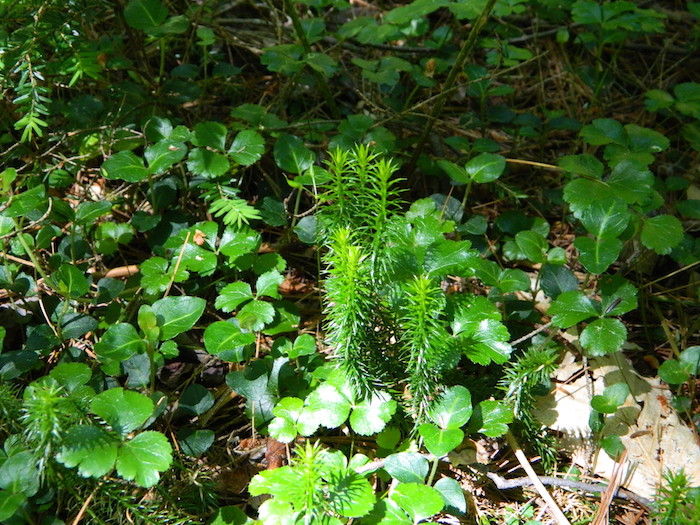
Club Moss (Lycopodium sp.). Second picture also includes goldthread (Coptis trifolia), partridge berry (Mitchella repens), and hemlock (Tsuga sp.).


Partridge Berry (Mitchella repens)


Starflower (Trientalis borealis)


Bog Rosemary (Andromeda polifolia)


Indian Cucumber (Medeola virginiana)


Labrador Tea (Ledum groenlandicum)


Links:

Thursday, August 13, 2015

Being Kind to Wild Neighbors

While out snapping some pictures of awesome clouds and sunset, I spotted a small bee already slowed by the cooling temperatures atop some Queen Anne's Lace (aka wild carrot). In these days when pollinators are so challenged for survival, letting some of your space be filled with flowering plants whether they be wild or cultivated varieties in gardens can only help them and in the long run, our planet. Refrain from using pesticides and herbicides to make your space an oasis for you and your wild neighbors.

Clouds
Spectacular Clouds

Sunset
Stunning Sunset

Bee on Queen Anne's Lace

Sunday, May 3, 2015

Early Spring Wildflowers

I love early spring wildflowers. But you must be vigilant in looking for them. If you blink with some (like the Twinleaf) you will miss them entirely. The twinleaf flowers last less than a day once they open. By nighttime, the petals have dropped. Here are a few from my woodland garden this spring.


Bloodroot
Bloodroot, Sanguinaria canadensis

Celandine Poppy
Celandine Poppy, Stylophorum diphyllum

Twinleaf
Twinleaf, Jeffersonia diphylla

Squirrel Corn
Squirrel Corn, Dicentra canadensis


Wednesday, June 4, 2014

Herb of the Week: Fringe Tree

Chionanthus virginicus
Fringe Tree, Old Man's Beard, White Fringe Tree

Chionanthus virginicus, Fringe tree
The Fringe Tree is thought by some to be one of the prettiest trees native to North America. In late spring this small tree is covered in white blossoms that have long dangling petals - its "fringe." Hardy to zone 5, the fringe tree's native range is the south-eastern US from NY to Florida and as far west as Texas. This pest-free tree will grow in full-sun or partial shade. The attractive leaves are ovate and yellow in the fall. The fringe tree is dioecious and the female plants produce purple drupes that resemble olives.

Over the years I have added many native plants to my gardens and landscaping. Even more so when they offer up both beauty and herbal use like the fringe tree. Six to eight years ago, I added a tiny little foot tall fringe tree seedling. It barely grew the first couple of years, often coming back so slowly in the spring I doubted it made the winter. While its growth has been slow in my cold and moist climate at the edge of its northern range, over the last couple of years it has finally put on some size and extra branches. This spring, after the coldest and hardest winter in decades, it gifted me with blossoms - the first since I planted it. (See picture above.) While I only have one cluster of flowers this year, I look forward to even more in future years!

The fringe tree -- like so many native plants -- were originally part of various Native people's medicine traditions which were later adopted by white herbalists and healers into their own herbal practices. Traditionally the fringe tree root bark has been used for liver and gall bladder disorders as well as wounds and rheumatism. For more on fringe tree's uses, see PFAF's entry on it or Peterson's Eastern/Central Medicinal Plants by Foster & Duke.

Learn more: 
http://en.wikipedia.org/wiki/Chionanthus_virginicus
http://www.pfaf.org/user/Plant.aspx?LatinName=Chionanthus+virginicus
http://www.wildflower.org/plants/result.php?id_plant=CHVI3

Looking to add this tree to your place? Try Forest Farm like I did.

Monday, April 28, 2014

Hot Stuff in the Greenhouse

Tree Philodendron
Be sure to check out my new article on Sonnenberg Garden's Strolling Through Sonnenberg blog.

It is about a plant world oddity that can be seen in bloom in the tropical plant collection in Sonnenberg's greenhouses. The strangeness is not so much in the fact that the plant is blooming, but in the characteristics that this plant, the tree philodendron (Philodendron bipinnatifidum), exhibits in its flowers.

Article:

Things are Heating Up in the Greenhouse

Wednesday, April 23, 2014

Herb of the Week: Blue Cohosh

I feel a day is wasted unless you have learned something new. It doesn't have to be a huge thing, just something new. After taking a recent hike to snap some spring wildflower pictures, I found out that new thing for the day. During the hike I saw some blue cohosh that had just sprouted up and was in flower (see picture below). It sported deep maroon flowers rather than the light green ones I was used too. I snapped some pictures and looked it up when I got back. This is when I learned that new thing.

I never realized there was more than one species of blue cohosh but it seems there are two. The maroon flowers were an indication of Northern Blue Cohosh (Caulophyllum giganteum) whereas the species I was more familiar with, Caulophyllum thalictroides, has more numerous, light green flowers.

Both plants overlay much of the same native range though C. thalictroides ranges a little farther south and west than its sister species. (See http://plants.usda.gov for range details.) As for how to tell which species it is other than by its flower? Well, C. giganteum blooms 10-15 days earlier and has larger and less pinnately divided leaves than C. thalictroides. Exact differences according to one source were:
The two species differ somewhat vegetatively. The ultimate leaf segments of  C. giganteum are 5–10 cm long and first leaf is 2- or, more commonly, 3-times pinnately divided. The ultimate leaf segments of C. thalictroides are 3–8 cm long and the first leaf is 3- or, more commonly, 4-times pinnately divided.
It was a good day for something new indeed!

Northern Blue Cohosh (Caulophyllum giganteum) in flower:


Northern Blue Cohosh (Caulophyllum giganteum) in flower


Blue Cohosh (Caulophyllum thalictroides) in flower:


Blue Cohosh (Caulophyllum thalictroides) in flower


Blue Cohosh foliage:


Blue Cohosh


Blue Cohosh fruits (green) early/midsummer:


Blue Cohosh fruits (green) early/midsummer


Blue Cohosh fruits (ripe) late summer:

Blue Cohosh fruits (ripe) late summer


Sunday, May 19, 2013

Spring Blooms - Eastern Redbud Tree

A favorite spring tree of mine is the native eastern redbud (Cercis canadensis). It is a spring blooming small tree that creates clouds of pink pea-like blooms.  The tree has a pleasing shape with a round or flat-topped crown which lends that shape to its cloud-like appearance of pink blooms.

I urge you to consider this beautiful, care-free tree in your landscaping plans. To learn more about the tree and its needs, see one of the following:

USDA Plant Guide or USDA Fact Sheet
Missouri Botanical Garden
Wild Flower Center

And for an always fascinating read, be sure to read the Plants for a Future entry on the redbud. Did you know that the flowers are edible? (I can attest to that since I've nibbled the blooms on hikes.) And did you know, that like so many of our native plants, there are herbal uses of the redbud? Read the PFAF entry for more!

To help showcase its appeal, here are some photos of the redbud in bloom:

Eastern Redbud, Cercis canadensis

Eastern Redbud, Cercis canadensis
Eastern Redbud, Cercis canadensis - blooms sprout from the trunk and branches


Eastern Redbud, Cercis canadensis, at Clifton Springs Hospital & Clinic Labyrinth
The eastern redbud (seen left) is a beautiful specimen tree for your landscape. 
It is seen here in the plantings around the Clifton Springs Hospital & Clinic's 
labyrinth gardens.  

Wednesday, May 8, 2013

Just Take a Breath

Dame's Rocket  (Hesperis matronalis)
Dame's Rocket
While you can certainly use tripods in your botanical photo taking, I find that lugging the extra equipment around and then setting it up destroys the ability to capture the essence of simple beauty and the sincerity of the moment that Mother Nature presented to us. All my nature photography is done without tripods and without "gardening" or otherwise setting up the shot. I take the shots as I find them for I believe that Mother Nature has the best eye for photo composition.

But since all the shots are taken by hand, it requires more - if you'll excuse the pun - focus put into each shot otherwise the result is a fuzzy mess. To do this, isn't hard and it starts with a simple breath. Take a breath and hold it for just the moment it takes for you to snap the picture. Amazingly in that held moment, you become so mindfully aware of your body and its every motion. It is a moment of mindful meditation where you become more aware of the tiniest of details - things that are often below your threshold of awareness. And in that attentiveness, you become still and you become very focused. So with breath held, body stilled, and your attention sharpened, you look to your subject and gently press the camera's button.

Give it a try. What moments of gentle beauty can you capture?


To inspire you, I captured the shot above and the couple below on a ten minute walk this morning...

Apple blossoms (I love the blush of pink)

Banded snail on dandelions

Wild grape - new foliage
New foliage and flower clusters on wild grape

Friday, April 19, 2013

Laughing in Flowers

If the Earth laughs in flowers, then spring must be quite the season of giggles and belly-laughs!

Some of my favorite flowers, such as violets, bloom this time of the year. Violets are one of my oldest and dearest favorites. I have very fond memories of them even as a young child. Some think of them as weeds - which is quite impossible to my way of thinking! Here are a couple of snaps of a few of my violets in bloom at the moment.

Viola odorata 'Rosina'

Viola odorata "Rosina"


A wild growing Viola sp. in my lawn (perhaps another Viola odorata)

Photo of a wild Viola sp.

Friday, March 29, 2013

Get Down Onto Your Belly

Photo: Wintergreen, Gaultheria procumbens
Wintergreen (Gaultheria procumbens)
The biggest tip I could give people for taking good plant pictures (other than buying a good camera to start with!) is get low, real low. Get down to the plant's level to take your photo. Sometimes in the case of tiny plants like wintergreen, it means you are at least kneeling or even on your belly to take the shot. The lovely part of getting down to take this picture was the soft and incredibly carpet-like nature of the moss bed in this beech grove (visible in this shot).

Monday, March 18, 2013

I Go to Nature to Be Soothed and Healed

Barnes Creek, Canandaigua, NY in Winter
Barnes Creek, Canandaigua, New York

"I go to nature to be soothed and healed, and to have my senses
put in order." 

John Burroughs, (American Essayist and Naturalist, 1837-1921)


If you are like me in that you retreat to Nature for solace and healing, you will want to read these articles: Find Therapeutic Healing in 'Forest Bathing' and Forest Bathing for more information about Shinrin-yoku or forest bathing which is a Japanese tradition of therapeutic walks in the forest. Now you have a name and some supporting science for what you already knew to be true!

Thursday, March 14, 2013

Signs of Spring

Turkey Vulture
Turkey Vulture (Cathartes aura)
(photo by Dori, Wikimedia Commons)
Unlike some, I find the return appearance of the American Robin (Turdus migratorius) a poor indicator of the coming spring season. Too many times I have seen these birds looking cold and miserable as a late winter snow storm pounds the area. No, I find a less beautiful bird a much better indicator and harbinger of the coming spring. The Turkey Vulture (Cathartes aura) doesn't make his return to my area until spring is very close - usually syncing their appearance with the emergence of pussy willow catkins and skunk cabbage flowers which are other seasonal signs I look for.

Over this past weekend I saw my first turkey vultures of the season plus my pussy willow tree is also getting large and fuzzy catkins. I'll have to go out hiking to look for other pussy willows (Salix spp.), skunk cabbage (Symplocarpus foetidus), and coltsfoot (Tussilago farfara) to get a better guess as to how close spring is.

Either way, I had better finish my garden planning for the upcoming season - it will be here soon!

Update: Shortly after publishing this article, I happened to spy another one of my key spring signs. A Northern Mockingbird (Mimus polyglottos) was visiting my place and looking to lay his claim again to my yard. These highly territorial and migratory birds are warm weather only visitors at my house. All summer long I get to hear their bird "Top 40" - as I call their repertoire of copied bird song. Many times the male mockingbirds have they fooled visitors to my house thinking I have resident bluebirds. No bluebirds here but their copied song by proxy!