Showing posts with label Hikes. Show all posts

Monday, August 10, 2020

A Rare Find (Repost)

 This is a copy of a blog post I made on another, now defunct, blog in 2010. I am posting it here so as not to loose this wonderful info.

A couple of weeks ago while hiking at Letchworth State Park, I came across a rare find. Nestled between stands of spotted jewelweed (Impatiens capensis) and pale jewelweed (Impatiens pallida) I came across a jewelweed plant the likes of which I had not seen before. 

This plant looked like spotted jewelweed in the shape of the flowers and the leaves but it had white flowers with red spots. I've never in all my stomping about in wild places or perusing through various field guides trying to ID wild plants seen one like this. 

After some investigation, I believe it is one of two very uncommon variants of the spotted jewelweed: Impatiens capensis forma albiflora (white flowers with red spots) or Impatiens capensis forma Pease (white flowers with larger red spots/splotches). These variants are referenced here in a NYFA Newsletter  if you wish to read more.

It was very late in the day and the light was low so these pictures are not my best but hopefully you'll be able to see and enjoy this rare beauty as well!


Tuesday, June 21, 2016

The Healing Power of the Green

The peace of the forest

Loss and grief, like a freight train has barreled into my life. Though well-meaning, tears fall at the simple phrase, "how are you doing?" How to fill those first few days? We found our way to places of meaning. Places he wanted to go when he got better. Places we went together as a family and enjoyed. Happier times, happier memories that we are able to touch upon.

One of those places he most wanted to go was a place of natural beauty - green woodland, streams, and the shore of a fresh water lake. He didn't get there but we did. We hiked a gorge along its stream bed to the waterfall. Some conversion but largely quiet and mediative.

Native woodland plants graced the woodland edges. Wild strawberry, wild ginger, jack-in-the-pulpit, blue cohosh, stone root, and more. Stress and loss melted away. The most peace I had found in days found me in that walk.

After the walk, the kids and I both found the beach. They swam and played in the sand. I found another area to sit beside the lake. To "sit by the lake" here was one of his top goals so I did it for him. A peaceful sleep stole in on me. When the kids were ready to go, they woke a very relaxed me.

Each day more reports of the physical and mental health benefits of a walk through the green are published and shared. But sometimes it is the spirit, which cannot be quantified in scientific studies, that most needs that time with the natural world for it can bring peace and solace to a broken heart, even if only for a time. And in my case, that healing green power was combined with a place that was meaningful to the person now gone, transforming it to a touchstone to shared and happier times.


Friday, November 20, 2015

Special and Unique Places: The Bog

There are few places that offer a more unique glimpse into the natural world than a bog. It is a pocket of conditions as well as flora and fauna that are completely different than the surrounding locale. I am fortunate to have visited a local bog on a few occasions which is not only a protected botanical preserve but it has also been designated as National Natural Landmark by the National Park Service. This place, The Zurich Bog, is located in Arcadia, New York. It is off the beaten trail to be sure, but the trip is worth it to see such a place of unique beauty. 

The Zurich Bog preserve encompasses hiking trails through a bog forest and a peat bog. There is a floating bog, a mat of vegetation over a pond, but access onto the floating bog is generally not permitted nor entirely safe.

The pictures below are only a few of the species seen there.

If you are a gardener please take note, such special places are threatened by the harvesting of the peat moss for the gardening industry. Even this protected location is threatened by the draining of water in order to harvest peat that goes on outside of the preserve. If these places are special to you as well, please choose soil mixes without peat in them. Read more about why to use no peat here.

Here are photos from the Zurich Bog Preserve. Click on any of the images to see a larger view.

Grass Pink Orchid (Calopogon pulchellus)


Tamarack (Larix laricina)


Northern Pitcher Plant (Sarracenia purpurea). Last image is the pitcher plant bloom.


White Fringed Orchid (Platanthera blephariglottis)


Spoonleaf Sundew (Drosera intermedia)


Goldthread (Coptis trifolia). Second photo also includes starflower (Trientalis borealis) and Canada mayflower (Maianthemum canadense).


Indian Pipe (Monotropa uniflora)


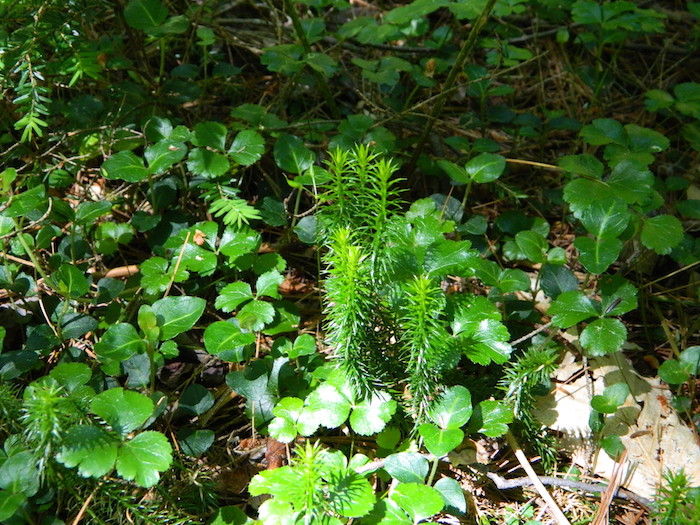
Club Moss (Lycopodium sp.). Second picture also includes goldthread (Coptis trifolia), partridge berry (Mitchella repens), and hemlock (Tsuga sp.).


Partridge Berry (Mitchella repens)


Starflower (Trientalis borealis)


Bog Rosemary (Andromeda polifolia)


Indian Cucumber (Medeola virginiana)


Labrador Tea (Ledum groenlandicum)


Links:

Sunday, May 19, 2013

Spring Blooms - Eastern Redbud Tree

A favorite spring tree of mine is the native eastern redbud (Cercis canadensis). It is a spring blooming small tree that creates clouds of pink pea-like blooms.  The tree has a pleasing shape with a round or flat-topped crown which lends that shape to its cloud-like appearance of pink blooms.

I urge you to consider this beautiful, care-free tree in your landscaping plans. To learn more about the tree and its needs, see one of the following:

USDA Plant Guide or USDA Fact Sheet
Missouri Botanical Garden
Wild Flower Center

And for an always fascinating read, be sure to read the Plants for a Future entry on the redbud. Did you know that the flowers are edible? (I can attest to that since I've nibbled the blooms on hikes.) And did you know, that like so many of our native plants, there are herbal uses of the redbud? Read the PFAF entry for more!

To help showcase its appeal, here are some photos of the redbud in bloom:

Eastern Redbud, Cercis canadensis

Eastern Redbud, Cercis canadensis
Eastern Redbud, Cercis canadensis - blooms sprout from the trunk and branches


Eastern Redbud, Cercis canadensis, at Clifton Springs Hospital & Clinic Labyrinth
The eastern redbud (seen left) is a beautiful specimen tree for your landscape. 
It is seen here in the plantings around the Clifton Springs Hospital & Clinic's 
labyrinth gardens.  

Monday, March 18, 2013

I Go to Nature to Be Soothed and Healed

Barnes Creek, Canandaigua, NY in Winter
Barnes Creek, Canandaigua, New York

"I go to nature to be soothed and healed, and to have my senses
put in order." 

John Burroughs, (American Essayist and Naturalist, 1837-1921)


If you are like me in that you retreat to Nature for solace and healing, you will want to read these articles: Find Therapeutic Healing in 'Forest Bathing' and Forest Bathing for more information about Shinrin-yoku or forest bathing which is a Japanese tradition of therapeutic walks in the forest. Now you have a name and some supporting science for what you already knew to be true!

Monday, February 25, 2013

Northeast Wildflowers and Wild Plants

As time allows, I will be creating and uploading videos featuring wildflowers and other plants of the woodlands of the Northeastern United States. These videos will feature identification tips, ethnobotanical information, and various bits of related trivia. I have created a playlist at YouTube for this series which you may find at YouTube or you may view it below. At the time of this writing, I have three videos available but visit often since there will be more!


Monday, December 31, 2012

Friend or Foe?

(click to see a larger image of any of the photos)
Just because winter has chased the leaves from the forest's trees and vines, doesn't mean that you can't still get poison ivy. The worst case of poison ivy I ever got was in the winter time when I was helping my dad cut and stack firewood. After that I learned to ID the dreaded PI in ALL seasons and all its many guises.

What makes it more complicated to those that don't know how to winter ID poison ivy is that we have three very common vines that grow in our area and may grow all together as the photo to the right indicates. The three vines are: poison ivy (Toxicodendron radicans), virginia creeper (Parthenocissus quinquefolia), and grape (Vitis spp.).

Poison Ivy


Poison Ivy climbing on a tree trunk
Poison ivy is the chameleon. It can appear as a vine, ground cover, and even rather bush-like plant. It is an attractive and robust plant all year long. If it didn't cause extreme contact dermatitis as it does, I'm sure it would be a much loved garden addition with hundreds of cultivars.

In winter it is the large bush-like and vine forms that we see most while out on the trails and the dried - yet still very irritating to the skin - vines on firewood. Yes, you can get the poison ivy rash from the vines on firewood too. Vines on firewood will look much like the picture to the right. Older vines will be thicker, woodier looking with a lot more of the hair-like tendrils along the length of the vine - more like the first picture above.

See the detail below for a close up of the hair-like tendrils. The detail also shows a shoot where leaves will sprout from come the spring. Slender buds can be seen on the tips of the vines. The picture farther below shows a vine with buds growing along an old fence.

Tendril detail
Like the grape and virginia creeper, poison ivy also has berries and the remnants can often be spied on the winter vines. These often still have a light color that hint at the white color the berries originally were. Both grape and virginia creeper have dark fruits. Poison ivy produces tiny fruits in greater numbers than either of the other two vines. (Click on any of the images for a larger view.)

Identification?

Wikipedia has a list of identification aids for this tricky plant. You can find it here.

There is also a whole site on poison ivy here with more info and images which you can find here.


Poison ivy vines and berries. Notice bud at end of vine.
Of course the image search at google will show you many images as well. If you add other qualifiers to the search like "vine," you will get other results that will show you many images of that specifically like so. Try other qualifiers like "buds" and "berries" for other images.

Got a photo of a plant you are questioning the ID of? Try GardenWeb's Name That Plant forum for identification help.


Virginia Creeper

Virginia creeper's small looping tendrils and knobbed joints 
Virginia Creeper is another common vine in the Northeastern US. Some people are sensitive to this plant as well and may also get contact dermatitis but that sensitivity is no where near as common. I personally pull this from the gardens (in which it can be quite a "thug") bare-handed with no ill-effects.

It too has its beauty - attractive leaves with 5 leaflets, scarlet fall color, and blue-black berries. This is also a "robust" and vital vine that is not easily removed from the garden. And a word of warning - never rototill the roots of this plant. Each piece will sprout a new plant. Yes, personal experience talking here!

The thin-barked and green fleshed vine
Unlike poison ivy, you rarely see any other form of this plant other than a vine. You may occasionally, however, see virginia creeper appearing as a ground cover in the full-shade of the forest understory. It is only waiting for some sunlight before vining off to the nearest tree. I have read that ginseng, too often harvested completely from areas, can hide amongst these young, low-growing creeper plants for it too has 5 leaflets. A thank you to the creeper for hiding the besieged 'sang!

Virginia creeper vines have a very thin bark with green flesh right under the surface. The vines have knobs or "knuckles" where the leaves would sprout come spring.
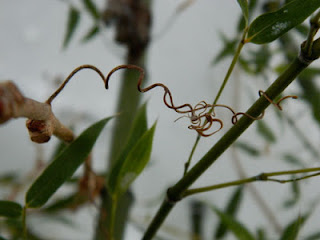
The tendrils grasping bamboo

The tendrils on the virginia creeper are never hairy. The tendrils are always small tight loops which they use to grasp fences, trees, or as in the pictures here, bamboo. All the vines featured here are very effective climbers.

Virginia creeper also has berries in the fall, but I have never seen them hold these berries into the winter season. The fruits are produced in clusters that have more of an umbrella-like arrangement than the standard downward hanging clusters that grapes prefer.

Identification?

Like with many plants, google image searches provide many wonder photos to compare against and learn from. Find one such google search here. Add other qualifiers to see more.

For information as well as images, please see here or here.


Grape
The large looping tendrils of the grape

Last but definitely not least, is the wild grape. The grape is the only one of the three vines featured here that is not poisonous - in fact, the fruit is edible and foragers can collect them for preserves and food. The leaves and young shoots are edible as well. Stuffed grape leaves - who doesn't love those!

The wild grape in our Northeastern forests can grow into such large woody vines that not only Tarzan but Tantor his elephant could successfully swing on them. The vines are also so plentiful in Eastern North America that the Vikings who discovered America, named the continent "Vinland" - "vine land." (The Vikings were first Europeans to discover America - sorry, Christopher Columbus!)

The bark and filaments in a grape vine
The grape is the visually most woody looking of the three vines. It has a rough bark when the vines get any sort of maturity on them. Larger, mature vines have almost a shaggy appearance to them with paper-like bark bits hanging from the vines. Even young vines demonstrate that papery quality if you break the vine - as in the picture to the right. Woody filaments are visible right under the surface of the bark and undoubtably give the grape vine some of its toughness and strength.

Last season's grapes
The grape also has rather knobby joints and "knuckles" on the vine - as you can see in the pictures here. But the large looping tendrils will not be confused with either of the two other vines featured here. See the picture at the top for a size comparison of of the tendril loops of the virginia creeper and grape. Side-by-side, the difference is incredibly obvious.

The grape often holds its last season's fruit clusters and maybe dried out bits of fruit on its vines. Albeit smaller, the wild grape fruit clusters look just like the cultivated grape clusters bought in a grocery store. They will look like a grape cluster to you.

Important - Before eating any wild grapes, be sure to know how to ID them from the poisonous look-a-like Canada Moonseed (Menispermum canadense). Always be smart and be safe.

Identification?

You have to love the images available via google - they are a boon to plant lovers and enthusiasts every where. Check out some wild grape images here and here. Use other qualifiers to the search for other image results.

Get more info and pictures of the wild grape from here and here.

Friday, August 10, 2012

Native Orchid: Summer Coralroot

Summer Coralroot (Corallorhiza maculata)

While on a recent hike I spotted an usual sight - a native orchid in bloom. I had never seen this plant before and had to ID it after the hike - good photos are always key to that! The plant was tiny and appeared to be possibly a parasitic plant since it had no leaves or green parts.

The plant I spotted was the blooming Summer Coralroot (Corallorhiza maculata). This orchid's native range is much of the US and Canada, including NY State, but this is the first time I have ever spotted it. According to Wikipedia, it "is a myco-heterotroph; it lacks chlorophyll and gets food by parasitizing the mycelium of fungi in the family Russulaceae." I guess first impressions were correct!

Orchids are a special sight and one in bloom even more so.  Other than this plant and the alien orchid Epipactis helleborine, I've only seen wild, native orchids blooming in one location, Zurich Bog. I've found lady slipper plants (no blooms!) in a couple of other locations but that is it. Our native orchids are special as are the places they grow for these plants usually have very specific needs.  Poaching these plants for your own garden - very illegal given the rules of the parks and preserves they usually grow in - is unwise. Few gardens are going to meet the growing needs these plants have and the plants will die. Take only photos and leave the plants be.

Because this was such an unusual plant, I referenced my ethnobotanical sources to see if the Native peoples here used these plants. According to Moerman in Native American Ethnobotany, the local Iroquois people used this plant for:
  • Basket Medicine - Infusion of pounded root used as a basket medicine
  • Hunting Medicine - Root placed in a half cup of water and used to wash guns and clothes as a hunting medicine
  • Love Medicine - Infusion of pounded roots used as a love medicine
  • Tuberculosis Remedy - Compound infusion of roots taken for tuberculosis
  • Veterinary Aid - Infusion of whole plant added to horse's grain for heaves
  • Witchcraft Medicine - Infusion of pounded roots used as an anti-witch medicine
Looks like the Iroquois found this plant to be special as well given the number of ceremonial "medicine" uses of the plant.

For more information on this plant, see the links below. I have also included other photos below as well.

For more information:

Orchids of NY State:
http://www.dec.ny.gov/docs/administration_pdf/orchidsofny.pdf

Plants For a Future:
http://www.pfaf.org/user/Plant.aspx?LatinName=Corallorhiza+maculata

Wikipedia:
http://en.wikipedia.org/wiki/Corallorhiza_maculata

USDA Plants:
http://plants.usda.gov/java/profile?symbol=coma25

Other Images:
Entire Plant
Plant with author's hand for scale

Monday, August 6, 2012

Sedges Have Edges

Rushes, cattail, and boneset at the water's edge


I must say that identification of grasses, sedges, and rushes is not something I excel at. In fact, I'm usually pretty bad at it but I can get the right grouping for the plant without any effort -- you have to love mnemonics! Here's what I know plus a couple of variations I've heard on it:

Sedges have edges, rushes are round, and grasses have joints.

Sedges have edges, rushes are round, and grasses are hollow right up from the ground.

Sedges have edges, rushes are round and grasses have knees that bend to the ground.
 Maybe this will help you get your plant into the right grouping as well!

Wednesday, August 1, 2012

Know Your Poisons

Poison Hemlock (along a local hiking trail)
In a conversation once with another herbalist about poisonous plants, we agreed that those were some of the first plants we learned in our wildcrafting and harvesting endeavors. Why learn the poisonous plants right away? You need that knowledge to avoid dangerous, potentially deadly mistakes.

You need to know what dangerous look-a-likes may exist (queen anne's lace or poison hemlock?). Also, how to avoid dangerous situations (don't plant deadly monkshood next to your edible chicory). You need to know that some plants have edible parts and toxic other parts. And still others need to be harvested at specific times or need special processing to make them usable and non-toxic.

Knowledge is power. Certainly so in this case. But even more than power, this knowledge teaches you to respect the power our green friends have. They can cure us or kill us with equal ease.

(If you like this sort of info, be sure to catch my daily herb posts at the Classical Formulas Facebook page.)

Wednesday, July 18, 2012

Native Medicinal Plants

Here's a couple of more pictures from my recent hike. They are all of more native medicinal plants. Enjoy!

False Solomon's Seal (Maianthemum racemosum)

The lack of rainfall has really taken its toll on all the flora. This plant was no exception and it is not the prettiest example I have ever seen of the plant. But there is a nice detail of the spotted berries. The berries will get redder as they ripen but the nearly metallic lime green with crimson mottling that they are now is spectacular. And yes, this is another one of the native medicinal plants. Please see the Plants For a Future entry on this plant for its medicinal qualities.

False Solomon's Seal (Maianthemum racemosum)


Red Elderberry (Sambucus racemosa)

The usual elderberry to spot in the woods and edges of farmers' fields is the common elderberry (Sambucus canadensis). But on this hike I managed to spot a red elderberry with fruit. The fruit are a stunning red. The fruit and flowers are edible while the plant parts are used medicinally. The stems of this elderberry are hollow and can be turned into whistle. See the PFAF entry on this plant for details on its uses.

Red Elderberry (Sambucus racemosa)
Pale Jewelweed (Impatiens pallida)

Growing in moister and shadier settings, the pale jewelweed is not seen as much as its more condition tolerant sister the spotted jewelweed (Impatiens capensis). Either species, jewelweed is a beautiful wildflower. And great amusement for young people when its seed pods are ripe. The seed pods "explode" seeds at a touch - hence the name "touch-me-not." For more on that, see another article I wrote on touch-me-nots and young people. It seems that jewelweeds are a common one to make it into my articles for I wrote another article on a rare color variation of I. capensis that I spotted on another hike. Anyways, this plant and its sister the spotted jewelweed are commonly used in herbal poison ivy remedies. But for the full list of uses, be sure to see this plant's PFAF entry.

Pale Jewelweed (Impatiens pallida)
  

Saturday, July 14, 2012

Stone Root (Collinsonia canadensis)


While hiking yesterday, I stumbled across a group of the plants below. It is Collinsonia canadensis or stone root. This plant has a plethora of common names including: Canada Horsebalm, Richweed, Hardhack, Heal-All, Horseweed, and Ox-Balm - common names like this speak of its rich history of herbal use.

This plant is a perennial native to eastern North America. It, like many indigenous plants, was used medicinally by the Native Americans to later be adopted into early American herbal traditions - its uses are referenced in both King's American Dispensatory by Felter and Lloyd as well as  Cook's Physiomedical Dispensatory by Cook.

According to Daniel Moerman in Native American Ethnobotany, both the Cherokee and Haudenosaunee (Iroquois) used this plant medicinally. The Seneca, one of the Haudenosaunee nations and in whose traditional homeland I live in, used it for a wide range of medical needs including as an analgesic, antidiarrheal, antirhheumatic, dermatological aid, heart medicine, and kidney aid. [Source: Native American Ethnobotany by D. Moerman]

I'll be sure look for this interesting and lemony scented medicine plant in my future hikes and travels. When I do find it, I think of the traditional healers that would have been happy to find this plant and the good such a plant would have done in their skilled hands.

Stone Root (Collinsonia canadensis)

Stone Root (Collinsonia canadensis)

Tuesday, May 8, 2012

May Flowers, Herbs, and Trees

May is always a time of abundant life and plants to me. It is the time when the forests become a verdant green and when wildflowers continue their spring show. It is also a busy time of gardening and planting for the coming season. To celebrate this greening of the world and the start of the new agricultural season, I take May 1st off of work. It is a 20-year old tradition. Often I spend the day in my gardens, but sometimes I take hikes or do other activities to celebrate May Day. 

In that spirit of celebrating the Earth and her greening cloak, it was my pleasure to attend not one but two plant hikes over this past weekend. The first of these hikes was led by Dr. Les Moore on Saturday May 5, 2012. It was held in Phelps, NY along the Ontario Pathways Trail System. This hike focused on identification as well as the medicinal properties of the wild plants found. This hike is also part of a series of classes Dr. Moore teaches on medical herbalism. If you are interested in learning more about these classes, please see the Classical Formulas website. I created the video at the bottom of this article from the photos I took on that hike.

The second hike was at Ganondagan and it was led by Tonia Loran-Galban and Peter Jemison on Sunday May 6, 2012. This hike was along the Earth is Our Mother trail and it focused on the medicinal as well as the ethnobotanical uses of the plants along the trail. It was a beautiful day for a hike - made even more special by the abundance of the migrating red admiral butterflies. You can see the slideshow from this walk on the Plant Hike slideshow webpage.

I hope you enjoy the slideshow and video. I wish for your May to be happy and abundantly green!