Showing posts with label Wildflower. Show all posts

Thursday, March 17, 2022

The Secret Sauce

Taking photographs of plants is a hobby decades in the making for me. Thousands of plant images every year.  And there is one thing that all the photos I love best have in common. "What is that secret sauce?" you say. In truth, it is nothing. Sure, there is a good composition, ample lighting, and a steady hand. But pictures I don't love can have that too. All the good ones have nothing from me in them. I was the conduit, but it is all about letting the plants speak for themselves. No fancy filters or crazy photoshop techniques can do as much as stepping back and letting the plant speak for itself. They all have their own beauty and stories to tell. 

Wintergreen
Wintergreen in a mossy bed in a beech grove

wild strawberry
Wild strawberry along a woodland trail


Monday, August 10, 2020

A Rare Find (Repost)

 This is a copy of a blog post I made on another, now defunct, blog in 2010. I am posting it here so as not to loose this wonderful info.

A couple of weeks ago while hiking at Letchworth State Park, I came across a rare find. Nestled between stands of spotted jewelweed (Impatiens capensis) and pale jewelweed (Impatiens pallida) I came across a jewelweed plant the likes of which I had not seen before. 

This plant looked like spotted jewelweed in the shape of the flowers and the leaves but it had white flowers with red spots. I've never in all my stomping about in wild places or perusing through various field guides trying to ID wild plants seen one like this. 

After some investigation, I believe it is one of two very uncommon variants of the spotted jewelweed: Impatiens capensis forma albiflora (white flowers with red spots) or Impatiens capensis forma Pease (white flowers with larger red spots/splotches). These variants are referenced here in a NYFA Newsletter  if you wish to read more.

It was very late in the day and the light was low so these pictures are not my best but hopefully you'll be able to see and enjoy this rare beauty as well!


Friday, November 20, 2015

Special and Unique Places: The Bog

There are few places that offer a more unique glimpse into the natural world than a bog. It is a pocket of conditions as well as flora and fauna that are completely different than the surrounding locale. I am fortunate to have visited a local bog on a few occasions which is not only a protected botanical preserve but it has also been designated as National Natural Landmark by the National Park Service. This place, The Zurich Bog, is located in Arcadia, New York. It is off the beaten trail to be sure, but the trip is worth it to see such a place of unique beauty. 

The Zurich Bog preserve encompasses hiking trails through a bog forest and a peat bog. There is a floating bog, a mat of vegetation over a pond, but access onto the floating bog is generally not permitted nor entirely safe.

The pictures below are only a few of the species seen there.

If you are a gardener please take note, such special places are threatened by the harvesting of the peat moss for the gardening industry. Even this protected location is threatened by the draining of water in order to harvest peat that goes on outside of the preserve. If these places are special to you as well, please choose soil mixes without peat in them. Read more about why to use no peat here.

Here are photos from the Zurich Bog Preserve. Click on any of the images to see a larger view.

Grass Pink Orchid (Calopogon pulchellus)


Tamarack (Larix laricina)


Northern Pitcher Plant (Sarracenia purpurea). Last image is the pitcher plant bloom.


White Fringed Orchid (Platanthera blephariglottis)


Spoonleaf Sundew (Drosera intermedia)


Goldthread (Coptis trifolia). Second photo also includes starflower (Trientalis borealis) and Canada mayflower (Maianthemum canadense).


Indian Pipe (Monotropa uniflora)


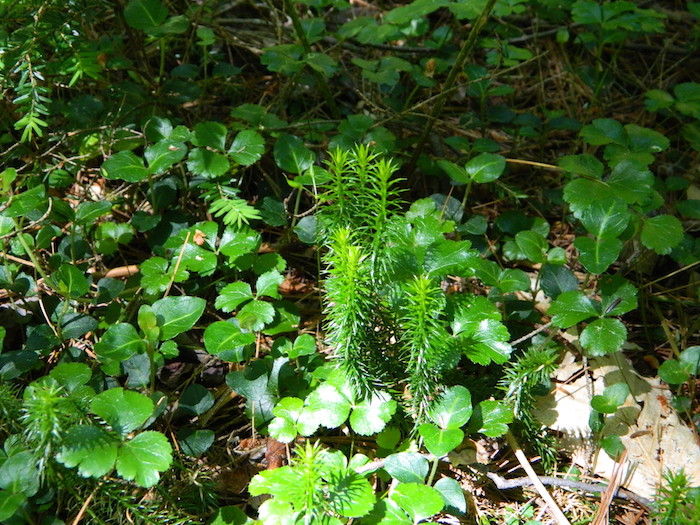
Club Moss (Lycopodium sp.). Second picture also includes goldthread (Coptis trifolia), partridge berry (Mitchella repens), and hemlock (Tsuga sp.).


Partridge Berry (Mitchella repens)


Starflower (Trientalis borealis)


Bog Rosemary (Andromeda polifolia)


Indian Cucumber (Medeola virginiana)


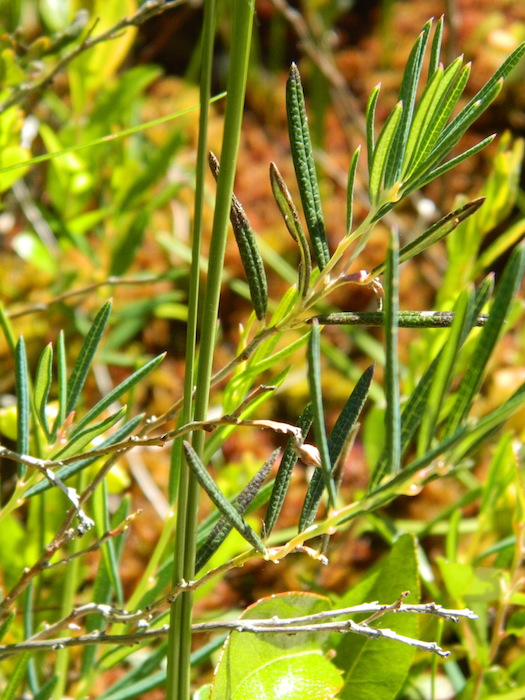
Labrador Tea (Ledum groenlandicum)


Links:

Thursday, August 13, 2015

Being Kind to Wild Neighbors

While out snapping some pictures of awesome clouds and sunset, I spotted a small bee already slowed by the cooling temperatures atop some Queen Anne's Lace (aka wild carrot). In these days when pollinators are so challenged for survival, letting some of your space be filled with flowering plants whether they be wild or cultivated varieties in gardens can only help them and in the long run, our planet. Refrain from using pesticides and herbicides to make your space an oasis for you and your wild neighbors.

Clouds
Spectacular Clouds

Sunset
Stunning Sunset

Bee on Queen Anne's Lace

Sunday, May 3, 2015

Early Spring Wildflowers

I love early spring wildflowers. But you must be vigilant in looking for them. If you blink with some (like the Twinleaf) you will miss them entirely. The twinleaf flowers last less than a day once they open. By nighttime, the petals have dropped. Here are a few from my woodland garden this spring.


Bloodroot
Bloodroot, Sanguinaria canadensis

Celandine Poppy
Celandine Poppy, Stylophorum diphyllum

Twinleaf
Twinleaf, Jeffersonia diphylla

Squirrel Corn
Squirrel Corn, Dicentra canadensis


Wednesday, April 23, 2014

Herb of the Week: Blue Cohosh

I feel a day is wasted unless you have learned something new. It doesn't have to be a huge thing, just something new. After taking a recent hike to snap some spring wildflower pictures, I found out that new thing for the day. During the hike I saw some blue cohosh that had just sprouted up and was in flower (see picture below). It sported deep maroon flowers rather than the light green ones I was used too. I snapped some pictures and looked it up when I got back. This is when I learned that new thing.

I never realized there was more than one species of blue cohosh but it seems there are two. The maroon flowers were an indication of Northern Blue Cohosh (Caulophyllum giganteum) whereas the species I was more familiar with, Caulophyllum thalictroides, has more numerous, light green flowers.

Both plants overlay much of the same native range though C. thalictroides ranges a little farther south and west than its sister species. (See http://plants.usda.gov for range details.) As for how to tell which species it is other than by its flower? Well, C. giganteum blooms 10-15 days earlier and has larger and less pinnately divided leaves than C. thalictroides. Exact differences according to one source were:
The two species differ somewhat vegetatively. The ultimate leaf segments of  C. giganteum are 5–10 cm long and first leaf is 2- or, more commonly, 3-times pinnately divided. The ultimate leaf segments of C. thalictroides are 3–8 cm long and the first leaf is 3- or, more commonly, 4-times pinnately divided.
It was a good day for something new indeed!

Northern Blue Cohosh (Caulophyllum giganteum) in flower:


Northern Blue Cohosh (Caulophyllum giganteum) in flower


Blue Cohosh (Caulophyllum thalictroides) in flower:


Blue Cohosh (Caulophyllum thalictroides) in flower


Blue Cohosh foliage:


Blue Cohosh


Blue Cohosh fruits (green) early/midsummer:


Blue Cohosh fruits (green) early/midsummer


Blue Cohosh fruits (ripe) late summer:

Blue Cohosh fruits (ripe) late summer


Monday, April 14, 2014

Has Spring Sprung Yet?

Bloodroot is one of my spring favorites but I haven't spied yet, but my pussy willow, coltsfoot, and crocus are blooming. I guess I will have to keep my eyes open!

Bloodroot, Sanguinaria canadensis