Showing posts with label Heirloom. Show all posts

Saturday, February 15, 2014

Do You Know the Quince?

Quince trees used to be common place. They are easy to grow and produce wonderful pink blossoms that turn into delicious yellow fruit. Oh yes, they are delicious but they require cooking before eating. Here's an article with some quince recipe links to get you started. And the fruit is also wonderfully high in natural pectin making it a perfect addition to any homemade preserves.

But to get you appreciating the beauty of this tree, here are some pictures of the blooms and its fruit. If looking for this variety, it is a Russian variety named, "Aromatnaya."

Buds just opening - Notice the large green sepals? They make the blooms look very rose-like.

Quince flower buds
Quince flower buds

Fully open blooms - The picture doesn't do the blooms justice. They are more pink and rose-like in appearance. The leaves have a silver fuzz to them. 

Quince blossoms
Quince blossoms

Immature fruit - The young fruit still bear the green sepals that were so prominent on the blooms. The fruit already has its distinctive yellow color. The fuzz on the fruit stays until it is manually rubbed off the mature fruits.  

Immature quince fruit
Mature fruit - Late in the season, October here in Western NY, the fruit are ready for harvest. The fruits of this variety are larger than most apples. 

Mature quince fruit
Mature quince fruit


Thursday, January 31, 2013

The Beauty of Seeds

Left: Tuscarora Bread Bean;  Top: Romano Pole;  Right: Seneca Speckled Egg 
Yesterday the first of my many seed orders arrived. Each year I try new varieties and wonder which will be new favorites to earn a permanent spot in my vegetable garden.

While the seeds of one variety of tomato may look exactly like another variety of tomato, the same cannot be said of beans. I always open up the bean seed packages to see what shape, color, and possibly patterning the seeds have. The seeds I received yesterday had two varieties new to my gardens this year: "Seneca Speckled Egg" and "Tuscarora Bread Bean" as well as a favorite from a previous year, "Romano Pole." The beauty of these seeds did not disappoint!

I'm especially excited to try the Tuscarora Bread Bean which is an heirloom variety that was originally passed on from a Tuscarora elder - the Tuscarora are one of the Six Nations of the Haudenosaunee (aka Iroquois). You can read more about the history of this bean on the beans product page at the Sample Seed Shop. This bean variety is used in the making of a traditional Native cornbread that has beans in it. The addition of beans makes this a heartier, more nutrition ladened cornbread. Interested in trying bean bread? You can find a recipe for bean bread on the Cherokee Nation website.

Looking for these seeds? Visit the The Sample Seed Shop.

Tuesday, January 22, 2013

Companion Planting with Pole Beans

Pole beans and borage
I must freely admit to being a bit of a "wild gardener." It is my term for gardeners who are the exact opposite of the gardeners who have their tidy, well-mulched gardens carefully planned, each plant with its defined and labeled space, and everything is rather prim-and-proper. "Wild gardeners" have a looser and more organic-style style to the gardens. We work with the natural tendencies of the plants to create gardens that take on a more natural and full look. Volunteer plants, those that self-seed themselves, are often seen as a bonus rather than something to be eradicated. Ok, I think I'm a very wild gardener.

Honeybee on a borage flower
This last spring and summer I had a slow start to planting the second half of my vegetable garden. By the time I got to planting the pole beans in one area, self-sown borage had sprouted. Borage (Borago officinalis) is probably one of the best self-seeders in my gardens outside of feverfew. Borage is potherb and medicinal plant - see more about its history and uses here. Even so, I really don't use borage outside of flowers for the salad bowl. But I do like to have borage in my vegetable garden because it is a terrific bee magnet. And once it starts blooming, it doesn't stop until the frosts kill it. The blooms are pretty and they bring pollinators to my garden in droves. So in a moment of "why not?" I left the young borage plants in place and planted my beans around them.

It wasn't long before the beans began their skyward climb up the poles I had put in place for them. The borage on the other hand, began its sprawl over the ground. Yes, borage is not a neat and tidy plant that respects the space in which you put it - it sprawls and it self-seeds. But I found it a wonderful underplanting for the pole beans. The borage smothered out the weeds plus provided a living mulch to keep the ground shaded and cool around the base of the beans. Best of all the borage plants attracted the bees that the beans so needed for pollination. It was a lucky happenstance that worked out very well.

In planning out your gardens this year, you may wish to try underplanting your pole beans with borage.  I'm going to do it this year -- but this year by choice!

Tuesday, January 15, 2013

Mid-Winter Sights

Even though it is in the middle of winter, some plants still provide beauty and edibles. Last week, prior to unseasonably warm temperatures and a thaw, I took some pictures of a few of the evergreen or "still going strong" plants peaking through the snow.

The picture of the sunrise on January 8th (to the right) was too beautiful not to share as well. It is a rare day here in winter when the sky is clear enough to see a sunrise let alone one so spectacularly colored. Enjoy.


Kale

If I recall correctly, this kale variety is "Fizz." The one you can barely see behind it is "Nero di Toscana." I have quite a number of different kale varieties in the garden still green and still very tasty. This is always a great plant to add to your veggie garden but especially if you end up getting a late start to things. Kale will happily grow into the fall and winter extending out your fresh harvest season.


Bloody Dock

While this plant is a little hidden by some grass - it did plant itself here after all, the beautiful red veining for which this dock was named, is visible. While you can add young leaves of this dock to the salad bowl, I like it better for it ornamental qualities since I don't find the flavor anything special.


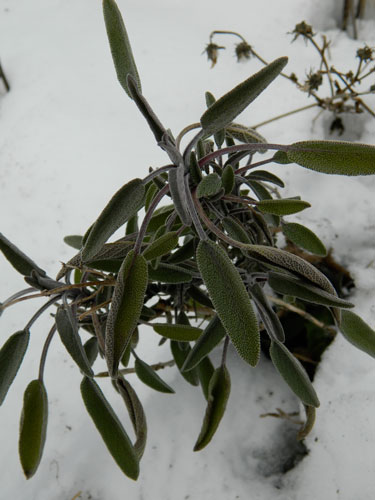
Sage

Sage (Salvia officinalis) is one my favorite herbs and garden plants. As a garden plant, what is not to like? It has striking grey-green foliage and blue-violet flowers and is a well-mannered and evergreen plant. In the winter my sage takes on purple colors - hints of that can be seen even in this picture. Some years, depending upon the severity of winter, they get even more purple. Even though the sage hails from the sunny Mediterranean, it survives Western NY State winters quite nicely.


Mustard

Like kale, I have a variety of mustards, radishes, green onions, and other cold tolerant plants still available in the garden. This is one of the many mustards still green in the garden. I can't seem to recall this variety's name at the moment but if I do recall correctly, it was from Kitazawa Seed Company. Kitazawa is a great source for Asian vegetable seeds of all sorts. 


Broccoli

This strikingly colored broccoli came along very late in the season. I got the seed in just as our summer-long drought began and so these plants got a slow start - my fault, not the seeds'. Even so, as our rains finally returned in the fall some of the plants that were in a "holding pattern" all summer finally began to grow. This variety is called "Purple Peacock" and I got the seed from Horizon Herbs. I've always been very happy with seeds I've gotten from Horizon Herbs - they are plant people who truly love their plants and the seeds always have shown that. 


Thursday, September 13, 2012

Seed and Plant Sources

One of the questions often asked of me is, "where do you get your plants and seeds?" My answer is always many places! Hopefully this article will share a little of my years of experience and favorite vendors with you.

Local

I shop locally whenever I can - and I'm not talking about your "Big-Box" stores like Lowes and Walmart. I urge everyone to visit your locally owned and operated nurseries. They are people who know and love plants and will be willing to work with you. They will help you make the best choices plus your dollars will be going back into your community.

Ok, yes. The Big-Box places have great prices on flats of summer annuals like petunias and marigolds. Get those there if you that is your thing, but shop at your locally-owned nurseries for everything else.

Vegetables & Food Crops

I have a lot of favorites here. Not every place carries all the varieties I want so I end up placing seed orders to a dozen or more vendors each year. Many of these vendors also carry herb and flower seeds as well. Some seed vendors also carry vegetable transplants if seed-starting isn't an art you've mastered.

Abundant Life Seeds - Organic and biodynamic vegetable seeds
Baker Creek Heirloom Seeds - One of my favorite heirloom seed sources.
Comstock Seeds - A 200 year old tradition of selling seeds
Johnny's Selected Seeds - A wide range of vegetable and herb seed. No genetically modified seed.
Miller Nurseries - A local company that specializes in fruit tree, shrubs, and plants. Get a variety of plants and varieties. Great edible landscaping source.
Pinetree Garden Seeds - A favorite place to get not only a wide range of vegetable varieties but a place to get small amounts of seed for a small price which is a wonderful way to test out a variety
Raintree Nursery - All manner of fruit-bearing plants and trees are available here. Great edible landscaping source.
Seed Savers - Heirloom vegetable seeds.
Seeds of Change - Organic vegetable, flower, and herb seed.
Territorial Seed Company - A wide range of heirloom, open pollinated, and hybrid vegetable varieties. No genetically modified or treated seed.
Totally Tomato - Can't find a particular tomato or pepper variety elsewhere? Find it here.
Terroir Seeds - Heirloom and open-pollinated seeds.
Kitazawa Seed Company - Specialty Asian vegetable seed source.

Medicinal & Native Plants

Other than the food plants I've planted in the vegetable garden and the edible landscaping I've done, this is where I spend the most gardening energy. Given the number of medicinal native plants, I rolled both this two categories together, but the sources are easy to pick which is which.

Horizon Herbs - Medicinal plants and seeds of many herbal traditions
Nichols Garden Nusery - A nice selection of culinary herb and vegetable seed
Richters - A wonderful source for medicinal plants and seeds of all sorts from nearby Toronto
Forest Farm - While shipping from the westcoast is costly, this is a wonderful place to find many hard to find plants, trees, and shrubs.
Musser Forests - A nice place to get many native trees and shrubs in small amounts or in quantity. Located in nearby Pennsylvania.
Prairie Moon Nursery - One of the best native plant and seed sources around.
Amanda's Garden  - A local nursery specializing in native perennial plants
White Oak Nursery - A local nursery specializing in native trees and shrubs
Ion Exchange - A great source for native plant seedlings

Flowers

I don't do much ornamental gardening these days but I do always slip some flowers into the vegetable beds to attract pollinators.

Select Seeds - Get antique flower seeds from this company including some of my favorite poppy varieties

Monday, June 11, 2012

Maize "Pearl" Earrings

Earring #1
We've all seen beautiful examples of jewelry made with seeds from plants that can only grow in tropical rain forest locations. We too can grow beautiful seeds to use in jewelry. The eldest of the Three Sisters, maize, is a beautiful example. It comes in a rainbow of jewel-like colors that just ask to be used as beads.

This project features earrings made using maize kernel beads. Three different styles with different materials are presented to suggest the variety of styles you might try.
               
All maize used in this the examples shown were grown in my garden. Earring #1 features the blue-grey kernels of "Hopi Blue Dent" and earrings #2 and #3 feature two different colored kernels (pearl white and burgundy) of the multi-hued "Painted Mountain."
              
Earring #1 (Silver & Turquoise)
  • 2 dried corn kernels
  • 2 size #11 crystal seed beads
  • 2 sterling silver earwires (22 gauge, fishhook w/ ball & coil)
  • 2 sterling silver 2-inch, 26 gauge headpins
  • 2 turquoise rondelles, 6x3mm


 Earring #2 (Chevron & Gold)
  • 2 dried corn kernels
  • 2 size #11 crystal seed beads
  • 2 chevron beads approx. 10x5mm
  • 2 gold-filled french hook earwires
  • 2 gold-filled 1.5-inch, 22 gauge headpins


Earring #3 (Silver & Garnet)
  • 2 dried corn kernels
  • 2 size #11 crystal seed beads
  • 2 sterling silver earwires (22 gauge, fishhook w/ ball & coil)
  • 2 sterling silver 2-inch, 26 gauge headpins
  • 4 garnet beads, 3mm
See vendor resources below for sources on where to get all the materials used.

Tools Needed
  • Jewelry pliers like round-nose pliers. Needle nose pliers will work.
  • Flush cut pliers or another tool capable of clipping fine wire
  • Hand awl or a hand drill/Dremel tool with a very fine drill bit
  • Small vise. If you do not one, a hinged clothespin will work to hold the kernels for drilling.
  • X-acto knife

Instructions
  1. Select only completely dried, well-formed corn kernels. The flat-sided and hard dent or flint corns generally work best. Trim any rough spots off the end of the kernel - do not cut into the kernel.
  2. Use a small vise or clothespin to hold each kernel so it can be drilled long ways. Drill the hole. If you use a hand awl, the hole will have a larger bore and you will need to put it through the middle of the flat side of the kernel. Adjust the complementing bead sizes as needed.
  3. Carefully trim or smooth any rough spots from drilling. 
  4. String beads and corn kernel onto headpin. Bead order: Earring #1 - seed bead, kernel, turquoise rondelle;  Earring #2 - seed bead, kernel, chevron bead;  Earring #3 - garnet bead, kernel, garnet bead
  5. For small gauge wire (i.e. 26 gauge), put headpin through the loop on the fishhook earwire. Use pliers to bend and loop the wire with the top of the loop being 3-5mm above the top bead. Use pliers to pull the free end of the wire around the headpin shaft, leaving a loop at the top to work down to the top bead coiling the wire 3-4 times. Trim excess. Use pliers to pinch the trimmed end flush with the rest of the coil.
  6. For the heavier gauge wire (i.e. 22 gauge), use the pliers to bend the wire at the top bead 45 degrees to the left. Use the tip of the pliers to grip wire at the top bead. Use your fingers or other pliers to bend the wire to the right, curling it around the plier nose until it crosses the headpin shaft. Trim the excess wire beyond where it crosses the shaft. Adjust loop shape as needed. Loop onto fishhook earwire.

If you are new to wire bending for jewelry, try out your wire bending skills with a similar gauge inexpensive brass or copper wire first. It is costly to learn on precious metals! I hope you enjoy this project!

Vendor Resources

Earrings #1:

Seed bead, Delica, glass, transparent rainbow crystal, #11
Earwire, sterling silver, 18mm flat fishhook with ball and coil with open loop, 22 gauge
Headpin, sterling silver, 2-inches long, 26 gauge
Bead, turquoise (D/S), 6x3mm rondelle

Earrings #2:
Seed bead, Delica, glass, transparent rainbow crystal, #11
Bead, chevron glass, multicolored, 4x2mm-12x8mm mixed shapes
Earwire, 14Kt gold-filled, 13mm fishhook with open loop, 21 gauge
Headpin, gold-filled, 1-1/2 inches long, 22 gauge

Earring #3
Earwire, sterling silver, 18mm flat fishhook with ball and coil with open loop, 22 gauge
Headpin, sterling silver, 2-inches long, 26 gauge
Bead, garnet, 3mm round

Ears of various colors of maize can be purchased at farmers' markets in late summer through late fall. But even better, grow some maize yourself. If you don't know where to get such seed, check the the vendors listed in the 'Vegetable/Food Crop' section of a gardening article I wrote. The vegetable seed vendors listed all sell heirloom/open-pollinated varieties of maize. Try growing some in your own garden for food or for crafts. As a bonus, some of the colored maize even has colored corn husks which lend themselves beautifully to corn husk crafts.