Showing posts with label Identification. Show all posts

Monday, August 10, 2020

A Rare Find (Repost)

 This is a copy of a blog post I made on another, now defunct, blog in 2010. I am posting it here so as not to loose this wonderful info.

A couple of weeks ago while hiking at Letchworth State Park, I came across a rare find. Nestled between stands of spotted jewelweed (Impatiens capensis) and pale jewelweed (Impatiens pallida) I came across a jewelweed plant the likes of which I had not seen before. 

This plant looked like spotted jewelweed in the shape of the flowers and the leaves but it had white flowers with red spots. I've never in all my stomping about in wild places or perusing through various field guides trying to ID wild plants seen one like this. 

After some investigation, I believe it is one of two very uncommon variants of the spotted jewelweed: Impatiens capensis forma albiflora (white flowers with red spots) or Impatiens capensis forma Pease (white flowers with larger red spots/splotches). These variants are referenced here in a NYFA Newsletter  if you wish to read more.

It was very late in the day and the light was low so these pictures are not my best but hopefully you'll be able to see and enjoy this rare beauty as well!


Wednesday, April 23, 2014

Herb of the Week: Blue Cohosh

I feel a day is wasted unless you have learned something new. It doesn't have to be a huge thing, just something new. After taking a recent hike to snap some spring wildflower pictures, I found out that new thing for the day. During the hike I saw some blue cohosh that had just sprouted up and was in flower (see picture below). It sported deep maroon flowers rather than the light green ones I was used too. I snapped some pictures and looked it up when I got back. This is when I learned that new thing.

I never realized there was more than one species of blue cohosh but it seems there are two. The maroon flowers were an indication of Northern Blue Cohosh (Caulophyllum giganteum) whereas the species I was more familiar with, Caulophyllum thalictroides, has more numerous, light green flowers.

Both plants overlay much of the same native range though C. thalictroides ranges a little farther south and west than its sister species. (See http://plants.usda.gov for range details.) As for how to tell which species it is other than by its flower? Well, C. giganteum blooms 10-15 days earlier and has larger and less pinnately divided leaves than C. thalictroides. Exact differences according to one source were:
The two species differ somewhat vegetatively. The ultimate leaf segments of  C. giganteum are 5–10 cm long and first leaf is 2- or, more commonly, 3-times pinnately divided. The ultimate leaf segments of C. thalictroides are 3–8 cm long and the first leaf is 3- or, more commonly, 4-times pinnately divided.
It was a good day for something new indeed!

Northern Blue Cohosh (Caulophyllum giganteum) in flower:


Northern Blue Cohosh (Caulophyllum giganteum) in flower


Blue Cohosh (Caulophyllum thalictroides) in flower:


Blue Cohosh (Caulophyllum thalictroides) in flower


Blue Cohosh foliage:


Blue Cohosh


Blue Cohosh fruits (green) early/midsummer:


Blue Cohosh fruits (green) early/midsummer


Blue Cohosh fruits (ripe) late summer:

Blue Cohosh fruits (ripe) late summer


Friday, May 24, 2013

Know Your Herbs?

Today's Know Your Herbs is a bit different. Instead of giving you one herb to identify, I'm giving you two. More than that, I'm giving you two that look very similar when coming up in the spring. (To get a closer look at the details of these plants, be sure to click on the images for the full sized image.) I specifically took the photos where both plants were similar in size and didn't have last year's stalks in view giving you other clues as to the identification.

These plants are both medicinal herbs native to the North Eastern United States. The shoots of one of these herbs can be eaten if prepared correctly. The other is toxic and no amount of cooking will change that. This is a wonderful example of why you must be able to correctly identify not only a plant but any possible look-a-likes before ever harvesting a single leaf.

Think you know what these are? Check your answer here.


Herb #1


Herb #2

Saturday, April 20, 2013

The Teaching Plant

Photo of Bittersweet Nightshade (Solanum dulcamara) plant.
Bittersweet Nightshade (Solanum dulcamara)
A reoccurring theme in the plant and garden forums I regularly frequent is parents that suddenly become concerned about the toxic plants in their yards and gardens. If you are one of them, I do applaud your concern, but I am sorry to say that there are many toxic plants that share the world with you. There may be ones in your yard, your gardens, the wild spaces around you, the parks you visit and more. And those plants were also in the lawns and gardens of your parents and you have grown to a healthy adulthood in spite of them! Just breathe. Relax. And read on.  

So what is a parent to do? When my own children were tiny toddlers, I did not turn them loose outside unsupervised. I stayed with them, played with them, and taught them. Not only did I protect them from the dangers beyond just poisonous plants that could present themselves to such tiny ones, I developed a much closer bond with my children. What parent wouldn't want that?

As they grew older, more teaching crept in. One of the very first outdoor lessons was plant safety. At the time, bittersweet nightshade grew everywhere at our place. Rather than go crazy trying to obliterate every trace of this toxic plant, as some parents in the forums I read would do, I took an alternate approach. I showed my children the plant with its brilliant red and rather appetizing looking berries. I explained that not all wild plants and berries were edible. In fact, some could make you sick and some could kill you. Their eyes grew big as that thought settled into their brains. The thought scared them - as well it should. I must say, I am not prone to exaggerating or "candy-coating" anything - my children learned that young. If I said it, I meant it and they believed it. They still do. 

So, what did I do next? I taught them how to identify this plant by its distinctive leaves, clusters of fruit, and purple blooms with yellow stamens. They could identify the plant at our home as well as at the parks and hiking trails we visited - places where I certainly could not obliterate every toxic plant that existed! I gave them power over this toxic plant. Further more, I also taught my children to never taste any unknown plant or fruits. They were to treat those plants and fruits as poisonous for they very well might be -- just like that nightshade they learned so well. They were only to eat wild plants and fruits if an adult they trusted (I can't stress how key this is) told them the plant or fruit was safe.
Bittersweet Nightshade (Solanum dulcamara) berries
Bittersweet berries

In time and with age, they joined me in picking wild berries, wild herbs, and food from our gardens and u-pick farms. They learned how to identify those plants, when it was ripe, and what parts are usable. When I was absolutely sure they could ID those with no error, they began to pick their own without my direct supervision. My youngest loves picking wild blackcap raspberries, strawberries, and mulberries. Summer is his time for he is a huge berry lover. These skills will stay with them the rest of their lives and I am sure will pass to the next generation.

So my advice? Shield and protect closely when children are too young to accept safety lessons by staying with them outdoors. As they get older, teach them how to be safe rather than trying to "bubble wrap" their world. The lessons will serve them the rest of their life in your yard and way beyond it. That said, I strongly advise you do some research into the ornamental plants you want to add to your gardens. You may wish to avoid highly toxic plants like castor beans and monkshood until your children are much older.  Or avoid them completely if poisonous plants give you pause.

Enjoy your gardens, enjoy your children, and enjoy the living world we are part of!


Be sure to learn more about bittersweet nightshade at the Poison Garden website: http://www.thepoisongarden.co.uk/atoz/solanum_dulcamara.htm

Monday, February 25, 2013

Northeast Wildflowers and Wild Plants

As time allows, I will be creating and uploading videos featuring wildflowers and other plants of the woodlands of the Northeastern United States. These videos will feature identification tips, ethnobotanical information, and various bits of related trivia. I have created a playlist at YouTube for this series which you may find at YouTube or you may view it below. At the time of this writing, I have three videos available but visit often since there will be more!


Monday, December 31, 2012

Friend or Foe?

(click to see a larger image of any of the photos)
Just because winter has chased the leaves from the forest's trees and vines, doesn't mean that you can't still get poison ivy. The worst case of poison ivy I ever got was in the winter time when I was helping my dad cut and stack firewood. After that I learned to ID the dreaded PI in ALL seasons and all its many guises.

What makes it more complicated to those that don't know how to winter ID poison ivy is that we have three very common vines that grow in our area and may grow all together as the photo to the right indicates. The three vines are: poison ivy (Toxicodendron radicans), virginia creeper (Parthenocissus quinquefolia), and grape (Vitis spp.).

Poison Ivy


Poison Ivy climbing on a tree trunk
Poison ivy is the chameleon. It can appear as a vine, ground cover, and even rather bush-like plant. It is an attractive and robust plant all year long. If it didn't cause extreme contact dermatitis as it does, I'm sure it would be a much loved garden addition with hundreds of cultivars.

In winter it is the large bush-like and vine forms that we see most while out on the trails and the dried - yet still very irritating to the skin - vines on firewood. Yes, you can get the poison ivy rash from the vines on firewood too. Vines on firewood will look much like the picture to the right. Older vines will be thicker, woodier looking with a lot more of the hair-like tendrils along the length of the vine - more like the first picture above.

See the detail below for a close up of the hair-like tendrils. The detail also shows a shoot where leaves will sprout from come the spring. Slender buds can be seen on the tips of the vines. The picture farther below shows a vine with buds growing along an old fence.

Tendril detail
Like the grape and virginia creeper, poison ivy also has berries and the remnants can often be spied on the winter vines. These often still have a light color that hint at the white color the berries originally were. Both grape and virginia creeper have dark fruits. Poison ivy produces tiny fruits in greater numbers than either of the other two vines. (Click on any of the images for a larger view.)

Identification?

Wikipedia has a list of identification aids for this tricky plant. You can find it here.

There is also a whole site on poison ivy here with more info and images which you can find here.


Poison ivy vines and berries. Notice bud at end of vine.
Of course the image search at google will show you many images as well. If you add other qualifiers to the search like "vine," you will get other results that will show you many images of that specifically like so. Try other qualifiers like "buds" and "berries" for other images.

Got a photo of a plant you are questioning the ID of? Try GardenWeb's Name That Plant forum for identification help.


Virginia Creeper

Virginia creeper's small looping tendrils and knobbed joints 
Virginia Creeper is another common vine in the Northeastern US. Some people are sensitive to this plant as well and may also get contact dermatitis but that sensitivity is no where near as common. I personally pull this from the gardens (in which it can be quite a "thug") bare-handed with no ill-effects.

It too has its beauty - attractive leaves with 5 leaflets, scarlet fall color, and blue-black berries. This is also a "robust" and vital vine that is not easily removed from the garden. And a word of warning - never rototill the roots of this plant. Each piece will sprout a new plant. Yes, personal experience talking here!

The thin-barked and green fleshed vine
Unlike poison ivy, you rarely see any other form of this plant other than a vine. You may occasionally, however, see virginia creeper appearing as a ground cover in the full-shade of the forest understory. It is only waiting for some sunlight before vining off to the nearest tree. I have read that ginseng, too often harvested completely from areas, can hide amongst these young, low-growing creeper plants for it too has 5 leaflets. A thank you to the creeper for hiding the besieged 'sang!

Virginia creeper vines have a very thin bark with green flesh right under the surface. The vines have knobs or "knuckles" where the leaves would sprout come spring.
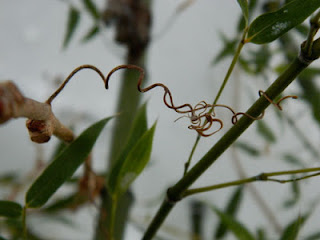
The tendrils grasping bamboo

The tendrils on the virginia creeper are never hairy. The tendrils are always small tight loops which they use to grasp fences, trees, or as in the pictures here, bamboo. All the vines featured here are very effective climbers.

Virginia creeper also has berries in the fall, but I have never seen them hold these berries into the winter season. The fruits are produced in clusters that have more of an umbrella-like arrangement than the standard downward hanging clusters that grapes prefer.

Identification?

Like with many plants, google image searches provide many wonder photos to compare against and learn from. Find one such google search here. Add other qualifiers to see more.

For information as well as images, please see here or here.


Grape
The large looping tendrils of the grape

Last but definitely not least, is the wild grape. The grape is the only one of the three vines featured here that is not poisonous - in fact, the fruit is edible and foragers can collect them for preserves and food. The leaves and young shoots are edible as well. Stuffed grape leaves - who doesn't love those!

The wild grape in our Northeastern forests can grow into such large woody vines that not only Tarzan but Tantor his elephant could successfully swing on them. The vines are also so plentiful in Eastern North America that the Vikings who discovered America, named the continent "Vinland" - "vine land." (The Vikings were first Europeans to discover America - sorry, Christopher Columbus!)

The bark and filaments in a grape vine
The grape is the visually most woody looking of the three vines. It has a rough bark when the vines get any sort of maturity on them. Larger, mature vines have almost a shaggy appearance to them with paper-like bark bits hanging from the vines. Even young vines demonstrate that papery quality if you break the vine - as in the picture to the right. Woody filaments are visible right under the surface of the bark and undoubtably give the grape vine some of its toughness and strength.

Last season's grapes
The grape also has rather knobby joints and "knuckles" on the vine - as you can see in the pictures here. But the large looping tendrils will not be confused with either of the two other vines featured here. See the picture at the top for a size comparison of of the tendril loops of the virginia creeper and grape. Side-by-side, the difference is incredibly obvious.

The grape often holds its last season's fruit clusters and maybe dried out bits of fruit on its vines. Albeit smaller, the wild grape fruit clusters look just like the cultivated grape clusters bought in a grocery store. They will look like a grape cluster to you.

Important - Before eating any wild grapes, be sure to know how to ID them from the poisonous look-a-like Canada Moonseed (Menispermum canadense). Always be smart and be safe.

Identification?

You have to love the images available via google - they are a boon to plant lovers and enthusiasts every where. Check out some wild grape images here and here. Use other qualifiers to the search for other image results.

Get more info and pictures of the wild grape from here and here.