When I launched this site I truly intended to have a new "Herb of the Week" feature each week. I started off with good intentions but found life got too busy to write the mini-monographs I was doing each week. I even have the next article partially drafted but it has been in that state for months - too many months.
So rather than abandon the feature, I will relaunch it with a different format. The feature will include photos and some brief info, links, or just my experiences with the plant - a teaser, to you dear reader, to learn more about the plant. I hope you enjoy the new format and articles!

Friday, April 26, 2013
Saturday, April 20, 2013
The Teaching Plant
 |
| Bittersweet Nightshade (Solanum dulcamara) |
So what is a parent to do? When my own children were tiny toddlers, I did not turn them loose outside unsupervised. I stayed with them, played with them, and taught them. Not only did I protect them from the dangers beyond just poisonous plants that could present themselves to such tiny ones, I developed a much closer bond with my children. What parent wouldn't want that?
As they grew older, more teaching crept in. One of the very first outdoor lessons was plant safety. At the time, bittersweet nightshade grew everywhere at our place. Rather than go crazy trying to obliterate every trace of this toxic plant, as some parents in the forums I read would do, I took an alternate approach. I showed my children the plant with its brilliant red and rather appetizing looking berries. I explained that not all wild plants and berries were edible. In fact, some could make you sick and some could kill you. Their eyes grew big as that thought settled into their brains. The thought scared them - as well it should. I must say, I am not prone to exaggerating or "candy-coating" anything - my children learned that young. If I said it, I meant it and they believed it. They still do.
So, what did I do next? I taught them how to identify this plant by its distinctive leaves, clusters of fruit, and purple blooms with yellow stamens. They could identify the plant at our home as well as at the parks and hiking trails we visited - places where I certainly could not obliterate every toxic plant that existed! I gave them power over this toxic plant. Further more, I also taught my children to never taste any unknown plant or fruits. They were to treat those plants and fruits as poisonous for they very well might be -- just like that nightshade they learned so well. They were only to eat wild plants and fruits if an adult they trusted (I can't stress how key this is) told them the plant or fruit was safe.
 |
| Bittersweet berries |
In time and with age, they joined me in picking wild berries, wild herbs, and food from our gardens and u-pick farms. They learned how to identify those plants, when it was ripe, and what parts are usable. When I was absolutely sure they could ID those with no error, they began to pick their own without my direct supervision. My youngest loves picking wild blackcap raspberries, strawberries, and mulberries. Summer is his time for he is a huge berry lover. These skills will stay with them the rest of their lives and I am sure will pass to the next generation.
So my advice? Shield and protect closely when children are too young to accept safety lessons by staying with them outdoors. As they get older, teach them how to be safe rather than trying to "bubble wrap" their world. The lessons will serve them the rest of their life in your yard and way beyond it. That said, I strongly advise you do some research into the ornamental plants you want to add to your gardens. You may wish to avoid highly toxic plants like castor beans and monkshood until your children are much older. Or avoid them completely if poisonous plants give you pause.
Enjoy your gardens, enjoy your children, and enjoy the living world we are part of!
Be sure to learn more about bittersweet nightshade at the Poison Garden website: http://www.thepoisongarden.co.uk/atoz/solanum_dulcamara.htm

Friday, April 19, 2013
Laughing in Flowers
If the Earth laughs in flowers, then spring must be quite the season of giggles and belly-laughs!

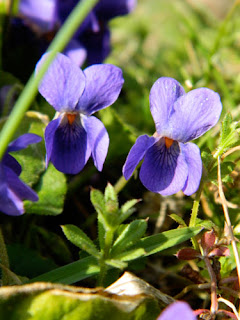
Some of my favorite flowers, such as violets, bloom this time of the year. Violets are one of my oldest and dearest favorites. I have very fond memories of them even as a young child. Some think of them as weeds - which is quite impossible to my way of thinking! Here are a couple of snaps of a few of my violets in bloom at the moment.
Viola odorata 'Rosina'

A wild growing Viola sp. in my lawn (perhaps another Viola odorata)

Friday, March 29, 2013
Get Down Onto Your Belly
 |
| Wintergreen (Gaultheria procumbens) |
Monday, March 18, 2013
I Go to Nature to Be Soothed and Healed
 |
Barnes Creek, Canandaigua, New York
|
"I go to nature to be soothed and healed, and to have my senses
put in order."
John Burroughs, (American Essayist and Naturalist, 1837-1921)
If you are like me in that you retreat to Nature for solace and healing, you will want to read these articles: Find Therapeutic Healing in 'Forest Bathing' and Forest Bathing for more information about Shinrin-yoku or forest bathing which is a Japanese tradition of therapeutic walks in the forest. Now you have a name and some supporting science for what you already knew to be true!
Thursday, March 14, 2013
Signs of Spring
 |
| Turkey Vulture (Cathartes aura) (photo by Dori, Wikimedia Commons) |
Over this past weekend I saw my first turkey vultures of the season plus my pussy willow tree is also getting large and fuzzy catkins. I'll have to go out hiking to look for other pussy willows (Salix spp.), skunk cabbage (Symplocarpus foetidus), and coltsfoot (Tussilago farfara) to get a better guess as to how close spring is.
Either way, I had better finish my garden planning for the upcoming season - it will be here soon!
Update: Shortly after publishing this article, I happened to spy another one of my key spring signs. A Northern Mockingbird (Mimus polyglottos) was visiting my place and looking to lay his claim again to my yard. These highly territorial and migratory birds are warm weather only visitors at my house. All summer long I get to hear their bird "Top 40" - as I call their repertoire of copied bird song. Many times the male mockingbirds have they fooled visitors to my house thinking I have resident bluebirds. No bluebirds here but their copied song by proxy!
Monday, March 4, 2013
Know Your Herbs?

Think you know what it is? Check the ANSWER to see if you are right!
 |
| A Detail of the Seed Head |
 |
| Entire Plant (Click to see larger image) |
Subscribe to:
Posts (Atom)