-- Rafe Martin, “The Hungry Tigress”
Wednesday, September 30, 2020
Responsibilities
Tuesday, August 25, 2020
Friends with Benefits
I have grown Elecampane, Inula helenium, for years but never realized until this summer that Elecampane had a special relationship with ants. While the buds were getting fat and preparing to bloom, they were guarded by a swarm of ants. "Ants???," you say. "Most definitely," says I. And while I could not find a specific reference to Elecampane having these special structures, the presence of the ants tells me it is there - extrafloral nectaries. Extrafloral nectaries are special nectar producing glands located outside of the flower and unlike the nectar produced in flowers, this nectar has nothing to do with pollination and reproduction. In fact, it is to entice bodyguards who help discourage herbivores.
Peonies are very common plants to see this mutually beneficial plant - ant relationship on. You do not to spray the ants off your peonies or Elecampane with water or any bug repellents because the plant has put out a place setting for its ant friends and will only benefit from their presence.
Friday, August 14, 2020
The Gift Not Intended
So a bit of a story. Probably about 10-12 years ago, I had collected some black walnuts in the fall. It wasn't tons...maybe a gallon or so of nuts from some wild trees. At the time I was doing an annual presentation to local fourth graders on wild foods and medicines as part of their "pioneer day" activities. I had quite the road show and was always looking for more things for the kids to see and touch - like these black walnuts.
I was always amazed at how disconnected so many kids were with the natural world around them and so I did my best to introduce them to as much as possible in my 45 minutes with each class which included at least 20 minutes of letting them explore everything I brought on their own. This included a foraging game I made up which was always one of the highlights. While many probably forgot what they saw the moment they walked out the door, it made all the work so worthwhile to see the "lights" turn on for some of the children as to what amazing things were right out their own backdoors.
So I stored the nuts but like many older homes (and mine is 160 years old), rodents are a continual issue and they got into the nuts. I pitched the nuts out to the compost bin. "Critters" enjoy my open compost bins and it seems one of them planted one of the walnuts near the foundation of my house -- there are no nearby black walnuts and this is the only time these nuts made it to the compost bin so it didn't take much thought to figure out its origin.
Some time along the way, my husband or I chopped the seedling down at least once as the trunk bears the evidence. But last year it finally dawned on me what the tree was. So I dug it up in this spring, potted it, and will add it to my ever expanding young food forest this fall.
So while I never shared the nuts in my wild plant extravaganza, I did get a tree I always wanted out of it.
Monday, August 10, 2020
A Rare Find (Repost)
This is a copy of a blog post I made on another, now defunct, blog in 2010. I am posting it here so as not to loose this wonderful info.
A couple of weeks ago while hiking at Letchworth State Park, I came across a rare find. Nestled between stands of spotted jewelweed (Impatiens capensis) and pale jewelweed (Impatiens pallida) I came across a jewelweed plant the likes of which I had not seen before.
This plant looked like spotted jewelweed in the shape of the flowers and the leaves but it had white flowers with red spots. I've never in all my stomping about in wild places or perusing through various field guides trying to ID wild plants seen one like this.
After some investigation, I believe it is one of two very uncommon variants of the spotted jewelweed: Impatiens capensis forma albiflora (white flowers with red spots) or Impatiens capensis forma Pease (white flowers with larger red spots/splotches). These variants are referenced here in a NYFA Newsletter if you wish to read more.
It was very late in the day and the light was low so these pictures are not my best but hopefully you'll be able to see and enjoy this rare beauty as well!
Tuesday, June 21, 2016
The Healing Power of the Green
Loss and grief, like a freight train has barreled into my life. Though well-meaning, tears fall at the simple phrase, "how are you doing?" How to fill those first few days? We found our way to places of meaning. Places he wanted to go when he got better. Places we went together as a family and enjoyed. Happier times, happier memories that we are able to touch upon.
One of those places he most wanted to go was a place of natural beauty - green woodland, streams, and the shore of a fresh water lake. He didn't get there but we did. We hiked a gorge along its stream bed to the waterfall. Some conversion but largely quiet and mediative.
Native woodland plants graced the woodland edges. Wild strawberry, wild ginger, jack-in-the-pulpit, blue cohosh, stone root, and more. Stress and loss melted away. The most peace I had found in days found me in that walk.
After the walk, the kids and I both found the beach. They swam and played in the sand. I found another area to sit beside the lake. To "sit by the lake" here was one of his top goals so I did it for him. A peaceful sleep stole in on me. When the kids were ready to go, they woke a very relaxed me.
Each day more reports of the physical and mental health benefits of a walk through the green are published and shared. But sometimes it is the spirit, which cannot be quantified in scientific studies, that most needs that time with the natural world for it can bring peace and solace to a broken heart, even if only for a time. And in my case, that healing green power was combined with a place that was meaningful to the person now gone, transforming it to a touchstone to shared and happier times.
Friday, November 20, 2015
Special and Unique Places: The Bog
The pictures below are only a few of the species seen there.
Grass Pink Orchid (Calopogon pulchellus)
Tamarack (Larix laricina)
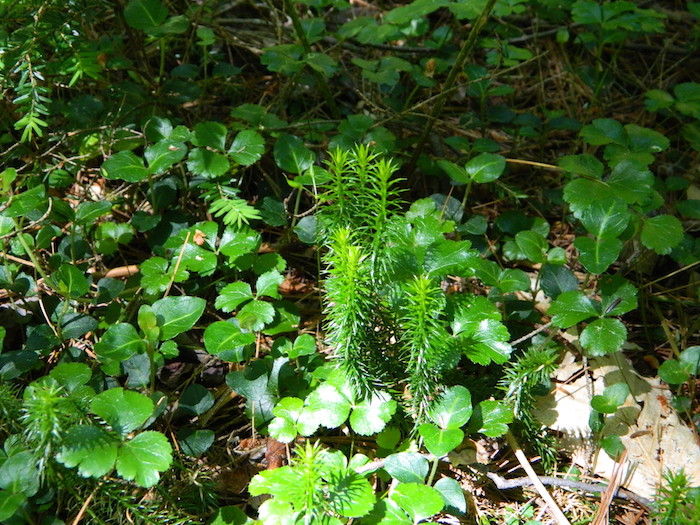
Club Moss (Lycopodium sp.). Second picture also includes goldthread (Coptis trifolia), partridge berry (Mitchella repens), and hemlock (Tsuga sp.).
Partridge Berry (Mitchella repens)
Indian Cucumber (Medeola virginiana)
Thursday, August 13, 2015
Being Kind to Wild Neighbors
| Spectacular Clouds |
| Stunning Sunset |
| Bee on Queen Anne's Lace |