Monday, November 26, 2012

And so it begins....

Just before Thanksgiving I received my first two 2013 gardening catalogs. (Huge grin!) I so love this time of the year. I start getting all my various plant, seed, and gardening supply catalogs - and I do get dozens. Some vendors are deciding to cut their paper catalogs or won't send you the paper catalog if you order online. (I request them if I don't get my copy!) But I love the paper catalogs so much. I curl up on the couch with them and like Santa Claus, I "make my lists and check them twice." I see who has what varieties I want and offers the best prices. Who is offering "new" heirloom varieties - yeah, oxymoron intended! I take the catalogs in the car, to appointments, and where ever else I have to sit and wait for five minutes. It is one of the ways to pass the dark and quiet winter months that I look forward to each year.

I'm no newbie to technology - I've worked professionally with it for decades. I know how to use the new technologies and browse online catalogs plus I do place many of my seed/plant orders online. But most all of my plant and seed shopping is done on paper. The paper catalog still offers me an experience that no smart phone app can compare to. So I offer a warning to plant and seed vendors, if you decide to drop your print catalog to save the cost, you will probably end up loosing my business.

Thursday, November 8, 2012

Cordage Plants

Our ancestors, regardless of what corner of the world they lived in, all had to answer the same questions with regards to food, shelter, clothing, and the other basic necessities of life. How they answered those challenges varied. Often those variations were because of the raw materials they had at hand.

Plants were often one of those key those raw materials that supplied our ancestors and in fact, still supply us with the basics of life. The study of how various peoples have traditionally used plants for food, medicine, utilitarian needs, sacred purposes, and so on is called ethnobotany. It is one of my passions because it combines two of my life-long loves - plants and archaeology/anthropology.

One of the things you will find in ethnobotanical references that modern peoples give little thought to is fiber and cordage plants. While we can visit our local department store for thread, rope, or even fabric whenever we want, our ancestors had no such resources. They made all the ropes, cords, and cloth that they needed. While certainly there are some animal sources like wool and sinew that were used for these purposes, plants provided the bulk of the fiber raw material used.

Why should this be so important and so universal a need? Think of what a cord, rope, or piece of fabric meant. A bow string, net or snare for hunting and fishing meant food. Fabric clothed and so warmed or protected our bodies. Even if you wore skins and furs, you probably stitched them in some manner to better fit and cover your form. Ropes and cords lashed our shelters together, made it possible for us to better haul, pull, or carry items. Ropes or other bindings kept our animals from wandering away. Fibers and the cordage were indeed a key element of survival.
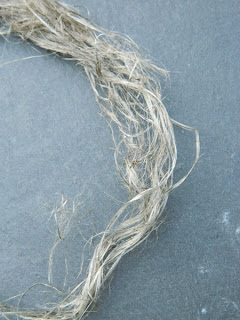
Stinging Nettle Fibers
Visiting my gardens this morning, I happened to collect up three examples of plant fibers traditionally used for cordage in different parts of the world - stinging nettle (Urtica dioica), jew's mallow (Corchorus olitorius), and dogbane (Apocynum cannabinum).

Stinging Nettle

Stinging nettle is one of the great plants of the world. Like the dandelion, it is much maligned yet it gives us so much. The leafy parts of the stinging nettle provide a nutritious food and a host of medicinal uses.

But the nettle has also been used in Europe since ancient times (Bronze Age at least), for fiber and cloth. The fiber from stinging nettle is linen-like. In the raw fibers I collected today, it was by far the most fine and luxurious to the touch.


Jew's Mallow Fibers
Jew's Mallow

Jew's mallow or "molokhuiya" is a popular potherb and vegetable in the Middle East and it too has some medicinal usage. The fiber from this plant is the main source of jute. Jute is a coarse fiber. It is indeed "sack cloth." But since it has so many utilitarian uses, it is second only to cotton in its important vegetable fiber source.

Like linen and variety of other fiber plants, jute is normally "retted" or soaked in water until the plant fibers can be worked free. I didn't ret the plants and my plants were not dry so the fibers were rather hard to peel from the stems. But it is clear that the fibers were the most coarse I collected today.


Dogbane Fibers
Dogbane

Dogbane is a New World plant that despite its toxic nature was a medicinal plant used by the Native Americans. But its use as a fiber plant gives dogbane one of its more common names, "Indian Hemp." Earlier this year I attended a workshop that focused on Haudenosaunee (Iroquois) cordage making. If you would like to see photos from that workshop or read more on that topic, please see my article on it.

Dogbane is an amazingly strong and fine fiber. I find it relatively easy to peel from the stems - no retting required. This native and hardy perennial supplies fibers that can be worked into a variety of cordage needs.  


Wednesday, November 7, 2012

Frosty Herbs

The frost this morning was so heavy that the ground looked white. I couldn't resist sharing these pictures of some frost-kissed herbs.

Common Mullein


Borage


Calendula


Thursday, September 13, 2012

Seed and Plant Sources

One of the questions often asked of me is, "where do you get your plants and seeds?" My answer is always many places! Hopefully this article will share a little of my years of experience and favorite vendors with you.

Local

I shop locally whenever I can - and I'm not talking about your "Big-Box" stores like Lowes and Walmart. I urge everyone to visit your locally owned and operated nurseries. They are people who know and love plants and will be willing to work with you. They will help you make the best choices plus your dollars will be going back into your community.

Ok, yes. The Big-Box places have great prices on flats of summer annuals like petunias and marigolds. Get those there if you that is your thing, but shop at your locally-owned nurseries for everything else.

Vegetables & Food Crops

I have a lot of favorites here. Not every place carries all the varieties I want so I end up placing seed orders to a dozen or more vendors each year. Many of these vendors also carry herb and flower seeds as well. Some seed vendors also carry vegetable transplants if seed-starting isn't an art you've mastered.

Abundant Life Seeds - Organic and biodynamic vegetable seeds
Baker Creek Heirloom Seeds - One of my favorite heirloom seed sources.
Comstock Seeds - A 200 year old tradition of selling seeds
Johnny's Selected Seeds - A wide range of vegetable and herb seed. No genetically modified seed.
Miller Nurseries - A local company that specializes in fruit tree, shrubs, and plants. Get a variety of plants and varieties. Great edible landscaping source.
Pinetree Garden Seeds - A favorite place to get not only a wide range of vegetable varieties but a place to get small amounts of seed for a small price which is a wonderful way to test out a variety
Raintree Nursery - All manner of fruit-bearing plants and trees are available here. Great edible landscaping source.
Seed Savers - Heirloom vegetable seeds.
Seeds of Change - Organic vegetable, flower, and herb seed.
Territorial Seed Company - A wide range of heirloom, open pollinated, and hybrid vegetable varieties. No genetically modified or treated seed.
Totally Tomato - Can't find a particular tomato or pepper variety elsewhere? Find it here.
Terroir Seeds - Heirloom and open-pollinated seeds.
Kitazawa Seed Company - Specialty Asian vegetable seed source.

Medicinal & Native Plants

Other than the food plants I've planted in the vegetable garden and the edible landscaping I've done, this is where I spend the most gardening energy. Given the number of medicinal native plants, I rolled both this two categories together, but the sources are easy to pick which is which.

Horizon Herbs - Medicinal plants and seeds of many herbal traditions
Nichols Garden Nusery - A nice selection of culinary herb and vegetable seed
Richters - A wonderful source for medicinal plants and seeds of all sorts from nearby Toronto
Forest Farm - While shipping from the westcoast is costly, this is a wonderful place to find many hard to find plants, trees, and shrubs.
Musser Forests - A nice place to get many native trees and shrubs in small amounts or in quantity. Located in nearby Pennsylvania.
Prairie Moon Nursery - One of the best native plant and seed sources around.
Amanda's Garden  - A local nursery specializing in native perennial plants
White Oak Nursery - A local nursery specializing in native trees and shrubs
Ion Exchange - A great source for native plant seedlings

Flowers

I don't do much ornamental gardening these days but I do always slip some flowers into the vegetable beds to attract pollinators.

Select Seeds - Get antique flower seeds from this company including some of my favorite poppy varieties

Tuesday, September 11, 2012

Even Pandora Prefers Natives


A couple of years ago a starved kitten started coming by our place. It was as wild and as untouched by human hands as cats can come. It would raid the compost bin of whatever was edible to vanish at the first sight of a human. Sometimes it would vanish for days or weeks at a time. So wild was it, that I started calling it "Pan" after the Greek god Pan who was the god of the Wild.

The weather turned colder and Pan roamed less and stayed more. We had 2 old barns filled old hay and straw that do provide a haven to many a critter. But it was clear that Pan was starving and I began to leave food out. I would call "kitty-kitty" and shake the food container to let Pan know that the human left the food and it just didn't fall like manna from the sky. Pan came to know the call meant food but was very secretive about coming for it and often waited until the human vanished again.

This went on for months....a year. Pan came more and now would let itself be seen but would keep a very safe distance. My husband began occasionally feeding the cat. He began talking to it. And over the course of many months and numerous hours of patient waiting, he was able to touch Pan. Over the following months, he came to be able to pet our feral cat. The cat even changed its scheduled time for visits to match his schedule. My husband also came to realize the cat we thought as male (red cats usually are) was female. Pan had become "Pandora."

Now 2 years later, she is still wild but she loves to be petted. She often hangs around our deck not only for food but for pets. Even though we speak of her as "Pandora" she knows her name as "Kitty-Kitty" from those early days of being fed.

She loves my "woodland" native plant garden. My woodland garden is on the east side of our house under a huge, old crabapple tree. It provides the copious leaf litter and shade to grow many native woodland plants. I grow wild ginger, twinleaf, bloodroot, jack-in-the-pulpit, black cohosh, blue cohosh, solomon's seal, spikenard, goldenseal, wild geranium, ferns, white baneberry, ramps, bellwort, and more in this garden. Some of the larger plants (like the solomon's seal and spikenard in the picture above) make a nice place to bed under. I couldn't resist snapping a picture of her snoozing there - of course she woke as I was going to take the picture, but you get the idea. 

Wednesday, August 15, 2012

Botanical Medicine Classes

Native Medicine Plant - Joe Pye Weed
My friend, Dr. Les Moore, is offering another series of his Botanical Medicine Certificate Program courses. These classes are excellent if you wish to learn more about medicinal applications of plants. Some of the plants covered are native, wild medicine plants while others are from other places and herbal traditions.

There will be six different classes will be held over a period of five weeks, September 20th – October 18th  2012. Students can elect to take the entire series or individual classes. The guided herb walk for this series will be held at Ganondagan on September 22.

Please contact Classical Formulas for details and registration - their website has full class descriptions and registration information.

Of note, Classical Formulas also now has a Facebook page that you can "like" to get news about upcoming classes, lectures, and workshops as well as daily posts by me about herbal medicine and medicine plants.  

Friday, August 10, 2012

Native Orchid: Summer Coralroot

Summer Coralroot (Corallorhiza maculata)

While on a recent hike I spotted an usual sight - a native orchid in bloom. I had never seen this plant before and had to ID it after the hike - good photos are always key to that! The plant was tiny and appeared to be possibly a parasitic plant since it had no leaves or green parts.

The plant I spotted was the blooming Summer Coralroot (Corallorhiza maculata). This orchid's native range is much of the US and Canada, including NY State, but this is the first time I have ever spotted it. According to Wikipedia, it "is a myco-heterotroph; it lacks chlorophyll and gets food by parasitizing the mycelium of fungi in the family Russulaceae." I guess first impressions were correct!

Orchids are a special sight and one in bloom even more so.  Other than this plant and the alien orchid Epipactis helleborine, I've only seen wild, native orchids blooming in one location, Zurich Bog. I've found lady slipper plants (no blooms!) in a couple of other locations but that is it. Our native orchids are special as are the places they grow for these plants usually have very specific needs.  Poaching these plants for your own garden - very illegal given the rules of the parks and preserves they usually grow in - is unwise. Few gardens are going to meet the growing needs these plants have and the plants will die. Take only photos and leave the plants be.

Because this was such an unusual plant, I referenced my ethnobotanical sources to see if the Native peoples here used these plants. According to Moerman in Native American Ethnobotany, the local Iroquois people used this plant for:
  • Basket Medicine - Infusion of pounded root used as a basket medicine
  • Hunting Medicine - Root placed in a half cup of water and used to wash guns and clothes as a hunting medicine
  • Love Medicine - Infusion of pounded roots used as a love medicine
  • Tuberculosis Remedy - Compound infusion of roots taken for tuberculosis
  • Veterinary Aid - Infusion of whole plant added to horse's grain for heaves
  • Witchcraft Medicine - Infusion of pounded roots used as an anti-witch medicine
Looks like the Iroquois found this plant to be special as well given the number of ceremonial "medicine" uses of the plant.

For more information on this plant, see the links below. I have also included other photos below as well.

For more information:

Orchids of NY State:
http://www.dec.ny.gov/docs/administration_pdf/orchidsofny.pdf

Plants For a Future:
http://www.pfaf.org/user/Plant.aspx?LatinName=Corallorhiza+maculata

Wikipedia:
http://en.wikipedia.org/wiki/Corallorhiza_maculata

USDA Plants:
http://plants.usda.gov/java/profile?symbol=coma25

Other Images:
Entire Plant
Plant with author's hand for scale